Sunday, February 7, 2021

Toy Review: Transformers Generations War for Cybertron Siege Red Heat & Stakeout (Rescue Patrol) (Micromaster)


Review: 
#628
Name:  Red Heat & Stakeout
Brand:  Transformers
Allegiance:  Autobot
Line:  Generations - War for Cybertron:  Siege
Year of Release:  2019
Size Class:  Micromaster (Wave 2)
Mold Status:  Red Heat is a retool of Topshot and Stakeout is a new mold

RESCUE PATROL:


The Rescue Patrol Micromaster pack comes with two figures, Red Head and Stakeout.


These are small figures and sold at the Legion price point.  However, they do seem to be priced a tad bit too high for what you get.

RED HEAT (VEHICLE MODE):


The first figure is Red Heat, who transforms into a fire truck.


For such a small figure, the vehicle mode is actually not too bad, and there are no exposed robot parts.


Above is a comparison against Legion Barricade, and you can see that Red Heat is noticeably smaller than it.


The ladder sits on a 5mm peg so it can rotate, and there are two hinges to allow it to lift up and down.


Considering the size, this is a solid vehicle mode.

RED HEAT (TRANSFORMATION):

As you can expect, Red Heat has a simple transformation.  The front of the vehicle unfolds to form the feet, while the sides lift out and fold down as the arms.  Flip him over to reveal the head and torso that had been underneath the truck all this time and you're done.

RED HEAT (ROBOT MODE):


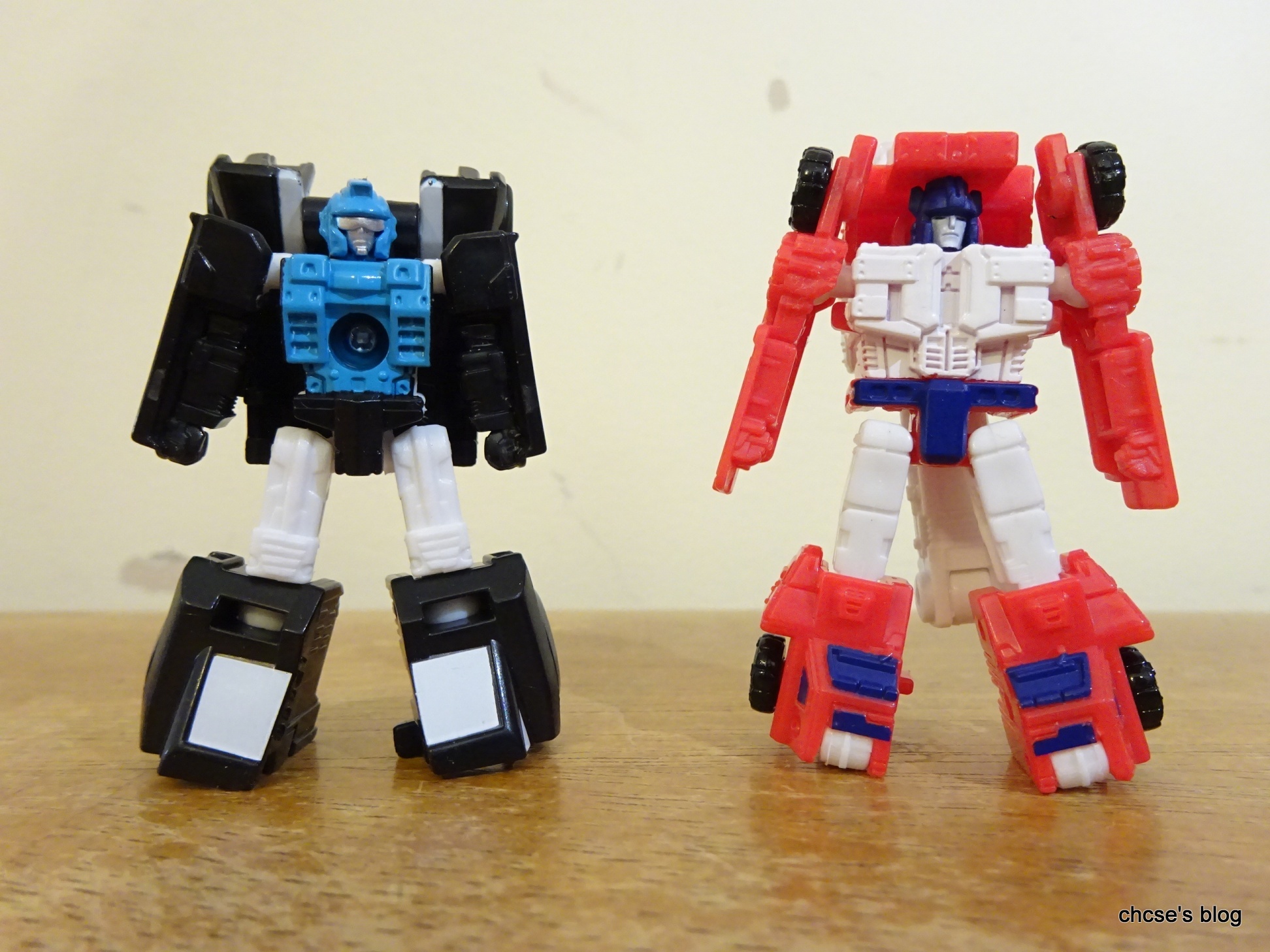
The robot mode is less flattering as there are some issues that prevent it from being stable.  At first glance, he looks pretty decent.


From the back, you can see the gigantic heel spurs to help with the ladder that remains on his back.  Unfortunately, the heel spurs don't lock into place and continues to fold into the lower legs, rendering it fairly useless.


The head is small but still packs quite a bit of sculpting and paint.  It can actually turn from side to side if your fingers manage to reach underneath that piece of kibble.


In robot mode, once again he is still shorter than a typical Legion figure.


The other issue stems from being so small and while he has balljointed hips, they love to pop off.  Coupled with the difficulty in keeping him balanced and upright, and it can be frustrating.  At least you can unfold the ladder to act as a third leg if required.


His articulation includes a head swivel, hinged arms, balljointed hips and hinged knees.  However, Red Heat can't really utilize all those joints to its full potential.

STAKEOUT (VEHICLE MODE):


Stakeout on the other hand transforms into a police vehicle, although "POLICE" is instead written in Cybertronian.


It's a sad thing to note that one of the highlights is how all the windows are painted, but it does prevent it from being too dark.


Naturally, it is around 70% of the size of a Legion figure.  The only play value here are the rolling wheels.


This is a pretty good vehicle mode.

STAKEOUT (TRANSFORMATION):

The back unfolds to form the legs, while the hood folds back to reveal the head.  Then the sides extend out to form the arms.

STAKEOUT (ROBOT MODE):


Stakeout's robot mode is much better than Red Heat's even if only for the fact that it can stand with ease.  That said, the hips do like to pop out from time to time.


He has the hood folded on his back and it does stick out, although it doesn't cause any issues with balance.


The head sculpt is great once again, and it has a swivel.


As you can see, Stakeout is much smaller than a Legion figure.


Articulation is decent and Stakeout can actually pull off some semi-decent poses with it.  He has balljointed shoulders, hips and knees.


The addition of blue works well with the black and white.  Stakeout is definitely the stronger figure of the set.

WEAPON MODE:


One of the gimmicks of the Micromaster packs are that the two figures can combine into a weapon.  Granted, it's not a great looking weapon but it is additional play value without compromising the individual figures too much.


For the Rescue Patrol set, you pretty much smash the two vehicle modes together to form a big gun, and there are two posts at the bottom of Stakeout's feet to act as the barrels.  Due to the size, it's best held by Voyager figures or larger.

OVERALL:

The set is okay.  Red Heat is weak and has too many issues in robot mode to forgive, while Stakeout is strong and shows off what can be achieved at such a small size.  The packs are pricey though for what you get.

------------------------------------------------

For other Transformers reviews, have a look at this page.

(As an Amazon Associate I earn from qualifying purchases)

Friday, February 5, 2021

Train to Busan (2016)


Train to Busan is a Korean zombie film and it is a great take on the zombie genre.  The film starts off innocently, slowly introducing the main character and his background.  Seok-woo is a workaholic and his familial relationship is suffering as a result.  His daughter is disappointed that she never sees him and his wife has divorced him.  On his daughter's birthday, they both take a train to Busan.  Unfortunately, this is where the trouble starts.  Just as the train is departing, a zombie apocalypse starts to unfold.  These are your typical zombies, who are senseless and are quickly moving bodies that chase down humans to bite them.  Once bitten, it only takes a few minutes before the infected human becomes another zombie.  Naturally, as these zombies are on the train, the film has numerous tense moments as the characters struggle in horror to escape these zombies in a confined space.  Not only does Train to Busan deliver on the tense thrills, but it also has a very human element.  It introduces various characters that over the course of the film you grow attached to.  It showcases both the worse and the best of humans.  Characters are torn between saving the few or protecting the many.  The zombies outbreak also seems invincible as it is hard to protect against them.  As the film moves towards its climax, so too do the surviving number dwindled.  It is surprising at how fast the time goes since once it hits its stride within the first fifteen minutes, the film does not relent.  Train to Busan is an excellent film that is 100% worth watching and one of the best zombie films released.

Thursday, February 4, 2021

Toy Review: Transformers BotBots Batterhead (Series 3)


Review:
  #627
Name:  Batterhead
Brand:  Transformers
Allegiance:  N/A
Line:  BotBots
Year of Release:  2019
Size Class:  BotBot (Series 3)
Mold Status:  repaint of Dumbeats

ALTERNATE MODE:


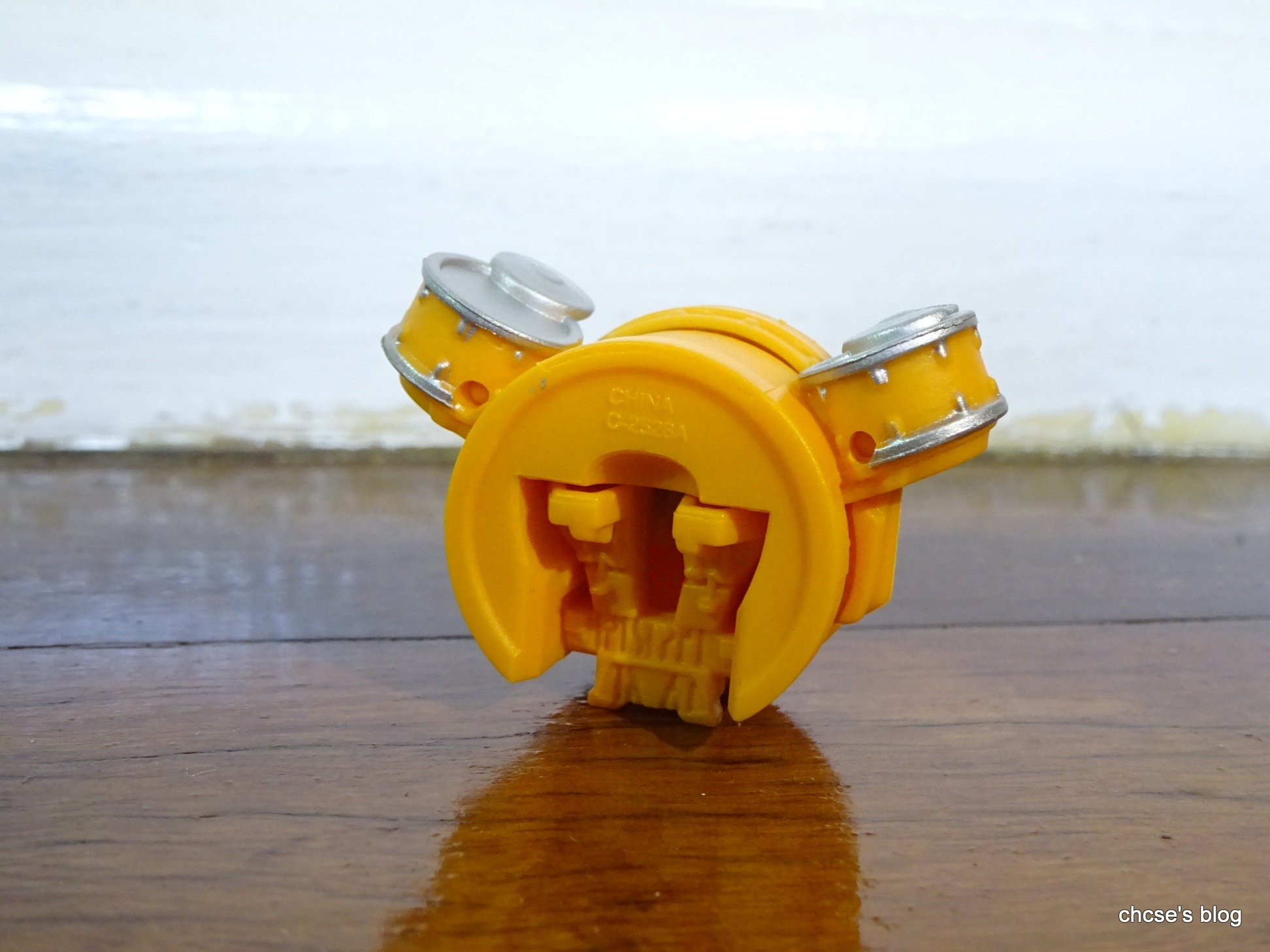
Batterhead transforms into an orange drum kit.  It is a great sculpt and immediately recognizable upon first glance.


The back falls flat a bit due to the need for the robot legs to store there so it is exposed and leaves a gap.


As a BotBot, Batterhead is very small, above is a comparison against a Legion figure.


This is a clever mode that holds a lot of charm purely because of the alternate mode that was chosen.

TRANSFORMATION:

Getting Batterhead to robot mode involves flipping down the legs, pulling the arms out from the sides, and then flipping the panel in front down to reveal the face.  It's easy and a little bit too bland.

ROBOT MODE:


Due to the shape of the alternate mode and how the robot keeps the same shape, Batterhead can appear just a tad bit chubby.


The smaller drums on the sides work well as bulky shoulder pads.


The head is not just a painted face like a lot of BotBots, so it actually has some decent sculpting and is not as big proportionally as some others.


Batterhead is extremely short, above is a comparison against Legion Crosshairs.


Articulation is bad, even for a BotBot.  Only his arms can swing out to the sides but pull it out any more and it doesn't look that great.

OVERALL:

Batterhead has a great alternate mode and a passable, if static, robot mode.  The orange is not the best color to use to highlight the drum but it's still a pretty solid figure overall.

----------------------------------------------------------

For other Transformers reviews, have a look at this page.

Wednesday, February 3, 2021

Charlotte (2015)


Charlotte is an original anime series with the concept written by the minds from Key, who is the developer of high emotional impact visual novels such as Clannad and Planetarian. The anime is 13 episodes long with an OVA. We’re introduced to Otosaka Yuu, who possesses a special ability. He is able to take control over the body of someone for a maximum of five seconds. Although it is more like that he transfers his consciousness over, leaving his own body exposed (which often just collapses onto the ground). Unfortunately, we’re shown that he’s quite a bit of an immoral character. He uses his ability to his advantage, from cheating to getting revenge.


What happens though is that the world is filled with young people like him that has special powers. Tomori Nao is another, who is able to become invisible in front a specific person or Takajo Jojiro who is able to teleport. Their powers are considered incomplete since there are limitations. They track down Yuu in order to force him to help them find others with special abilities. They tell him that his power will eventually fade away as his grows older.


The anime has a strong first episode as we’re shown just what type of person Yuu is. He uses his powers in various situations and the pacing is good when Tomori and Jojiro turn up to effectively blackmail him into helping them. Then it kind of turns into a show where they track down others with the abilities such that organizations with a darker objective won’t find them and subject them to inhumane experiments. This leads to it feeling like a generic anime where the plot doesn’t progress much each episode.


Despite his selfishness that was shown in the first episode, Yuu ends up turning pretty quickly into a stereotypical good protagonist. This was disappointing since it removed his one point of difference. As expected, Tomori ends up becoming an important person to Yuu. She influences him for the better, and Yuu doesn’t realize it until later on (even though it’s really obvious to viewers). Like several of Key’s games, the plot has a high focus on familial bonds.


The same structure for each episode keeps repeating until around the halfway point. This was when it hits you hard with a surprising development. The anime did a pretty good job at lulling you into a false sense of security, slowly building up your familiarity with the characters before throwing in that hard hitter. At first, it isn’t a major emotional moment; it’s shocking sure, but nothing too influential. However, the effect it has on Yuu, and how he recalls those day-to-day moments that he realizes that he never truly appreciated them, is when the anime truly shines.


Unfortunately that peak goes as quickly as it comes. By the time the next episode comes, things kind of revert to normal. Yuu seemingly goes back to his normal life pretty quickly and that’s a bit disappointing. And then the anime goes right back into a massive peak, as it unveils a massive explanation on the abilities, conspiracies and the history before everything in the show. However, it introduces various plot holes or questionable points that are glossed over. You feel that some characters had made decisions before fully comprehending or considering the more obvious risks. While it doesn’t quite ruin the anime, it’s there always at the back of your mind.


And then it subsides from there, the momentum couldn’t continue until the very end. As it tries to wrap up such a large scale issue, it can feel too naïve and optimistic. It is too much for one person to solve and yet that is exactly how the problem was resolved. It becomes a messy ending in that it tries to cram too much into the final episode. Its developments are predictable, as is the ending. The OVA takes place between episodes 4 and 5, and takes on the same structure as those earlier episodes. In it, the group finds another ability user and confronts them in a bid to stop them using it and drawing attention to themselves. It adds nothing to the show’s lore and one of the only reasons to watch it is to see the interactions between Tomori and Yuu.


Overall, Charlotte is really uneven. The pacing goes all over the place. Just when you thought all that slowness was worthwhile, the peak rapidly falls off a cliff. There are times where you think if it is all worth it, and it is a hard question to answer. There was a lot of potential, and a significant chunk of it was realized. The animation was great, there were some touching scenes but the ending as well as the generic feel of the earlier episodes dampens the enthusiasm somewhat.

---------------------------------------------

For other anime reviews, have a look at this page.

Monday, February 1, 2021

Tomoyo After ~It's a Wonderful Life~ (PC)


Tomoyo After ~It’s a Wonderful Life~ is a visual novel by Key that is a direct sequel to Clannad. Unlike the After Story portion of that game, this is a spin-off that takes place if Tomoya had paired with Tomoyo instead, and continues on from that route. One of the more interesting aspects of the history of this game is the number of versions. It was initially released with mature content; then the mature content was removed for an all-ages version and the story significantly bulked up with Tomoya’s voice being added; then Tomoya’s voice was removed and the original mature content was added back in. Finally, it was the all-ages version that was selected to be the one to be translated into English and released on Steam.


Naturally, you should have played and completed at minimum the Tomoyo route of Clannad. In terms of the timeline, it is set one year later with Tomoya having finished high school, while staying as a couple with Tomoyo. There are some parallels to After Story, in that Tomoya has moved out to his own place, and Tomoyo regularly comes around, even to cook and stay the nights. Given his delinquent status, Tomoya has found a full time job at a waste recycling and collection center where he collects and fixes household items. On the other hand, Tomoyo has continued on with her studies.


The prologue sets the scene and that is the pair is living a fairly good life so far. Tomoya has a (somewhat) fulfilling job, and their relationship is going on well. Tomoyo’s younger brother, Takafumi, often comes to visit. It’s filled with small sweet moments interspersed with funny events. Tomoya teases the often serious Tomoyo into doing embarrassing things (including dressing up) and Takafumi pops in at the worst possible moment. Unfortunately, we all know that this sort of life would not last and the “problem” comes soon after.


If you came to this straight after Clannad, then it might be a hard sell with Tomoyo being the love interest. While Tomoyo’s route in the original was one of the better ones, the sheer overexposure to Nagisa may make the concept of anyone else being Tomoya’s destined one tough to accept. Nevertheless, Tomoyo After does a good job at making it feel like a natural extension of Clannad, with new music and aesthetics, but with some small similarities so that it doesn’t feel like a completely different product.


The structure of the plot is that it takes place on a day by day basis. While on some days it can feel like they are dragging it out to fill in the time, it also allows the story to develop in detail. It pushes forward slowly, relentlessly, and you’ll be surprised as how much it would have covered in a few “days” than you would expect. Similarly to After Story, it focuses on motherly love and familial bonds, while at the same time it has Tomoya and Tomoyo enjoying their relationship with each other.


The story cannot only focus on Tomoya, Tomoyo and Takafumi, so new characters are introduced. It can feel a bit of a cheap way to introduce Tomo, and then later on, Kanako, in order to fit with the theme that the story wants to tell, yet still only taking place one year after Clannad. Tomo is cute and someone you’d just want to protect due to her innocence, while Kanako is like the past version of Tomoyo, strong… and a bit rough around the edges. There’s a weak kind of reason on why they start constantly turning up in Tomoya and Tomoyo’s life.


This is a visual novel and the gameplay is predominantly comprised of reading. There will be points in the story where you are able to select from a number of options to progress the story. These choices will dictate the type of ending that you would get, and one of the slightly more annoying things about the game is that you don’t realize you end up picking the wrong choice until the bad end happens many days later. There is another new element where there’ll be a scene with the characters, and you’re able to talk with the characters as much as you want before progressing along.


As always, the peaceful life does not last long. And while you wouldn’t call it soon, eventually, problems will start to crop up. Tomoyo’s past life, when she was still mingling with the tougher crowds, fighting and defeating all, starts to haunt her. Delinquents challenge her out of the blue for the first time in years for some reason. Despite the cheery attitudes of several characters, they are all hiding a painful past. Just like in Clannad, it falls upon Tomoya to open them up and help them move past their regrets. These are the best parts of the game, being the tender moments where they finally come to terms and move on.


The story also continues on the theme of time moving on whether you are ready or not. The lively days that Tomoya is living finishes so quickly, and when he reflects upon that, it rings true. It’s only after that he realizes how much he enjoyed them and is now missing on. It might surprise you but Tomoya is actually quite clever. Often in the story, he studies hard and picks u pa new skill fairly easily. This isn’t to mention his strength from his work and delinquent days.


The humor is pretty spot on. It’s subtle at times, but when it hits you, it’ll make you laugh out loud. The best part is that the jokes work because the game quickly builds up the characters’ personalities and then uses that familiarity to great effect. The music is really soothing to listen to and has some catchy tunes. It comes to the forefront towards the end when the sadder things start happening.


Once the second major arc finishes, the story takes a turn into the unexpected. It’s a surprising change, and the plot device kind of clashes with what came before it. It felt like a cheap clichéd plot twist, and while it tries to trigger nostalgia with Clannad, it doesn’t quite work. It can actually feel somewhat tedious to read through once the arc begins. This last arc, being the main arc that the story has been building upon to, takes a weird turn. It feels different in tone, and has the characters’ personalities feel a bit different to how they were for most of the game. However, all that changes once the second plot twist hits and it hits you hard. All of a sudden, everything that happened before takes on a whole new level of meaning. It’s a shock and you try and contemplate what this means.


The final arc in Tomoyo After feels like a flip of Clannad’s after story. In After Story, it was all about Nagisa, while in Tomoyo After, yes, it is still about Tomoyo and her situation, but there is also significant focus on Tomoya. The final part manages to suddenly drag the tone and atmosphere to a single saddening emotional moment. You don’t know if the couple will have a happy ending, and when the final dialogue is spoken, as a way to motivate the viewer, it really hits home. While it is not as emotionally intense as After Story, it is still one of the harder hitting stories. The ending is vague enough that you can interpret it either way, whether that is happy or sad or bittersweet.


If you’re a fast reader, than the game is much shorter than Clannad, and it’ll only take you around 7-10 hours to complete the true route. There are various bad endings but interestingly, there are a very small amount of choices in the game. Once you hit the last choice, you’re only around two-thirds of the game in.


In addition to the story, there is a mini-game called Dungeons & Takafumis. It’s like a RPG lite, and has hours’ worth of gameplay. The story of the mini-game is that the real Takafumi has been kidnapped and currently residing in the deepest floor of a tower. The other copies of Takafumi has tracked the real one to that tower and enlisted the help of the three swordsmen and the magus (being Tomoya, Tomoyo, Kanako and Tomo).


The gameplay is simple; you do not directly control the characters but sets their actions including when to use skills. As you defeat opponents, you gain loot to help improve your characters as well as leveling them up. You play through in blocks of five floors, and once you’re past a block you cannot return. It is an addictive cycle of fighting, retreating, and powering up. There are various character classes with their own unique attributes.


Even the simple story is quite amusing and funny as you meet the various copies of Takafumi. For a mini-game, a bit of effort has been made with the ending including unique artwork. The hardest part in the later levels is the fact that you cannot control the characters directly. It can be up to sheer dumb luck to try and avoid your characters being surrounded and mobbed to death (when that happens, it is really frustrating and annoying). It is actually a decently fleshed out mini-game that you spend around 3-4 hours completing.


Overall, Tomoyo After ~It’s a Wonderful Life~ is a worthwhile sequel. While it doesn’t hit the same highs as the original, it is still very much its own thing. It is a neat addendum to expand upon Tomoyo’s route from Clannad. However, it does feel very segregated into its three main arcs, but the title is very apt. It is about a wonderful life, the wonderful life of Tomoya and Tomoyo, as they enjoy their days as lovers and as family. It has a feel good message that doesn’t feel cheesy and has a few emotional scenes.

-----------------------------------------------

For other game reviews, have a look at this page.
Blogger Widget