Monday, March 21, 2022

White Album - Season 2 (2009)


The second season of White Album is again at thirteen episodes long and concludes the story. It starts off straight after the first season, and if you were hoping for improved storytelling, then your expectations was too high. It is still as disjointed and confusing as well, jumping between the different characters. It mostly follows Toya, and his interactions with several female friends / romantic interests / goddesses. It’s not always about him though and that’s where you will be confused at scenes that seem irrelevant.


Toya and Yuki is still supposedly a couple, although their relationship is muddy. Yuki’s job as an idol prevents her from being with Toya too much since she doesn’t have much time herself. At least in this season, the pair are seeing each other again and actually communicating, instead of just thinking about the other and avoiding each other’s phone calls. Toya’s dad also suddenly became a lot more important with quite a bit of focus on him in the earlier part of the season. Again, it’s hard to tell since the anime does such a poor job at everything. All we know is that Toya and his dad has a bad relationship, and somehow one of Toya’s female friends is wrapped into all of this.


The season also places a heavy focus on Rina and Yuki. While they seem to be genuine friends, they are also rivals at the same agency. While Rina’s brother is the one calling the shots, he seems to favor Yuki a lot more. He thinks Yuki holds promise and does a lot of things to prioritize her, which can be confusing in the scheme of things on why he is neglecting Rina despite her still being extremely popular. This is made even more confusing when Rina holds no bitterness, and continues to support Yuki by truly looking out for her.


Just like at the end of the first season, Toya is not presented in a good light. His has relationships, or at least hints of one, with many of the characters, and yet never really gets serious with any of them. He doesn’t think or reflect what he is doing, and takes a more passive approach which is why the character is so unlikable. If he consciously two or three or four timed the characters, then it’s a clearer picture but at this stage, you’re not sure what story the anime is trying to tell because everything is so confusing and poorly explained.


Toya is just too selfish and it’s hard to see why he is so sought after by all the other characters (apart from being a visual novel / anime protagonist). He hurts pretty much everyone, whether intentionally or not, but we don’t really get to see what makes him so attractive in the first place.


Whether it is poor writing, or context is skipped during the adaptation from the visual novel, or this is just how it is, the lack of intent or explanation is present on all characters. We see one character being effectively blackmailed by another, who is clearly a terrible person, but they end up being so submissive and as the viewer, you have no clue why the situation had gotten this bad. The only good thing about the anime is the music that plays at certain points.


There are many scenes where it feels very coincidental and at times unclear, on how and why all of the characters seem to know each other or are linked to each other, in unexpected ways. They end up just turning up in one episode as if it was assumed all along. As expected, the ending is not great either. It does reveal what all the “goddess” business that Toya was going on about but due to the lack of build up and lack of caring of the characters, it was never going to be satisfactory.


Overall, if you liked the first season of White Album, then you’ll like the second season. Conversely, if you didn’t like the first season then the second season will in no way change your mind. The storytelling is subpar, the scenes are disjointed and the characters aren’t great. It had potential, focusing on a complex relationship between a normal person and an idol, but it feels too distracted, and the characters having too many coincidences linking them together.

------------------------------------------------

For other game reviews, have a look at this page.

Sunday, March 20, 2022

Toy Review: Transformers Cyberverse Cheetor (Deluxe)


Review:
  #708
Name:  Cheetor
Brand:  Transformers
Allegiance:  Autobot
Line:  Cyberverse
Year of Release:  2021
Size Class:  Deluxe (Wave 6)
Mold Status:  new

BEAST MODE:


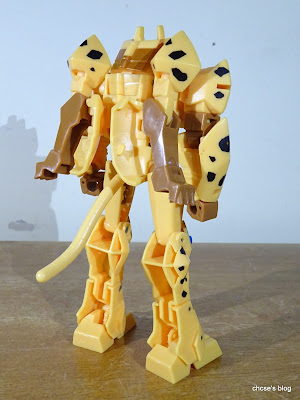
Cheetor, like his namesake, transforms into a yellow robotic cheetor.


The beast mode is barely passable as it is very obviously a robot crouching on all fours, particularly the rear legs which has the minimum effort required to be put in.


The beast is pretty much dominated by the long rear legs, and the hollowness when viewed from behind can be a bit disappointing.


The beast mode is quite limited in articulation here, although the mouth opens.


In both size and mass, Cheetor is smaller and lighter than contemporary Deluxes, even his recent Kingdom version.


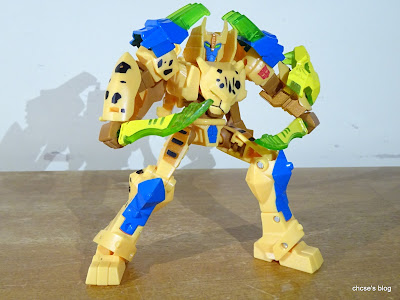
However, the one thing that this version has going for it are the armor parts, which are a pair of claws, a pair of swords and a helmet.


The helmet pegs onto the beast head, the claws on top of his normal claws, and the sowrds on his shoulders.


The armor parts is awesome, and makes the beast mode much better, as it gives a more futuristic robotic element tot he figure.


The clip on armor for his face also makes him look much more powerful and wicked.


So while the beast mode may seem disappointing at first, it's surprising at how five pieces of plastic that clips on can make such a big positive impact.

TRANSFORMATION:

As expected for the Cyberverse line, the transformation is really simple.  The rear legs just straight t oform the robot legs.  the front legs fold up into the back, while his arms come from underneath the beast mode.  Fold the beast head down, flip out the head and you're done.

ROBOT MODE:


The robot mode is fine, a bit on the lankier side thanks to the long legs but otherwise, it is passable.


For some reason, even though they're the same price, the Cyberverse Deluxes seem to have heavier cost-cutting in the form of hollow parts in more obvious places in comparison to the Generations Deluxes, which is a shame as it cheapens the figure a lot.


The head sculpt is fine, it's still very much Cheetor, even if you're unfamiliar with this character from the cartoon.


In terms of size, he's roughly the height of a normal (short) Deluxe nowadays, but as mentioned, he has so many hollow parts that he feels lighter than what his looks might indicate.


Articulation is fine, with joints for his head, shoulders, elbows, wrists, waist, hips, knees and ankles.


He has plenty of weaponry options, as the robot mode can utilise all five of the armor pieces in various ways.


Naturally, his can hold both swords in his hands, and thanks to the clear plastic used for these parts, they look fantastic.


One thing to note though is that the beast head doesn't properly clip into the torso, which feels like a minor design flaw.


If you don't want to use the swords, they can be stored on his shoulders, whether facing up or down, depending on your preferences.


The beast head pegs onto either forearm to form a shield and it works surprisingly well like this.


Lastly, the claws peg onto his shoulders to form shoulder armor, just like beast mode, it's surprising at how much it can elevate the robot mode with just five pieces of plastic.


His large feet coupled with the ankle joints means that he is extremely easy to pose, as his feet will more likely than not be able to stand flat on the surface.


The core robot mode is passable but when you add in the armor pieces, then this is just brimming with play value that also looks great.

OVERALL:

At its core,  Cheetor is a mediocre figure.  Add in the five armor pieces and suddenly, he opens up a lot of options and becomes very fun in the process.  As a result, this is one of those rare Cyberverse figures that's actually worth purchasing if it interests you.

------------------------------------------------

For other Transformers reviews, have a look at this page.

(As an Amazon Associate I earn from qualifying purchases)

Friday, March 18, 2022

White Album - Season 1 (2009)


White Album is an anime that is based on a visual novel. The first season is thirteen episodes long. It has a confusing first episode where it feels disjointed and doesn’t properly introduce the setting. Instead, it feels as if we are thrown into the midst of things and left to piece it together ourselves. Perhaps what makes this noticeable is that scene transitions are abrupt and they don’t seem to tell a coherent story. Or maybe it’s due to the frequent periods of silence with no background music, causing a solemn atmosphere and a feeling of unknown. Nevertheless, this feel persists for the whole season.


The story follows Fuji Toya, a university student who is dating Yuki. Yuki has just become an idol and is currently working hard to gain popularity. We see that she has to suffer some unpleasant things in the industry and that it is not all easy and fun. She has to put in a lot of hard work and good for her that it’s starting to show results. As far as you can tell, Toya is sad that he doesn’t get to spend more time with Yuku due to her work and wishes that it wasn’t so.


There are many characters introduced that relate to the two protagonists in some way. However, it is tough to determine how exactly they relate to the story being told. Eventually we come to realize that all these female characters are Toya’s “goddesses”. They’re probably the romance options in the visual novel but it doesn’t translate to this anime well. We have Rina, who seemingly develops an interesting Toya. She takes the initiative to contact him but what’s confusing is that she keeps creating opportunities for Toya and Yuko to meet so that they can catch up, which is a nice thing to do.


Another character of note is Haruka. It feels like there is more to the background yet we only see a tiny bit. It doesn’t explain why for some reason she keens showing up wherever Toya is and waits for him until she is noticed. All these alternate character viewpoints feel so out of place and their interactions are too awkward.


What’s tough is that while it feels like Toya and Yuki are the main pair and that the story revolves around them, it jumps around too much and becomes out of focus. It’s always looming there in the background but we may get a scene with them after several unrelated interactions of Toya and another character, making the whole plot feel out of focus. You can see that there are serious issues in Toya and Yuki’s relationship, affecting them both. Yuki’s job as an idol severely restricts her freedom and she has an image to uphold. It’s a big sacrifice and one that can be too much of an ask for Toya. This makes it all the more shame when you see how they got together in the first place.


It just doesn’t feel like that there would be a good ending for anyone at the rate things are going. Toya has a “bad end” with some characters where they don’t end up together. And just when a character doesn’t seem relevant anymore, they pop up interacting with another character and you’re wondering if that will lead to anywhere. The problem is with the way the story is structured and written, you don’t have a strong connection to any of the pairings. They are all too distant and disjointed and thus you have no investment into any of the characters. It gets to the point where Toya’s unfaithfulness and indecisiveness does not paint him in a good light.


Another thing is that you can tell that the original visual novel is set in an older time and the anime keeps it in that time period. This is because the characters still rely on payphones and home phones. There are more than a few situations which would have been easily resolved nowadays with the convenience of mobile phones. Due to all this drama unfolding from miscommunication, it’s harder to stomach when you realize how easily these misunderstandings and problems could have been solved.


Overall, the first season of White Album is extremely mediocre. It’s disjointed while at the same time, it is trying to cause drama but not succeeding at this as there are a lot of contrived moments and misunderstandings. This can be forgiven if at least the story is told well but it’s just not. The characters are not likable or memorable. You will actually feel glad when the season finale is up, only to feel disappointed when you remember that this is only the first season. At least the one good thing in the anime are the various pieces of music.

----------------------------------------------

For other anime reviews, have a look at this page.

Wednesday, March 16, 2022

Omega Quintet (PS4)


Omega Quintet is a JRPG by one of the developers of the Hyperdimension Neptunia series. As a result, you’ll probably find the graphics very familiar, feeling quite low-res at times and somewhat bland looking. The premise is that there is something called the Blare which spits out monsters known as MAD. The only ones with the power to defeat the MADs are Verse Maidens, young girls using their singing abilities. It sounds more imaginative than in practice, as the characters end up using conventional weapons like guns and swords to deal damage anyway.


You play as Takt but he doesn’t actually participate in the battles himself. Instead, his childhood friend, Otoha, discovers she has the ability to become a Verse Maiden and Takt ends up being a manager for the group. The story itself is somewhat lighthearted with a lot of jokes that ends up relying on insulting a character. It can be charming in its own right but utilizes a lot of anime tropes. The character models are the 2D / 3D style with proper animations so they’re more natural than a 2D portrait but less awkward than a complete 3D model.


The worst thing about the game in the beginning is the abundance of tutorials and how it introduces them. Instead of easing you in and introducing the mechanics naturally, it ends up throwing walls of text at you very frequently. Just when you thought that all the features of the battle system were explained, up comes another tutorial text, which is quite annoying. The battle system itself is nothing too fancy, despite all the tutorials, it is a turn-based system with assists by Takt, who does not participate in it directly. Each character can use various skills, items or defend, and there is a weakness system. The coolest part is probably how the characters, and also enemies, get to do multiple actions in one turn once they have levelled up enough.


The negative thing with the game is that is still continues to introduce new mechanics with the cumbersome tutorials 10 hours in. However, once you get the five characters to form the full party, you’ll come to realize that the battle system has a lot of elements, much more so than at first glance. You’ll start strategizing more, especially since the game ramps up the difficulty with harder and more numerous enemies. You’ll consider chaining your combos to dish out bigger damage without expending all of your SP, plan out turn orders and play around with the different attack abilities of each character. Basically, you’ll stop mashing X and actually have to think about your moves.


Naturally, being an anime game protagonist, Takt is popular with the ladies. There is an affection system with each of the Verse Maidens, which is a requirement for the true ending. Increasing affection is as simple as watching their events and pairing up with them during battle. However, if you want to max it out (only if you care for Trophies), then it’ll require tedious grinding that is simply not worthwhile.


The environments are deceptively big. You can never explore it all the first or second or even the third time you enter an area. Sections are blocked until you progress the story, and complete quests, where you gain and level up your abilities to unlock those areas. Then you will come to realize how massively huge these areas can be, although since they’re filled with enemies and more sections that are blocked off until later, it can become tedious. However, the load times are really fast, which is surprising so going between areas is really quick.


A lot of enemies in the environments in tight spaces means it is annoying as you’ll inevitably get pulled into a battle even when you don’t want to. The items that allows you to avoid battles only lasts a really short time, and since the spaces are so tight, there are oftentimes where you cannot get past them so you end up having to waste your time either waiting for them to move or the item’s effect to run out so you can battle them to get them off the map.


There are a few quality-of-life issues with the game. For the true ending, you need to complete certain quests, but these are all on a time limit that you must complete them before each major story event. Furthermore, it can be easy to miss one or two and it doesn’t tell you which ones are needed. Even if you are completing the quests, it requires specific enemies and items but the search and sort functions of the monster database is not robust enough to find them easily. This gameplay loop of doing the multitude of quests, sitting through an abundance of cutscenes and running through the same areas again and again trying to find that one monster can get tiresome by the midway point.


There are several difficulty spikes. These could be the enemies in the environments, or more likely, the bosses. Enemies have the ability to “order break”, which ignores the turn order and gives themselves a few turns, this is only available for them and not your own characters. It is usually triggered by defeating other enemies or getting the boss down to a certain amount of health and it is frankly very cheap and unfair. It is literally giving the enemy an ability to cheat, making any time you lose something that you feel was completely luck based.


There is a fairly robust studio where you can design your own dance routines for the characters. You select the song and then pick specific dance moves, as well as scheduling when the characters move during the song. Unfortunately, this is a niche appeal and isn’t required for the story (apart from the initial introduction), so can feel superficial and is easily ignored.


As mentioned, the story is lighthearted but only at the beginning. Taking place in a world with the Blare, that generates monsters known as MAD, only Verse Maidens have the power to eradicate them. As a result, a lot of areas outside the town are dangerous, and to make it worse, there are usually only one or two Verse Maidens at a time. It’s a bleak time, but with Otoha becoming a Verse Maiden, things seem to change for the better. It’s a roundabout story since it mainly involves the party traveling around and defeating MAD, getting into typical anime shenanigans and slowly finding out the truth about the Blare.


The ending felt a bit rushed, especially with the twist in the last few chapters. Once that was easily resolved (idealistically as typical of the genre), it was final boss time. You could rush through the final dungeon but it also means you might get surprised at how strong the bosses got. That is the biggest problem of the game, there are difficulty spikes, and it just keeps spiking and spiking. Unless you’re playing on the easiest difficulty, you’ll need to grind and upgrade your equipment. The story itself, basically of how Takt and the Verse Maidens known as Omega Quintet, eventually defeat all the Blare. It felt handwaved, as if the writers gave up and just said happily ever after without actually making it work.


If you don’t spend a lot of time grinding, then the game is thankfully not too long by JRPG standards. It takes around 30 hours to get through the story, that includes doing the quests required for the true ending, as well as exploring all the main story maps. Then there is a heap of postgame. Unfortunately, some of the postgame content is locked behind the hardest difficulty, and since you cannot change difficult after you have selected it upon starting a new game, you’ll need to play through it all again if you want that extra content. The postgame content is extremely grindy though, so it’s not much of a reward but can be addictive with its carrot and stick approach.


Overall, Omega Quintet is a surprisingly solid JRPG. It has a lot of flaws, from the overabundance of tutorials which ironically are very poor at explaining the game mechanics, to the excessive grinding required to overcome difficulty spikes. It has some addictive parts such as the big open dungeons that slowly unlock as you gain more abilities (Metroidvania style) and the combat system which has some deep mechanics. It can feel cheap though and repetitive, and the story, which is filled with anime cliches, isn’t told in the best way. Yet it is still an enjoyable experience and something about it keeps you coming back.

------------------------------------------

For other game reviews, have a look at this page.

(As an Amazon Associate I earn from qualifying purchases)
Blogger Widget