Sword Art Online: Hollow Fragment is a PS Vita exclusive game based upon the
light novel series and
anime of the same name; however, it is set in an alternate universe compared to the others, thereby excluding it from proper canon. It is highly recommended that you at least either read the first two light novels or watch the first 14 episodes of the anime before diving into this game in order to enjoy it to the fullest extent. It's preferable to read up to the eighth light novel or finish watching the first and
second seasons of the anime to be familiar with all the characters since the game has a lot of fan service which can cause you to be out of the loop otherwise.
Going into spoiler territory, as a quick background, Sword Art Online takes place in the future in 2022 in which virtual reality gaming takes off with the release of a highly anticipated MMO called Sword Art Online. However, upon entering the world, players find that they cannot log out and if you die in the game, you die in the real world. In order to escape, players have to clear all 100 floors. The game takes all of this information for granted, while the anime ends on Floor 75 once the boss was defeated by Kirito, a bug occurs and players find that they're still trapped within the game. The final battle can be re-watched in the game's introduction as a recap (with the game's own twist to show the bug happening).

Therefore, Kirito and the other lead group players have decided to continue on and clear the remaining 25 floors to clear the game as was the original intention. The player is tasked with controlling Kirito (although you can change his name and appearance) as he embarks upon this monumental task. The player is able to travel and explore through Floors 76 to 100, with a glitch being the reason why we can't return to the lower floors. This is the premise of the first Sword Art Online game which was released on the PSP in 2013 in Japan only, called Infinity Moment. Hollow Fragment is a remaster of this game, containing updated graphics and all the content, as well as adding in a whole new area called the Hollow Area, filled with new story content, game mechanics, dungeons, monsters and maps.

Hollow Fragment is an action RPG and the combat system is inspired by MMOs (I wouldn't know as I've never played a MMO before but I'm taking other people's word for it). The combat system is complex and takes a while to get your head around, especially as the tutorial isn't very comprehensive or adept at explaining all the elements. Basically, you map abilities to the four face buttons; you pull alternative menus by pressing the L and R shoulder buttons, thereby giving you a total of twelve customizable slots. Activating an ability is performed by pressing the corresponding button, after which a cooldown is required before you can use that ability again. Abilities are split into various categories. You have the iconic Sword Skills which are special attacks and require SP to use (i.e. magic points). Sword Skills typically deal massive damage and are your main source of attack.

Then there are Support Skills which range from increasing your defense, protecting you from physical attacks, healing etc, there are a wide range of abilities. Lastly, there are your basic abilities such as attack, dodge and defend. However, you cannot just mash the attack button until you can use your Sword Skills as there is also a Burst Gauge. This gauge is split into five segments, using "Burst Attack" (your main form of attack apart from Sword Skills) will use up the segments, which determines your attack power. The more segments you have, the more damage you do. As a guide, early on you can do something like 4000 damage per attack but if your gauge is empty, it reduces to around 600 damage, which makes a huge difference.

Your gauge recharges automatically when you're not attacking but the speed at which it recharges is determined by your Risk Level. Risk ranges from Level 1 to 5, and the higher the risk, the slower your gauge recharges and the more damage your receive. Furthermore, you can time your Burst Attack such that your Burst Gauge doesn't deplete as quickly. It's a complicated system but you will start to get a hang of all the mechanics after clearing a few bosses. During battle, you can use items to heal or buff but using items is awkward because you need to pull up the menu, navigate around and activate it. All the while, the battle is still going on around you. This is where "Switching" comes in.

During the game, you will have the choice of partnering up with another character; it's in your best interest to do so. Switching involves the other character being the lead attacker and enemies targeting them instead of you. Not only does this allow you to freely navigate your menu for items, it resets your Risk Level and recharges your Burst Gauge. Often, boss battles require you to attack, switch, buff/heal, switch, attack and repeat. To mimic MMOs, you can partner up with another character, the game touts that you can partner up with over 100 different characters. While this may be true, most of the 100 characters are no name characters. You can talk to anyone roaming the streets to partner up which is pretty cool. Or, you can partner up with a named character: Klein, Asuna, Lisbeth, Silica, Leafa and Sinon.

Yes, you've read that right. Leafa and Sinon appears in the game as well even though they aren't introduced until after Aincrad in the light novels and anime. The explanation given for them appearing is paper thin, however, the explanation given for Leafa is far more plausible than for Sinon (where the reason is pretty much the game glitched). In addition, there are two game exclusive characters called Strea and Philia. With the female characters, there is a relationship system in which if you spend time with them, your relationship grows. It's a huge grind to max out the rank (required for Trophies) since you just talk to them and keep mashing either the R shoulder button or Circle button, which was a bit disappointing at the shallowness of it all.

Furthermore, as you travel around, you will get requests from other players to see if you could help them level up. Doing so is also in your interests because it strengthens the lead team during boss fights. However, these requests gets so numerous and they are the exact same each time that it is repetitive and tiring. You start off in Arc Sophia, the city on Floor 76 and this is your base. This is the only town in which you can free roam in, all other floors are menu based. There are three areas: a shopping district, a teleport district and a leisure district which houses the inn. Its impressive at how many characters roam the city but the frame rate drops when there are a lot of characters, which is pretty annoying.

Shops include your standard affair such as items, weapons and armor. For weapons, you can use Lisbeth's smith skills to boost particular straits. How powerful you make it depends on how far you get into the story as there is a success rate attached and in the beginning, the success rate dramatically decreases after the third reinforcing. Environments are large, considering that this was originally a PSP game, similarly, the graphics are decent, although environments are noticeably sparse in terms of the amount of objects and each section is separated by a loading screen. Enemies roam among the fields, some will chase you while some will ignore you. Battles take place on the same screen so there is not transition, which is sweet.

The game's structure is predictable and repetitive though. You explore the fields, including some dungeons and then the Labyrinth area which is where the boss room will be located. Once you've found it, you are transported back to the original city; you can then challenge the boss once you've fulfilled the criteria. Criteria usually involve finding the boss room, clearing a particular quest and defeating a powerful monster. This structure works well for the first five floors and feels consistent with the source material but it gets quite dry when you have to repeat it 25 times. Interspersed are some story elements which are told through static images and character portraits. The boss battles themselves are not as epic as the source material but still decent. The bosses are usually bigger than normal monsters and have three health bars.

A team of characters will accompany you during boss battles, you can bring one of your choice and then another five or six from players of other guilds. They can die too but it's only game over if Kirito or his partner dies. Sidequests are your stock standard fetch quests or kill a certain number of monsters. This is quite disappointing that all sidequests are like this. Kirito starts off at Level 100 which is higher than any other characters you encounter. Defeating monsters net you XP, leveling up means an increase in base stats. Leveling up is painful and slow in this game, Kirito needs an absurd amount of experience points to level up with monsters giving you a low amount. E.g. Kirito requires 40,000 points to level up but monsters give you approximately 10 to 400 points.

You earn skill points through repeated usage of Sword Skills which in turn allows you to learn more abilities. Hollow Fragment allows a lot of customization, you don't have to stick with Kirito's Dual Wield ability, you can use a mace, axe, sword or shield or some of the other available weapons, complete with their own Sword Skills and abilities. Furthermore, you can customize Kirito's appearance. Another cool thing is that different equipment is reflected in the character model (i.e. equipment different armor will change his appearance). Free DLC includes stuff such as iconic weapons (Heathcliff's sword and shield, Yuuki's sword, Kirito's GGO laser sword etc), character costumes (Kirito's GGO costume, Sinon's GGO costume etc) and additional quests.

The story is simple and never deviates from the main objective of clearing the remaining 25 floors to return back to the real world. There are some subplots but they are all quick affairs without too much meaning behind them. The game has Japanese voiceovers with English subtitles. If you've watched the anime in Japanese then you'll be pleased to know that they have retained all the original voice actors, including Sinon. The game manages to keep the spirit of Sword Art Online well, with the many character events such as picnics or quests feeling natural in this game world. A heavy criticsm of the game is the obvious rushed translation job. There are numerous grammatical errors, spelling mistakes and formatting issues, however, it is not as bad as a lot of reviews make it seem. It's still easy enough to understand and the humor isn't lost in the translation.

The Hollow Area component of the game, which feels very much like a separate and self-contained portion of the game, contains a bigger more satisfying subplot. Philia is the female protagonist int his area, who mysteriously attacks Kirito in the beginning of the game. Throughout the game, we learn what this huge expansive Hollow Area signifies with some surprising appearances of familiar faces. If you thought Aincrad, with its 25 levels of multiple dungeons was big, then Hollow Area is gigantic. Even the area maps alone in Hollow Area are five times the size of Aincrad's normal dungeons. One area in the Hollow Area is like one floor of Aincrad and there are 100+ areas for you to explore. The size of it just blows your mind; it takes a long while to map out each area.

However, there are massive difficulty spikes and you will easily die if you decide to explore the Hollow Area straight after the tutorial as various bosses are casually scattered around the map. Map bosses can be up to Level 140 in the first Hollow Area alone and represents a bigger challenge than the normal story bosses. The tutorial in the Hollow Area shows the exclusive stuff that you can do and how the Hollow Area work, such as Hollow missions which are additional sidequests, and Implements which are challenges. The one thing lacking in this game though are effective tutorials because the game mechanics can be overwhelming and it does not do a good job of explaining how to go about doing things. There are a few annoying features of the Hollow Area, teleport points (i.e. fast travel) are only in certain areas which sucks when maps are so big.

If you need to traverse two or three maps to get to your desired destination for an event, prepare to walk around for a few minutes from the closest warp point. This is made worse when you need to go there multiple times. Why? This is because exclusive character events in the Hollow Area needs to be triggered initially by getting to the location with Kirito only, then you travel back to Aincrad, pair up with the required character and trek back to the same area. Despite the huge amount of content, you can easily burn out due to the repetitiveness of the game. Dungeons and monster designs are often reused, with uninspired environments which doesn't fully capture your attention. That said, it gets satisfying when you're clearing Floors 90+ because you feel you have journeyed with the characters the whole way through.

It is especially satisfying once you complete Floor 100, taking down the final boss and you watch the ending. The ending was okay and the overall story, while not very important and negligible in the whole scheme of things, does a good job of introducing the characters in later arcs and reconciling the story back to Alfheim Online. The final boss battles were long but lack any sort of epicness. Furthermore, if not for the Hollow Area where you can level up faster, there would be some severe difficulty spikes from around Floor 90 onwards. The Hollow Area portion of the game allows multiplayer, but it is ad-hoc only (i.e. you need to have someone physically close to you). The game allows a simulated version of the multiplayer which allows you to party up with up to four characters.
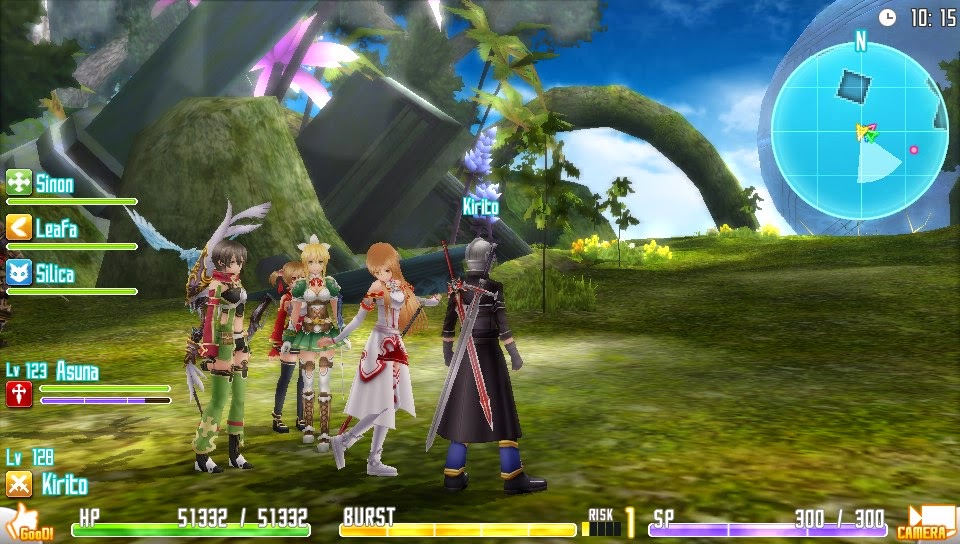
By being able to form a multiplayer party of five characters, it helps in defeating some of the tougher enemies while earning XP points for everyone. A downside of this is that the game doesn't automatically save during multiplayer sessions so you have to watch out and keep manually saving by disbanding the party for fear of losing all your progress upon death. It's a shame that they couldn't use the music from the anime, probably due to licensing reasons. The music used here isn't bad and does eventually warm up to you. Overall, Sword Art Online: Hollow Fragment is a solid action RPG. It is really more for the fans of the light novels or anime though due to the fan service it provides and the in-jokes. The game can get repetitive but if you can sit through that, then this game is well worth your money due to the huge amount of content it provides.
-----------------------------------------------------
For more PS Vita game reviews, check out this
page.