Tuesday, April 25, 2017

Tales of Zestiria (PS3)


Tales of Zestiria is the fifteenth flagship title in the Tales series, originally developed for the PS3, it was ported over to PS4 when it was localized.  This game is supposed to celebrate the 30th anniversary of the Tales series and as such, it has a number of changes and attempts at improving the core Tales gameplay.  Tales games have always had a great battle system which builds upon the past.  In Tales of Zestiria, it is called the Fusonic Chain Linear Motion Battle System.  It is extremely complex with many facets to it, so much that it is entirely confusing and difficult to get a grasp upon when playing for the first time.  It takes most of one playthrough in order to understand the different elements at play.  The game features a four-member party but it is always comprised of two humans and two Seraph characters.  A Seraphim must always be paired with a human, therefore there will often be times in the story where you will only have a two-character party.  You can change your partner Seraphim during battles to capitalize on an enemy's weakness which is a nice feature.

The key feature of the battle system is Armatization.  Weaved into the story where there are humans and Seraph (who are kind of like spirits), two characters can combine into one.  The combined character has stats equal to the sum of their parts but have more powerful moves to offset the loss of one party member.  It is very powerful and can be used to get out of tricky situations.  One of the most confusing parts of the battle system is that there are three different types of artes:  Martial, Hidden and Seraphic.  Each has their own advantages such as casting time or ability to cancel other artes.  The game doesn't do a good job of explaining it in an easy to understand way though.  Characters can usually only do up to four combos in one hit, and the types of artes you can use are determined by SC points, which automatically replenish when you run around, dodge or block.  A new counter for each character called the Blast Gauge is introduced.  You can consume Blast Gauge points for a variety of actions such as extending your combo, performing powerful Mystic Artes and healing when armatized.

One of the most annoying things is that auto-item usage is removed from the game.  You cannot set conditions which trigger when to use a particular item anymore and it sucks.  You'll have to manually open the items menu, determine the character to use the item, select the item and then select the character to use it on.  It feels like a step backwards when it is so tedious to use.  Also, only the Seraph characters have access to one or two healing spells, or you can armatize and use your precious Blast Gauge to heal.  One of the neat improvements is that Tales of Zestiria features a quicker transition to the battle arena.  Whenever you approach an enemy and initiate a battle, the environment instantly cordons off into a circle for the battle to happen.  It's seamless and a step towards the right direction in updating the gameplay when so many games don't feature battle transitions anymore.  Unfortunately, this isn't without its problems because the game has a horrible camera when you battle in tight spaces.  Walls will be blocking your view or the camera will suddenly zoom into an enemy so you can't see what your character is doing.  Thankfully, all boss battles are in wide open spaces so it's only a problem when you're exploring dungeons against normal enemies.

On the topic of environments, Tales of Zestiria tries to encourage exploration.  There are huge maps for each environment which takes minutes to traverse.  At its best, this is fun and before you know it, you've spent hours scouring the environment.  At its worst though, and this happens much more frequently, the environments are simply too big and empty so exploring isn't worth the time when all you get is a few treasure chests for items.  What makes this worse is that the enemies on the fields are too frequent and quite often, you cannot outrun them forcing you to get into tens of fights.  It also doesn't help that enemies respawn so quickly.  There isn't much variety in the environments as it is mainly green fields and forests.  It sucks because the fantasy setting has a lot of potential, at least there was a desert and a mountain setting to break things up a little bit.  Tales of Zestiria is touted as "open world" but the game restricts where you can go in order to keep the story moving along, so it is false freedom.  Dungeons are usually filled with padding like blocking you in a room to force you to wait or do mundane tasks before you can plod along.

While exploring, superficial abilities like burning spiderwebs that block your way or speeding over a short gap also serve to further irritate the player.  Later dungeons have "puzzles" which amount to little more than even more padding.  It feels like the developer is testing how much they can get away with wasting the player's time.  In Tales of Zestiria's case, they have gone too far.  These "puzzles" including lighting torches in a specific order, scouring around to find items to open certain doors and crumbling platforms that cause you to repeatedly fall onto the floor below are frustrating.  Worse yet, there is a whole dungeon where if you accidentally get "spotted", you are sent back to the very beginning.  The plot follows the protagonist Sorey, who lives in Elysia.  He is the only human with all the other residents being Seraphim who are normally not able to be seen by normal humans.  One day, he meets the Princess Alisha and Sorey ends up journeying out of Elysia along with his friend Mikleo.  From then on, it is your typical JRPG plot but even simpler, as Sorey travels the world gathering more party members including the assassin/merchant Rose, and a few more Seraphim.

The key concept in Tales of Zestiria is the legend of the Shepherd, who returns to bring the world back to peace.  Needless to say, Sorey is this generation's Shepherd and he goes on a grand quest to gain more powers and eventually defeat the great evil that is threatening to destroy the world.  The plot never gets more complicated than this but it sure loves to try via convoluted plot devices, exaggerated scenes and an extra dose of padding.  The story stagnates early on in the game and it never recovers.  It is extremely boring because you just don't care about the characters or the scenes.  Everything is so dry and bland, with the ending being average, most of it coming from that you're glad the game has finally ended.  One of the big drivers of the player's lack of attachment is that Tales of Zestiria tells its story so obnoxiously.  There are frequent cutscenes which break the gameplay up so much that is gets frustrating.

The game plays like this:  a 2 minute cutscene, the player takes four steps, a 4 minute cutscene, the player then takes 5 steps, now a 2 minute cutscene, okay, now we can go into the next area, oh wait, here's another 5 minute cutscene, then rinse and repeat.  It is mind numbing and it would have been more preferable if they had just shoved in all the cutscenes in one hit without trying to be interactive when there isn't any.  There are plenty of attempts at humor and some of it works.  When the humor does work, it works well and is funny, although it's only the one or two characters that carries it for the game.  Skits make a return, which are additional pieces of dialogue from characters.  However, a large amount of them feels like it is explaining the game mechanics to the player, so they are not fun to watch and skits needs more interesting ways of triggering because most of them are regulated to being seen at save points and inns.  Tales of Zestiria still uses save points but there is a quick save feature which allows one save file to be saved anywhere.  This is to avoid save scumming and to be frank, the one save file for saving anywhere is enough if you're playing normally.

It takes around 10 hours before you really get into the game, it handholds you so much in the beginning, from the frequent tutorials and clear objective markers.  However, midway through, the objective markers become vaguer and makes you waste your a lot of time and gald to travel around the large empty environments to find your next destination.  Fast travelling requires gald (the currency in the game) which is annoying when money is hard to come by unless you play on higher difficulties and grind.  The fast travelling cost is on a stupid system where the more gald you have on you at the time, the more it costs.  At certain points in the story, fast travel is disabled and you need to trek through the large empty environments gain to progress along, another case of excessive padding.  In terms of developing your characters, the basic levelling up system is still in place.  You defeat enemies to increase your characters' stats.  In their infinite wisdom, the developers decided to tie the stat boosts to consumable items that you find in the environments and beating various bosses for additional HP.  As a result, there is a heavier reliance on equipment as they provide additional stat boosts, "encouraging" the player to spend time and farm for better equipment.

For a game developed specifically for the PS3 and after the first two Xillia games, it is seemingly worse than Tales of Xillia.  There are heaps of jaggies and dull environments that are severely lacking in detail.  There is heavy pop-up and the draw distance is low.  Despite this, the game still stutters from time to time even while the character is only running.  The PS4 version seems to be definitely be better optimized compared to the PS3.  There are multiple difficulties where interestingly, each has its advantages and disadvantages.  Hard Mode will provide less experience but more gald to spend, while easier modes have more experience but less gald.  Once you finish the main story, a bonus dungeon becomes available which gives another 4-5 hours of gameplay.  This dungeon is very difficult as the enemy levels ramps up a lot forcing you to grind levels to stand a chance on even the easiest difficulty setting.

Another staple of the series is the New Game Plus where you use grade you have earned during the game to spend on bonuses such as double damage, higher item capacity etc.  The grade, which is another category of points, this time around accumulates in a stupid way.  If you don't deliberately farm it and find an efficient way to do so, you will not be able to get much grade to spend.  Once you have most of the bonuses, New Game Plus is actually more fun since you don't have to sit through the story and can blast your way through all the monsters.  Overall, Tales of Zestiria is a divisive Tales game.  You can see what the developers were trying to do but a lot of it fails and combined together into a very irritating and frustrating package.  The main flaws involve a chore of a story, a chore of traversing the huge empty environments, chore of time-wasting mundane events that are forced upon the player and an overly complicated battle/equipment system.  It's even worse when Tales of Zestiria is supposed to celebrate the 30th anniversary.  While there will definitely be fans of this game, in the reviewer's opinion, Tales of Zestiria isn't that fun and is best to avoid as there are too many things that ruin it.

Alisha's Story:  The Strength of a Knight
The very first story DLC within the Tales franchise and with additional Trophies to boot, this additional story is titled Alisha's Story, The Strength of a Knight.  The plot follows Alisha after the game's ending with how she finally accepts her path and believing in herself.  She is discussing the peace conditions with Roland when hellions attack.  Naturally, Rose turns up with Lailah and Edna to help her, before joining into the one party to find the source of the new malevolence.  Unfortunately, the story paints Rose in a really horrible picture.  Rose's attitude towards Alisha is disgusting and feels different to how Rose acted during the main game.  The beginning is some pointless bickering between Rose and Alisha with some extremely awkward and cringeworthy dialogue.  It is made the worse when you know that they will make up.  Rose's behavior during the whole DLC is hard to sympathize with and seems contrived.  In this DLC, most of the areas are blocked off as expected but there are two new dungeons and one new pathway in between them.  One of the dungeons is 12 floors filled with dead ends, treasures and multiple routes.

At the end of the day though, these dungeons are still the same backdrop so there is nothing much exciting.  You will be running through environments overfilled with enemies, watching the cutscenes that frequently crop up and break the gameplay.  Surprisingly, there are a few pieces of new music, or at least ones that isn't played as often during the main game.  It gives it a fresher feel.  There are new items and enemies to encounter, although the enemies are recolors of existing ones from the main game.  One of the neat things is that you can bring in a save from the main game after you've finished the story and it will keep your bonuses, gear and levels which makes it so much easier.  Otherwise, you can play with predetermined levels and gear.  Overall, the DLC will take 3 to 6 hours to complete depending if you end up fighting monsters along the way, skip them, or are going for the Trophies.  Alisha's Story was free in the first few weeks after release and for that, this is nice.  However, it now costs around $10 and considering that it doesn't feel substantial or memorable, it is not a must-have DLC.

-------------------------------------------------

For other game reviews, have a look at this page.

Monday, April 24, 2017

Book Review: Dragonar Academy Volume 1


Review:  #655
Title:  Dragonar Academy Volume 1
Series:  Dragonar Academy - 1st volume
Author:  Shiki Mizuchi
Read Before:  no
Comments:  Dragonar Academy has a interesting concept but also a heavy dose of ecchi.  It is set in a fantasy world where humans and dragons coexist.  A dragon lives inside a human until it can take form, and the pair forms an inseparable link afterwards.  Being the main character, Ash’s dragon, Eco doesn’t take a form that’s like your typical dragon, instead it takes on the form of a girl, which is very unusual.  Add in mysterious characters, a tsundere princess and a harem is just waiting to be created.  Dragonar Academy’s ecchi can be quite heavy at one point but the story and setting shows promise.
Rating:  6/10

Saturday, April 22, 2017

Toy Review: Transformers Movie the Best MB-07 Soundwave


Review:  #374
Name:  Soundwave
Brand:  Transformers
Allegiance:  Decepticon
Line:  Movie the Best
Year of Release:  2017
Size Class:  Human Alliance
Mold Status:  repaint of DOTM Human Alliance Soundwave

PACKAGING:


As part of the 10th anniversary of the first live-action movie, TakaraTomy released the Movie the Best line, a series of redecoes using molds from the various movie lines.  Soundwave was chosen as part of this line.


While this release uses the Human Alliance mold, it actually skips out on the Mr Gould and Laserbeak figures the original release had.

VEHICLE MODE:


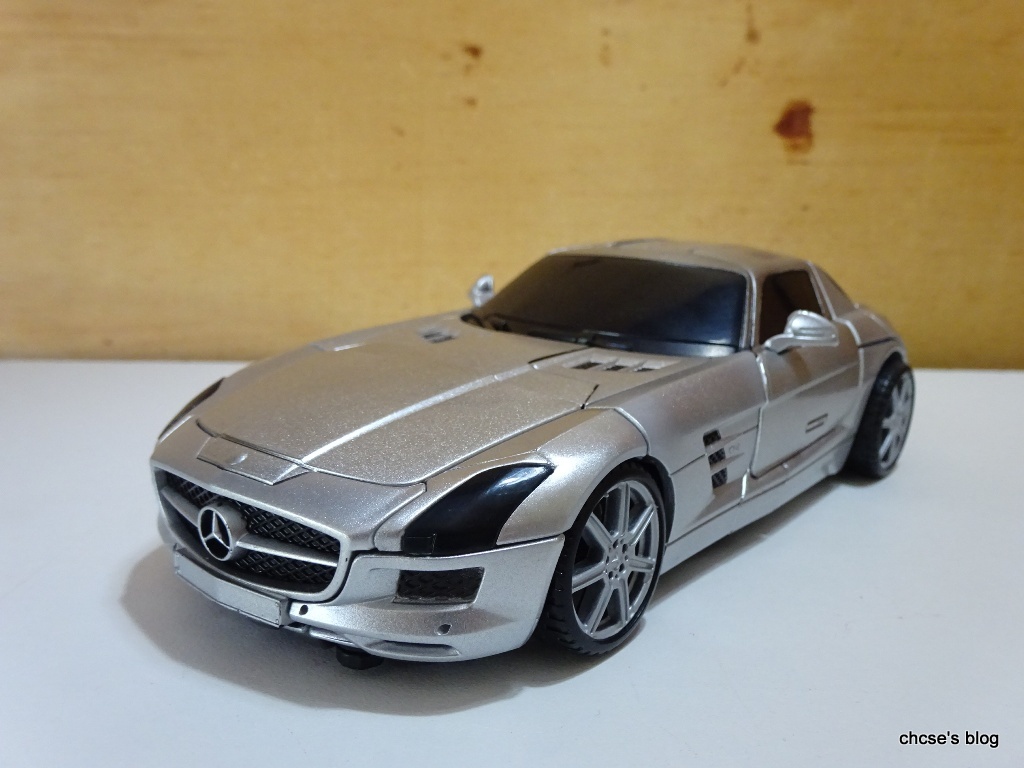
Soundwave transforms into a licensed Mercedes-Benz SLS AMG, and the biggest difference here compared to the original release is the swaths of silver paint covering the whole exterior.


The silver paint does a wonderful job of making the vehicle stand out, and it looks amazing in person.


There are plenty of sculpted details here, and even the front brakes are painted silver (although interestingly, the brakes in the rear wheels aren't painted).


The windows are dark clear plastic.  With all this paint, you do have to watch out for scratches and paint chipping during transformation.


Soundwave is roughly Voyager sized, above is a comparison against Human Alliance Jazz.


As a remnant of the mold's original release, the gullwing doors open up.


The interior is rudimentary with only the steering wheel as instantly recognizable.  There is a seat but otherwise, it's nowhere near the detail of the Binaltech line.


A fantastic alternate mode, it's crazy how a layer of silver paint can make the vehicle mode look so good.

TRANSFORMATION:

As expected, Soundwave is a complicated beast to transform, not made any easier when you want to be careful not to chip any paint.  Perhaps the most surprising aspect is that 3/4 of the vehicle form the arms, and only the very rear of the vehicle, which is a tiny lump, unfold to become his legs.  There are a lot of panels in the arms that you have to manipulate to achieve better screen accuracy and they can be fairly fiddly.

ROBOT MODE:


Soundwave's robot mode, let's be honest, takes some getting used to.  However, once again, the silver paint goes a long way to making it look better and more premium.


Unfortunately, there are a ton of kibble surrounding the arms, which is to be expected when most of the vehicle went into the arms in the first place.  The biggest offender are the car doors which just hangs off the back.


The headsculpt is messy, trying to replicate the complicated alien designs of the movie.  It succeeds to a degree but can still be hard to distinguish the eyes and mouth.


The head has a gimmick where you can tilt it back to mimic the mouth opening.  It's unobtrusive although underwhelming.


The detailing is amazing since there were a few addition pieces you manipulated to get the look of the character model, from the grill compacting into his chest, to the smaller sonic cannon on the sides of his torso.


Soundwave trades height for bulk, and so he is a bit shorter than most Voyagers.  The only letdown here is that the sonic cannons on his arms are unpainted grey plastic, which clashes with the rest of the figure.


Articulation is excellent although you may have to move some of the kibble around to not get in the way.


Due to his small skinny legs, they feel restricted and balancing the figure in more dynamic poses is an issue.


One of the bigger negatives is that Soundwave lacks a weapon, would have been nice if TakaraTomy could have given Soundwave a gun since they are usually pretty good with this kind of stuff.


Nevertheless, the robot mode is amazing as a display piece and will probably stand out in a good way on your shelf.

OVERALL:

This version of Soundwave is the definitive version of the character thanks to the premium paint job.  While the transformation can be finicky, the end results are worth it.  If you haven't already gotten a version of this character, then Movie the Best Soundwave is highly recommended.

------------------------------------------------------------

For other Transformers reviews, have a look at this page.

Friday, April 21, 2017

The Internship (2013)


While basically advertising Google as a great place to work in, The Internship offers a little bit more.  It has a predictable story about underdogs working together great as a team and triumphing but it works quite well.  Billy and Nick are middle aged and having lost their jobs as a salesman in a technologically evolving age, they decided to go for the position of interns at Google, for a chance to get a full time position.  Obviously, they are surrounded by people in the early twenties and being the outcasts, they form a team of questionable ability.  Only one team will be able to secure full time positions which seems quite brutal in a company about inclusiveness.  Everything about the plot is predictable but it doesn't make it any less interesting.  The antagonist is suitably annoying and the way Nick and Billy gets by is what you'd expect.  There were a few scenes where it felt out of place, such as the night club sequence or the last challenge's submission during the ending.  As a comedy, it works more often than it doesn't, with some fun puns but it resorts to crude humour a little bit too much.  Overall, a better film than expected.

Thursday, April 20, 2017

Book Review: Cage of Eden Volume 20


Review:  #654
Title:  Cage of Eden Volume 20
Series:  Cage of Eden - 20th volume
Author:  Yoshinobu Yamada
Read Before:  no
Comments:  This volume takes a while to get into the swing of things but once it does, it keeps putting forward mystery after mystery.  Some of these new mysteries are answered, but most are not, and it keeps teasing how close the group is to finding it out.  The whole volume is spent exploring the fourth and last remaining building.  It’s annoying when the characters keep saying that they have suspicions about what is happening but never reveal it.  The ending is also a major cliffhanger but given that most chapters end in a cliffhanger but becomes an anti-climax in the next, it’s nothing much to be excited about.  The author tries to increase the tension but ends up feeling amateurish and melodramatic.
Rating:  6/10

Wednesday, April 19, 2017

IA/VT Colorful (Vita)


IA/VT Colorful is a rhythm game released only in Japan.  The game is in Japanese but the menus are easy enough to navigate and have limited English headings.  If you've ever played a rhythm game before, then you can guess which option is what.  The game features the Vocaloid known as IA, which is a voice synthesizer.  There are a total of 60 songs, which is a huge amount of content that will take you approximately 4 hours to play through each song once.  Add in three sets of difficulty, challenges and collectibles and you have a meaty game that will give you hours of game time (it takes roughly 24 hours to get the Platinum trophy as a guide).


You first start off with only a limited amount of songs to play but you unlock more as you level up.  You level up through obtaining points via completing songs to a certain rank, the higher the rank, the more points you get.  You don't get points if you end up obtaining the same rank for a song as last time.  This is fine though since unless you are horrendous, you will never reach a point where you run out of new songs to play due to not unlocking them in time.  As a rhythm game, the mechanics are clearly the most important aspect.  Thankfully, IA/VT's gameplay is polished and works really well.  It only uses the D-pad and the four face buttons as button prompts.  It is surprising that it doesn't attempt to use the touch screen, analogue sticks or shoulder buttons.


IA/VT is super easy to pick up and play, relying on solid simple controls rather than annoying gimmicks.  The game is forgiving as the window of timing for pushing the right button is wide.  You can easily get a "Cool" rating even though it feels like you were too late or early.  This makes even Hard Mode a breeze and you can get a "Perfect" rating on the song in your first try.  Even if you didn't, it only takes a few more retries before you will get that "Perfect" rating.  Hard is the recommended difficultly to get the most fun out of the game as it provides enough of a challenge, a faster pace and is not too difficult.


The game inserts a little bit of difficulty via a moving rhythm line.  Usually, the button prompts travel upon a line which makes then easier to predict and track.  This line will end up moving in higher difficulties of the song, which can provide more challenge than initially expected.  The main gimmick of the game are score multiplier segments called Colorful.  You can get up to 2x score multiplier depending on your timing on certain button prompts in earlier segments.  There are at least two to three of these Colorful segments in each song which usually takes place during the chorus so you really do feel as if you were working up to that point as the climax.  As is expected from Vocaloid rhythm games, a video plays in the background during gameplay.  Some of the songs are pre-rendered videos while others are rendered in real-time, therefore allowing you to change costumes.


You'd notice a lot of the songs are pre-rendered, in reality, only 15 of the songs allow you the option of changing costumes displayed during the video.  This feels limiting considering that there are more than 60 costumes to unlock.  IA/VT has a bright colorful user interface that you can also change.  The short loading times are fantastic.  While there is a large quantity of songs, none of them really jump out at you immediately that'll make you love it.  The choruses of many songs feel like an anti-climax since they are usually slowed down segments after an epic build up.  Each of the songs require you to listen to them multiple times in order to start liking it more.  IA/VT focuses at being a good rhythm game and doesn't include any tacked on modes.


Various other modes do exist, the main one being Step Up Play.  These are stages where it provides various challenges.  The game gets much harder in these stages as you are playing through predetermined songs with handicaps, ranging from speedier prompts, dual notes of using different face buttons (i.e. instead of Right D-pad and Circle at the same time, you have Down D-pad and Circle which is very confusing), higher rank requirements and prompts coming from multiple directions at the same time.  This makes it very challenging and frustratingly unfair at times because it is not about skill at that point but rather whether you have memorized all the patterns by playing the same song fifty times.  The game also cheats in Step Up Play when it throws the prompts that require you to press D-pad and a face button at the same time but the two prompts come from different directions and are sneaked in between normal button prompts.


In the harder levels of Step Up Play, the prompts are randomized thanks to the "Random" modifier.  What could be X prompts in one playthrough of a song would be a Triangle prompt in the next which makes it much more annoying to learn the song.  Another mode is the Daily Play mode where each day, there will be one song that you play and fulfill certain criteria to earn points.  You can only play the song once and cannot retry at all.  There is a My List mode which lets you select songs to play one after another, and also an Online score leaderboard.  Overall, IA/VT Colorful is a fantastically fun rhythm game.  The forgiving nature of the gameplay, coupled with a good song selection that eventually grows on you makes it perfect to satisfy your hunger for the rhythm genre.

---------------------------------------------------

For other game reviews, have a look at this page.

Monday, April 17, 2017

Toy Review: Transformers Robots in Disguise (2015) Blurr (Legion)


Review:  #373
Name:  Blurr
Brand:  Transformers
Allegiance:  Autobot
Line:  Robots in Disguise (2015)
Year of Release:  2017
Size Class:  Legion (Wave 11)
Mold Status:  new

VEHICLE MODE:


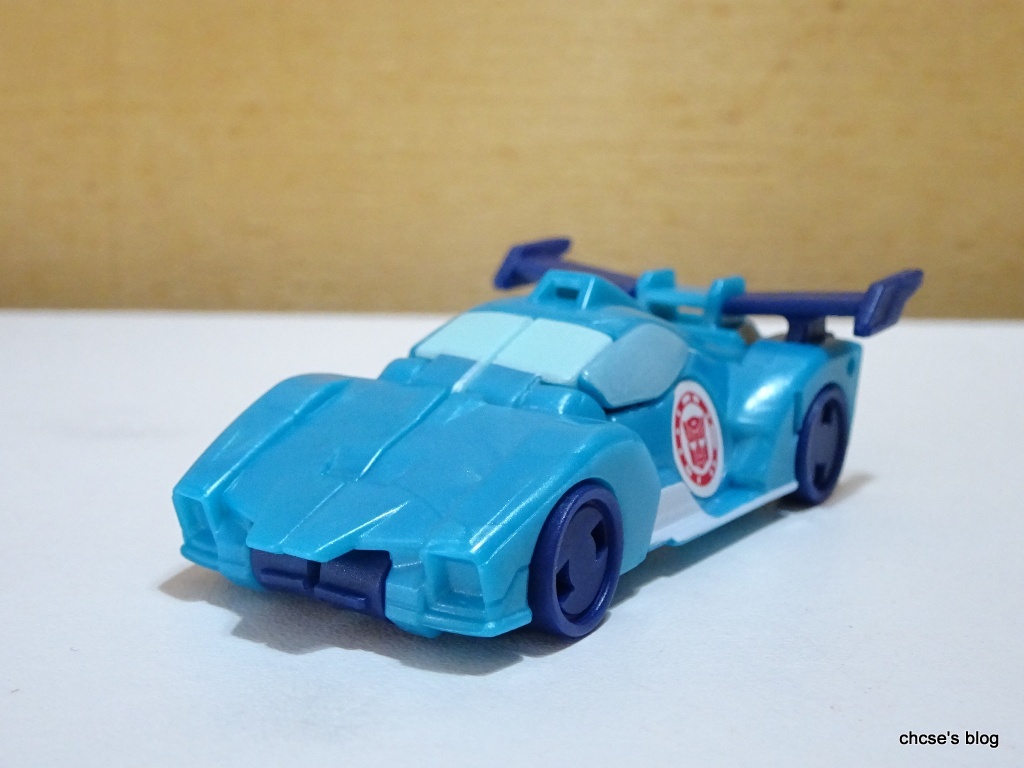
Blurr transforms into a blue sports car, with a bright blue for the windshield, and everything else a darker shade of blue.


The back has a bit of a gap due to transformation, and the rounded shape is kind of odd, but otherwise, this is a great vehicle mode.


Being a Legion-sized figure, he is fairly small.  Above is a comparison against RiD Legion Optimus Prime.


There's an insignia on the left side, which you can scan for the app to unlock the character temporarily.  A functional vehicle mode.

TRANSFORMATION:

As you'd expect, transforming Blurr to robot mode is very easy.  There isn't anything surprising here, although the spoilers folding up for the shoulders is a nice touch.

ROBOT MODE:


Robot mode isn't as sleek as you'd expect, instead opting for a bulkier look thanks to the shoulders and thicker legs.


He has half of the vehicle on his back as kibble, which sits flush against the torso so it isn't a problem.


The headsculpt is great, with a splash of white.  The goggle-like eyes look great.


Height-wise, he's average.


Articulation is restricted to his shoulders, hips, knees and ankles.


The shoulders are big enough to hamper the articulation there but on the whole, not too bad for a figure of this size.


A decent robot mode, which, while it doesn't do anything new, is still very solid.

OVERALL:

Blurr is a nice solid figure in the RiD line.  Both modes won't blow you away, but both are solid, doing everything right and doesn't take any risks.  Since he's a relatively inexpensive figure, Blurr is recommended.

---------------------------------------------------

For other Transformers reviews, have a look at this page.
Blogger Widget