Monday, August 19, 2019

Book Review: The Blue Lotus


Review:  #859
Title:  The Blue Lotus
Series:  The Adventures of Tintin – 5th book
Author:  Herge
Comments:  The Blue Lotus is a direct continuation of Cigars of the Pharoah.  As Tintin heads to Shanghai, the conspiracy gets bigger and he finds himself in more trouble than ever.  The plot mainly revolves around Tintin being targets by the Japanese and Tintin escaping every single time.  There are plenty of funny visual gags but the fact that Tintin only survives due to contrived coincidences is starting to wear thin.  It is surprising to find how the author portrayed many characters as corrupt, and then on the flip side, how easy it is for Tintin to just truss up some of the villains, drop them off at the local police station and declare that they will receive justice.  While The Blue Lotus doesn’t do anything new, the detail in the art is still wonderful.
Rating:  6/10

Sunday, August 18, 2019

Toy Review: Transformers Generations War for Cybertron Siege Soundwave (Voyager)


Review:  #511
Name:  Soundwave
Brand:  Transformers
Allegiance:  Decepticon
Line:  Generations - War for Cybertron:  Siege
Year of Release:  2019
Size Class:  Voyager (Wave 2)
Mold Status:  new

ALTERNATE MODE:


Soundwave transforms into... a hovercraft, apparently.  It's a really poor alternate mode and disappointing in this day and age.


The worst part is that this version of the character doesn't even have to based on any existing design or model.  This mode is literally the robot mode sitting down with the limbs pegged together.


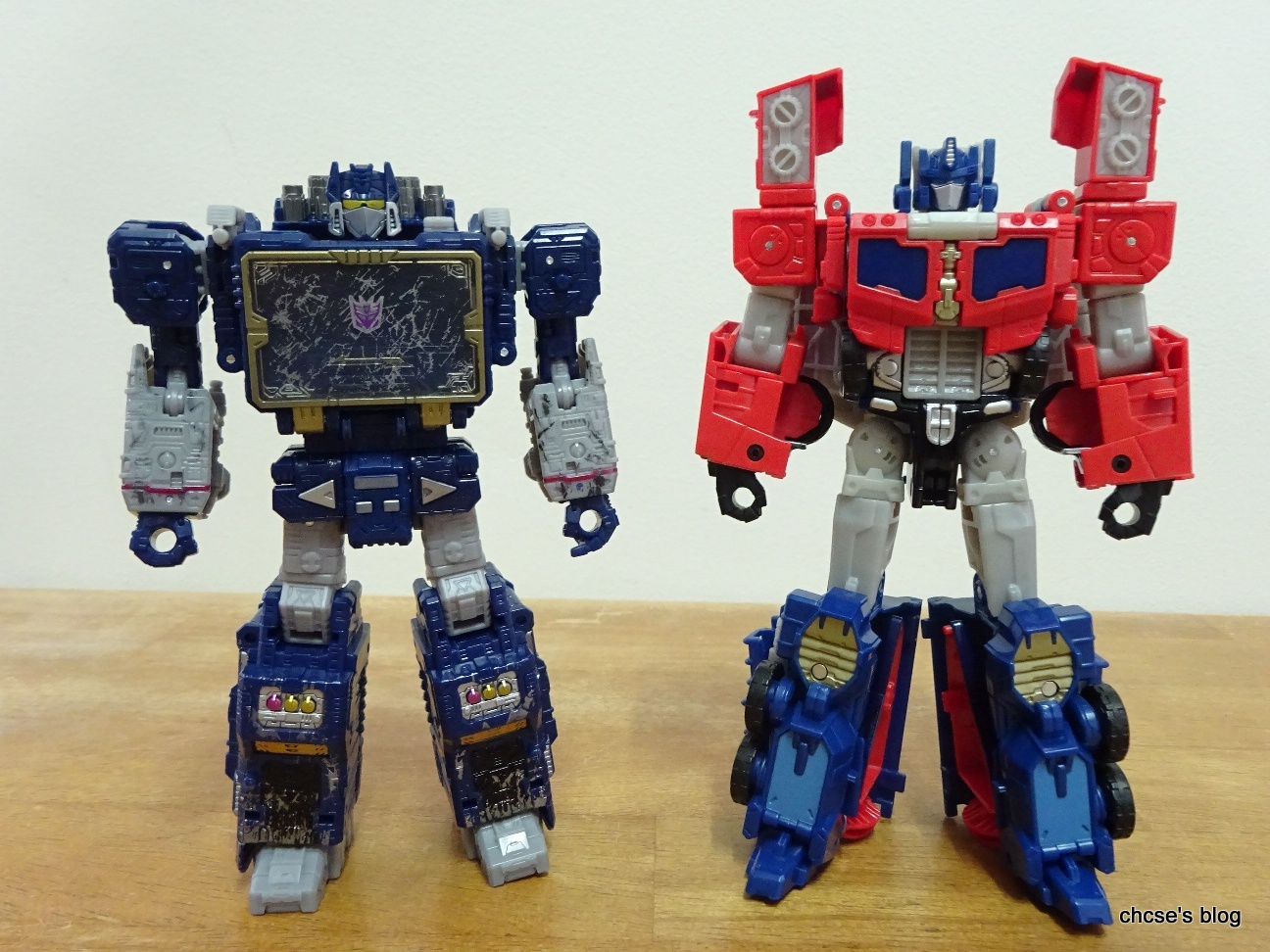
Soundwave is a Voyager classed figure, above is a comparison against Titans Return Optimus Prime.


There is a small cockpit in the middle of the hovercraft.


There are three fold out sleds to stabilize it on the table.  It's not aerodynamic in any way or from any angle you look at it...


A poor alternate mode, made worse by the vast swathes of silver "battle damage".

TRANSFORMATION:

Getting Soundwave to robot mode requires more steps than you'd expect.  The front splits to form the legs, while the bottom of the hovercraft folds up to form the arms, and the head pops out from the chest.

ROBOT MODE:


This is where Soundwave's strongest mode is and the robot mode does look good.


There's a bit of kibble in the form of thrusters, but they look pretty good there.


The headsculpt is fantastic and Soundwave has something that's (sadly) rare nowadays, lightpiped eyes.  They work really well.


Soundwave is a tad bit shorter than previous Voyagers but is still clearly bigger than a Deluxe.


Articulation is what you'd expect, with joints for his head, shoulders, elbows, waist and knees.


A carry over from hovercraft mode but he has a lot of the silver battle damage on his, which is made worse when it is covering the actual painted details, meaning it'll be next to impossible to remove the silver without removing the underlying paint.


His left hand has the index finger sculpted in such a way that he can be posed pressing his own eject button.  His chest is also springloaded to open up where you can put the Micromasters Laserbeak and Ravage if you have those figures.


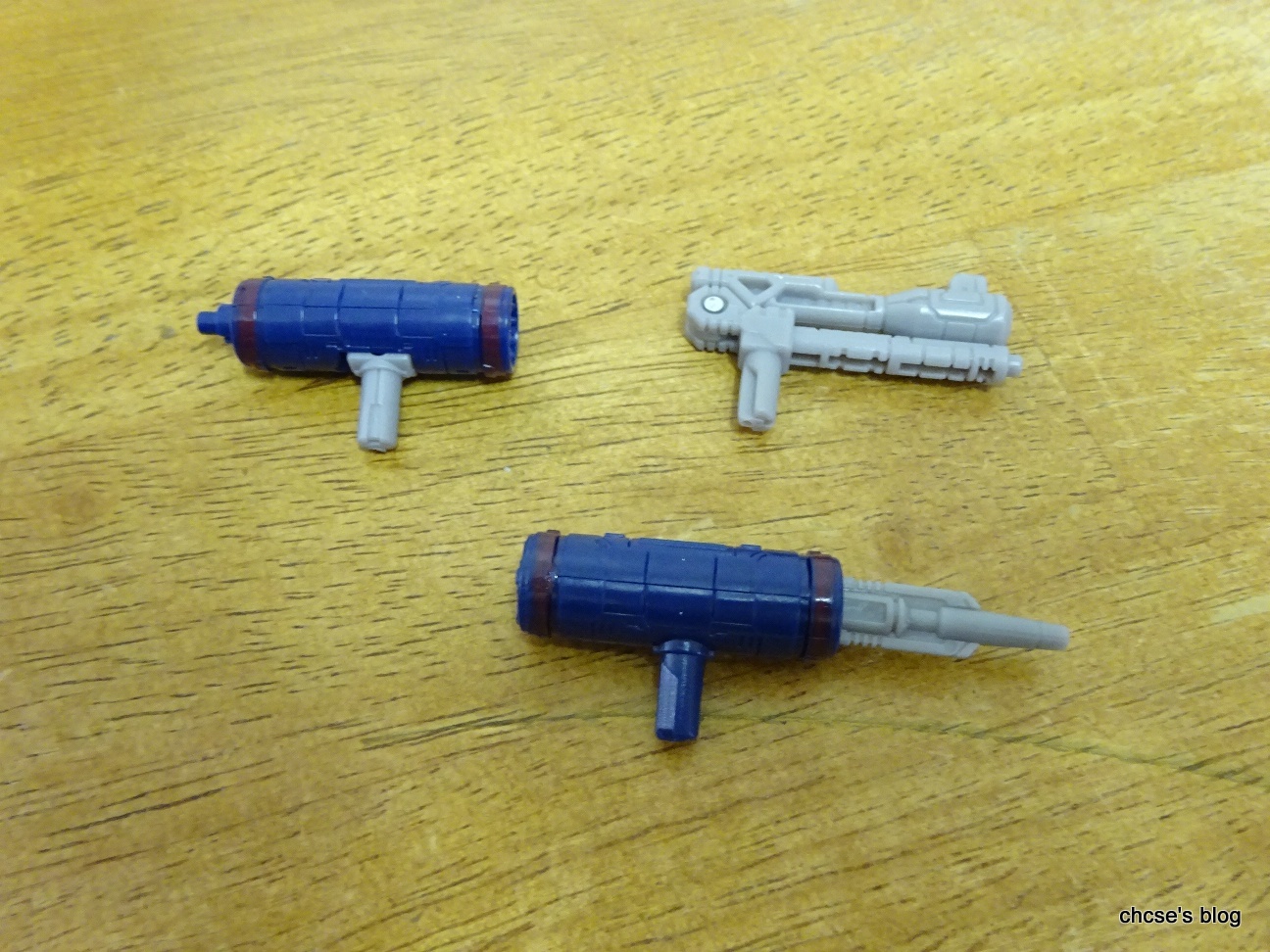
Soundwave has three weapons, his iconic shoulder cannon, blaster and one more grey gun.


The shoulder cannon just pegs onto his shoulder.


While he can hold the blaster in either hand.


There are various 5mm ports over his body if you have more weapons that you would like to arm him with.


The other gun is actually folded in half but looks decent.


You can combine all three weapons together into one long weapon but looks a bit weak and forced.


Soundwave has just about enough articulation to hold the long weapon with both hands.


The last option, and this may not be intended, is that you can flip out the sleds from hovercraft mode underneath each arm to act like blasters.


A good looking robot mode that helps makes up the shortcomings of hovercraft mode.

OVERALL:

Soundwave is a nice toy in robot mode.  He's a bit disappointing as a Transformer since the hovercraft is so poor.  He does pack quite a bit of playability thanks to the three weapons included and is worth a purchase if you don't already have a G1 inspired Soundwave or you find this guy on sale.

--------------------------------------------------

For other Transformers reviews, have a look at this page.

(As an Amazon Associate I earn from qualifying purchases)

--------------------------------------------------

There is an Easter egg of sorts and that is that Soundwave can transform into his light-post mode as he transformed into in one of the G1 cartoon episodes.  The packaging actually has line art depicting this mode.


Saturday, August 17, 2019

Persona 4: Dancing All Night (PS4)


Persona 4:  Dancing All Night is a rhythm game spin-off based on Persona 4, originally for the Vita.  It was later ported to PlayStation 4 and available as part of the Endless Night Collection as a digital download along with Persona 3:  Dancing in Moonlight and Persona 5:  Dancing in Starlight.  Unlike the rhythm spin-offs of 3 and 5, Dancing All Night contains a full story mode.  Told as a visual novel, it is a surprisingly engaging story complete with full voiceovers, animated cutscenes, excellent music and multiple dialogue options at certain points (but still the same ending).


Rhythm games aren't known for their plot but Dancing All Night merges it with the gameplay really well.  At certain points in the story, the cast will have a valid reason to start dancing.  The justification on not using Personas to fight the Shadows, but rather use their dancing to express their emotions is clever.


The premise is familiar to anyone who has played Persona 4 (and so you should before you start the game, as half the fun is seeing all the characters again).  There is a rumor that if you look at a particular website at midnight, a grainy video of an idol who had passed away performing a dance will play.  The cast is wrapped around in this because they are currently practicing in order to perform as support dancers for Rise's comeback performance.


While the story ends up devolving into a really simple "people are taken to the other world, now the characters will go and help save them", it contains familiar themes.  The new characters that they save each have their suppressed feelings which must be accepted before they can be released.  While most characters have their voice actors return, unfortunately, Rise has a different one (due to scheduling conflicts) and this hurts because Rise has a prominent role here.


The story mode is beefy clocking in at around 5-8 hours long if you read fairly quickly.  While the second half felt like it was dragging on thanks to its tendency to repeat familiar event structures in order to fit in songs, it had a nice ending.  The ending is very much Persona 4, with its message of bonds and trust, likewise with the huge amounts of cheesy dialogue.  The rhythm gameplay uses six buttons:  three from the d-pad, and three from the face buttons.  As the button prompts overlap the icons on the side of the screen, you press the corresponding button in time with the music.


As per usual with rhythm games, there are several different types of button prompts.  Hold Notes require you to hold down the button and Scratch Notes which require you to flick the analogue stick although you can map it to the shoulder buttons which is much easier on the higher difficulties.  Each note has one of four ratings depending on your timing:  Miss, Good, Great and Perfect.  Getting a Great and Perfect will build up your combo, increasing your score multiplier.  Furthermore, getting specific Scratch Notes will unlock Fever Time, a section of the track where you get better points, won't lose your combo if you don't miss and additional events.


Throughout the whole time, the background has several of the characters dancing.  The crowd is comprised of Shadows and since the button prompts are yellow (the theme color of Persona 4), it can be distracting at first.  However, at its core, Dancing All Night is quite easy until you get to the All Night difficulty.  You'll probably breeze through the other three difficulties:  Easy, Normal and Hard.  The most fun can be ha din Hard as the note prompts fit the melody really well, while All Night can get very crazy.


You can tell that Dancing All Night came first and is a Vita port.  This is because compared to Dancing in Starlight and Dancing in Moonlight, it is a bit rougher around the edges, with the UI being less polished.  While character portraits are sharp, texts are oversized with blurry edges.  The backgrounds and character models also lack the sharpness you'd expect of a PS4 game.


In addition to the Story Mode, there is Free Dance Mode.  As the title implies, you can select a song to play.  Initially, you only have access to a limited number of songs but as you clear them, more unlocks.  This mode is also where you earn $ to use in the in-game shop for costumes and accessories.  Each character has their own specific costumes which are pretty cool, but most of the accessories are shared.


Free Dance is also the only place where you can customize the partners that appear during Fever Time in each song, what they wear and use any modifiers.  These modifiers can make it easier or harder, but they also come with a high score penalty or bonus when you use them.


The game features music comprised of original and remixed.  It's a shame about the remixes as they are not as nostalgic and the originals always feel better.  The song list is interesting in that it takes from not only the original game but from Persona 4 Golden, Persona 4 Arena, Persona Q and the anime series.  Thus, it'll be a lot more enjoyable if you have already experienced those other titles.  Playing through all the songs in Free Mode will take you another 2-4 hours, more if you want to challenge yourself and get higher scores in each song.


Finally, there is a Collection Mode where you can check out the visual novel galleries, your high scores and character models.  Overall, Persona 4:  Dancing All Night is a great rhythm game since it features stellar music and solid rhythm gameplay.  While this is a straight port of the base game from the Vita, it still plays really well and the graphics still hold up well.  If you got the Endless Night Collection, then this is definitely a nice bonus.

----------------------------------------------

For other game reviews, have a look at this page.

Friday, August 16, 2019

Love Live! The School Idol Movie (2015)


Love Live!  The School Idol Movie takes place after the second season of Love Live.  While the anime provided a satisfactory closure, this movie closes it for good.  If you thought Î¼'s was a big deal in the anime, they eventually get even bigger now, which is a bit hard to accept.  The group gets invited to help promote Love Live even more and given the chance to travel to New York to perform.  This lends to some team bonding scenes and lets the characters experience another culture.  However, this section does exaggerate the characters' defining traits such as Umi's shyness and Hanayo's love for rice.  While you do expect various insert songs and most of them feel natural, there are a few scenes where it suddenly breaks into a performance which feels jarring with the transition.  As Î¼'s completes nears their final performance, you are supposed to feel elated and satisfied but since the group already kind of sorted this out in the anime, it doesn't have as big an impact.  So while in the end, Love Live!  The School Idol Movie is enjoyable if you like the franchise, the plot is too melodramatic and exaggerated to take seriously.

Thursday, August 15, 2019

Book Review: Cigars of the Pharaoh


Review:  #858
Title:  Cigars of the Pharaoh
Series:  The Adventures of Tintin – 4th book
Author:  Herge
Comments:  Cigars of the Pharaoh marks a turn in the series in that it has a more involved plot and events that flow better.  Despite the title, while Tintin starts off looking like he will spend his time in Egypt, the plot that he discovers ends up taking him to various other countries.  While it had potential, it never quite lives up to it because it feels like the plot was put into the afterburner as an excuse for the random gags.  At this point, it is a trademark and expected that Tintin will find himself into dire circumstances and then get out of them miraculously thanks to pure luck.  It’s also great that we are starting to see the introduction of characters that will end up being staples in the series.  Cigars of the Pharaoh doesn’t require as many leaps of logic as previous volumes and is more enjoyable as a result.
Rating:  6/10

Wednesday, August 14, 2019

Okami-san and Her Seven Companions (2012)


Okami-san and Her Seven Companions is based upon the light novel series.  The anime is set at 12 episodes long.  The anime takes place in Otogibana City, specifically focusing upon Otogi High School.  Okami Ryoko is the titular character and heroine, but she is joined by various other characters, including the male protagonist Morino Ryoshi.  This high school is different in that there is a club called the Otogi High School Bank.  They serve their clients via favors.  Any student can come in to ask for assistance in any matter, the payment is only a reciprocal favor when asked and it is implied that they can be heavy handed.


Ryoko is part of this club, along with eight other characters.  The anime opens with Ryoko on an assignment with Ringo (a cute petite girl) where they are attacked by a knife wielding thug.  During this scene, we learn that Ryoko is a capable fighter, specializing in boxing and not someone to be trifled with.  Ryoshi on the other hand is a shy boy who can't stand people looking at him.  However, he's quite talented as he was a hunter and competent when no one can see him.  Aiding this is the fact that he has a low presence, able to hide himself without others noticing quite easily.  He has a crush on Ryoko and that is the basis for joining the same club.


Ryoko easily falls for Ryoshi and you can see this a mile away.  She refuses to show it and actually hides a lot of things about herself that she doesn't want others to know.  Throughout it all, there is a snarky narrator adding their own comments.  Sometimes the narrator is serious, other times it's sly.  It breaks the fourth wall sometimes with the characters but occasionally, it tries too hard and fails (such as constantly bringing up the whole disappointing fan service aspect with Ryoko).  It is a weird addition since it talks just a tad bit too much.


The main twist here is that the characters are based on fairy tales and parodies it.  The club's first real task that we see has elements of Cinderella in it.  While Ryoko and Ryoshi are based on the wolf and hunter from Little Red Riding Hood.  These elements are not overused and can be amusing when you recognize the similarities.  The tone of the anime is definitely not serious.  There are plenty of random events and plot points as well as over the top reactions.  A character may be introduced as someone not to be taken lightly but then in the same scene, they are shown to be a sleazy pervert.  It also seems to load in the fan service more and more as the episodes go on.


The season mostly follows from one client to the next.  It averages one person an episode and so it becomes fairly predictable.  There is a large variety of requests, from finding a bride to having a double date; it's unpredictable to say the least.  Unfortunately, it never gets too interesting as on the whole, the script is fairly bland even when it's trying to develop the characters via telling us their backgrounds.


As the season nears its end, it takes a slight shift in direction.  The antagonist that had been haunting Ryoko finally makes his move but despite hinting at what a devious and sly person he is, it wasn't anything special and felt like a previous episode.  It also feels that the anime ended one episode too much as the final episode felt like it didn't fit into the same theme as the previous ones.  While it provides a bookend it was also a lot more normal.


Overall, Okami-san and Her Seven Companions is an average anime.  There's nothing special really going for it.  The concept of basing characters off fairy tales is novel at first but then you realize that it doesn't utilize it in unique ways.  Despite having a large cast of characters, it only ever focuses on a few so you never get the feeling of camaraderie between the members of the Otogi Bank like you'd expect.

--------------------------------------------

For other anime reviews, have a look at this page.

Monday, August 12, 2019

Book Review: Tintin in America


Review:  #857
Title:  Tintin in America
Series:  The Adventures of Tintin – 3rd book
Author:  Herge
Comments:  Tintin in America is now in color and this time, as the title suggests, Tintin heads over to America and clears the city off gangsters.  It’s a big task but Tintin always manages to do it somehow.  He has all the gangster bosses focusing upon him, trying to silence him for good.  However, for every dire situation that Tintin finds himself in, he manages to pull through by sheer luck alone and that is the comic’s biggest negative.  Tintin never uses his own cleverness to get out of sticky situations, it’s all due to coincidences one way or another and this feels boring.  Tintin goes from one situation to another, with a paper thin plot barely holding it together.  It’s a shame since it had potential and there were plenty of good humor but in the end, it feels a bit too haphazard and boring.
Rating:  5.5/10
Blogger Widget