Wednesday, July 22, 2020

The Seven Deadly Sins (2014-2015)


The Seven Deadly Sins is based upon the manga series.  The first season is comprised of 24 episodes and two OVAs.  The anime is set in a fantasy world.  There was a group known as the Seven Deadly Sins, each member being extremely powerful.  Ten years ago, it was told that the seven decided to overthrow the king but was repelled by the Holy Knights.  Notably, the Seven were also formerly part of the Holy Knights, thus they were branded as traitors.  Afterwards, they managed to escape and disappeared, even rumored to be dead, although they are still currently wanted.


Fast forward to the time of the first episode and it follows a young boy named Meliodas who is apparently the owner of the Boar Hat tavern.  He is accompanied by his talking pig companion, Hawk, when he encounters Elizabeth, someone who is seeking the Seven Deadly Sins.  Since Meliodas himself has a deeper history than one would expect, he has his own reasons for finding them and thus the pair goes off to search for the members.  During their search, they frequently encounter the Holy Knights who try and stop them.  Each of the Holy Knights have their own unique power giving them an edge in combat.  Despite their role in being protectors of the kingdom, they are portrayed as the ultimate evil.  They frequently abuse their power and oppresses the population.  Considering the amount of bad things they do, it is hard to fathom how they are so organized.


The pacing is fairly quick since Meliodas manages to find and recruit several members of the Seven Deadly Sins in quick succession.  Due to this fast pacing, the objectives eventually shift from finding members to something else.  It may be cliched but it does make for some fun classic adventuring.  That being said, since the members are being recruited so quickly, it makes the legends being told about them feel overblown.  Despite the ragtag band of adventurers, each member of the group complements each other well.


Meliodas and his team are severely overpowered.  Each of the Seven is special in some way.  They have powers that others do not and the difference between them and the Holy Knights is that the Seven’s powers are extremely potent.  No matter how strong a Holy Knight is or whether they attack in numbers, you can confidently assume that they will easily dispatch them.  It’s a bit annoying when they introduce new characters in the episodes because the new character will be the overpowered one saving everyone else who suddenly takes a heavy beating.  It can feel inconsistent at times.


The anime features highly exaggerated battles with characters flying everywhere in high speed.  Mountains will crumble, the ground will crack and characters, even background characters, rarely die.  There is a tendency for characters to call out their attacks.  It is most ridiculous when you have seven call outs right after each other.  Characters are also really fond of exposition, launching into a detailed explanation of their attacks, what’s currently happening onscreen and other obvious points.


There is a lot of obvious fan service.  However, this type of fan service has been done too many times before so it feels lazy and contrived.  Meliodas doesn’t stop with his blatant inappropriate touching but there’s no charm in his actions.  There is some good potential for the plot but the anime doesn’t quite leverage the amount of excitement and tension that it should from these twists and revelations.  There is a surprising amount of connections between each of the characters to the point of being contrived.  The world the characters live in doesn’t have anything unique that makes it stand out.  It is your typical fantasy archetype which can make it feel generic.


The last arc of the season changes the format that we’re used to and gives us a really good climax.  The group is forced to head to the capital and fight all out against the Holy Knights.  Not only are the action sequences some of the best in the season but it gives us a lot of context in what motivates each of the main characters.  It is a satisfying ending and brings the strong comradeship between the members of the group up to the forefront.  Surprisingly, the arc in the season ends neatly and provides enough closure such that even if there were no further seasons (there are), it doesn’t leave many threads open.


There are two OVAs, each one is a side story.  The first one expands upon the story of Ban (one of the Seven Deadly Sins).  It reuses the clips from the season and adds in some new ones.  Unfortunately, this OVA only served to highlight how fickle Ban’s relationship was since it made clear the short amount of time he had spent with the girl he loved.  The second OVA is less serious.  It is a series of shorts that shows us a side of the characters that we normally wouldn’t see, it is funny and amusing.


Overall, The Seven Deadly Sins may not blow you away but it is a fun adventure.  It feels like a classic story that doesn’t try anything bold, but what we’re given works well.  You will warm up to all the characters, and the story is engaging enough to keep your interest even though there are plenty of detours.

-------------------------------------------

For other anime reviews, have a look at this page.

Monday, July 20, 2020

Book Review: The Eye of Minds


Review:  #922
Title:  The Eye of Minds
Series:  The Mortality Doctrine – 1st book
Author:  James Dashner
Comments:  The Eye of Minds is set in a world where virtual reality has advanced to the point if being indistinguishable from reality.  People go into “coffins” where a series of connections allow the user to experience physical sensations.  Following Michael, who is your typical teen with an attitude, he is recruited to try and find the latest menace in the virtual world.  He is joined by two friends and throughout the whole adventure; you can’t help but feel this is extremely familiar to other stories before it.  Everything feels predictable and well trodden, leaving you with no surprises.  The author tends to saturate the text with pointless descriptions.  The journey is supposed to be one of intelligence but none is shown by the characters.  It constantly uses jargon and references techniques which are made up but never once is it explained what they actually mean by it.  This means that whenever the characters “look at the code”, you don’t know what they are actually doing.  The virtual world is too realistic to feel virtual and everything feels contrived.  The saving grace is the end which was what all the mystery was leading up to.  It manages to hide a neat twist (but not the most original) that allows you to see the characters’ actions in a new light.  Despite its flows, the ending was worth the lead up.
Rating:  6/10

Sunday, July 19, 2020

Toy Review: Transformers Generations War for Cybertron Earthrise Ironworks (Deluxe)


Review:  #572
Name:  Ironworks
Brand:  Transformers
Allegiance:  Autobot
Line:  Generations - War for Cybertron:  Earthrise
Year of Release:  2020
Size Class:  Deluxe (Wave 1)
Mold Status:  new

BASE MODE (CRANE):


The official alternate mode of Ironworks is the base mode with the crane.


To be honest, it's pretty hard to screw up a base mode where it is just a flat platform with a crane on top so Ironworks looks pretty good in this mode.


As a Deluxe, the base mode's size isn't that impressive.  It's kind of scaled for Micromasters but they look a bit too big on it.


The crane arm can life up and rotate, and if you have other bases, then you can connect them.  While Ironworks looks good, his play value relies on you having other compatible figures.

TRANSFORMATION (TO COMMUNICATION TOWER BASE MODE):

Ironworks is a partsformer so you have to take him apart and then reassemble him to get to the communications tower base mode.  This isn't in the instructions but was shown in promotional materials. It's not hard to get to this and you can figure it out from photos alone but it is a clever reuse of each of his parts.

COMMUNICATION TOWER BASE MODE:


The communication tower base mode was something the original toy had and replicated in this Deluxe iteration.  It looks great, especially with the scoop halfway up the tower.


The tower is approximately the height of a Deluxe.


The size means that it is scaled okay for Titan Masters.


A good looking base mode but once again, play value relies on having other figures.

PLATFORM MODE:


Mentioned in the instructions, if you take the robot legs and two of the panels, you can create a platform of some sort.  It's actually really hard to get a flat surface since the joints are not strong enough and the platform sags.


Officially, Hoist's towing panel can peg onto the platform.

TRANSFORMATION (ROBOT MODE):

To transform into robot mode, once again you break the base mode into separate pieces and then reassemble them together to form the robot mode.  The arms and legs are easy, but the torso requires a little bit of manipulate and is the more interesting part of the process.

ROBOT MODE:


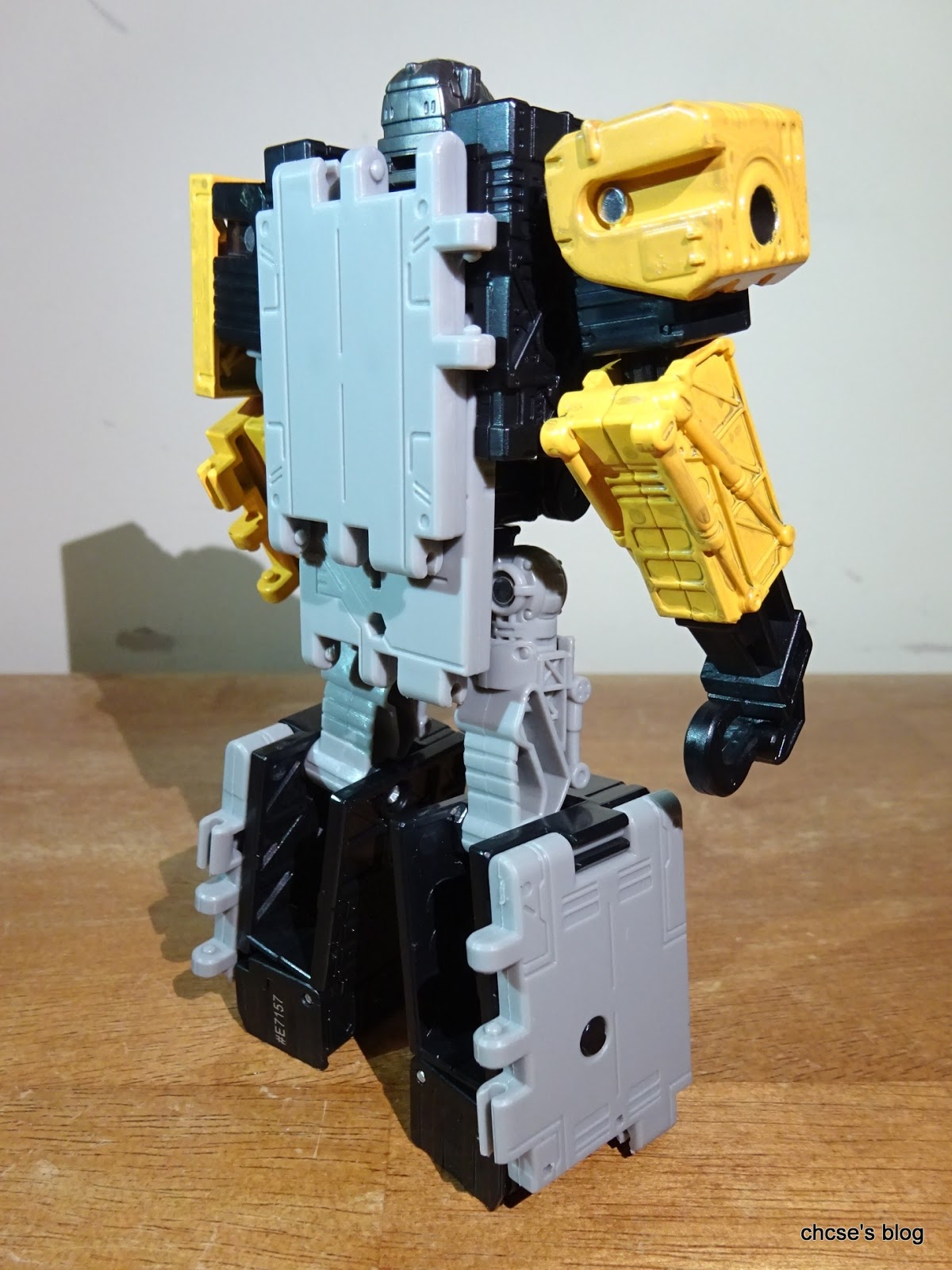
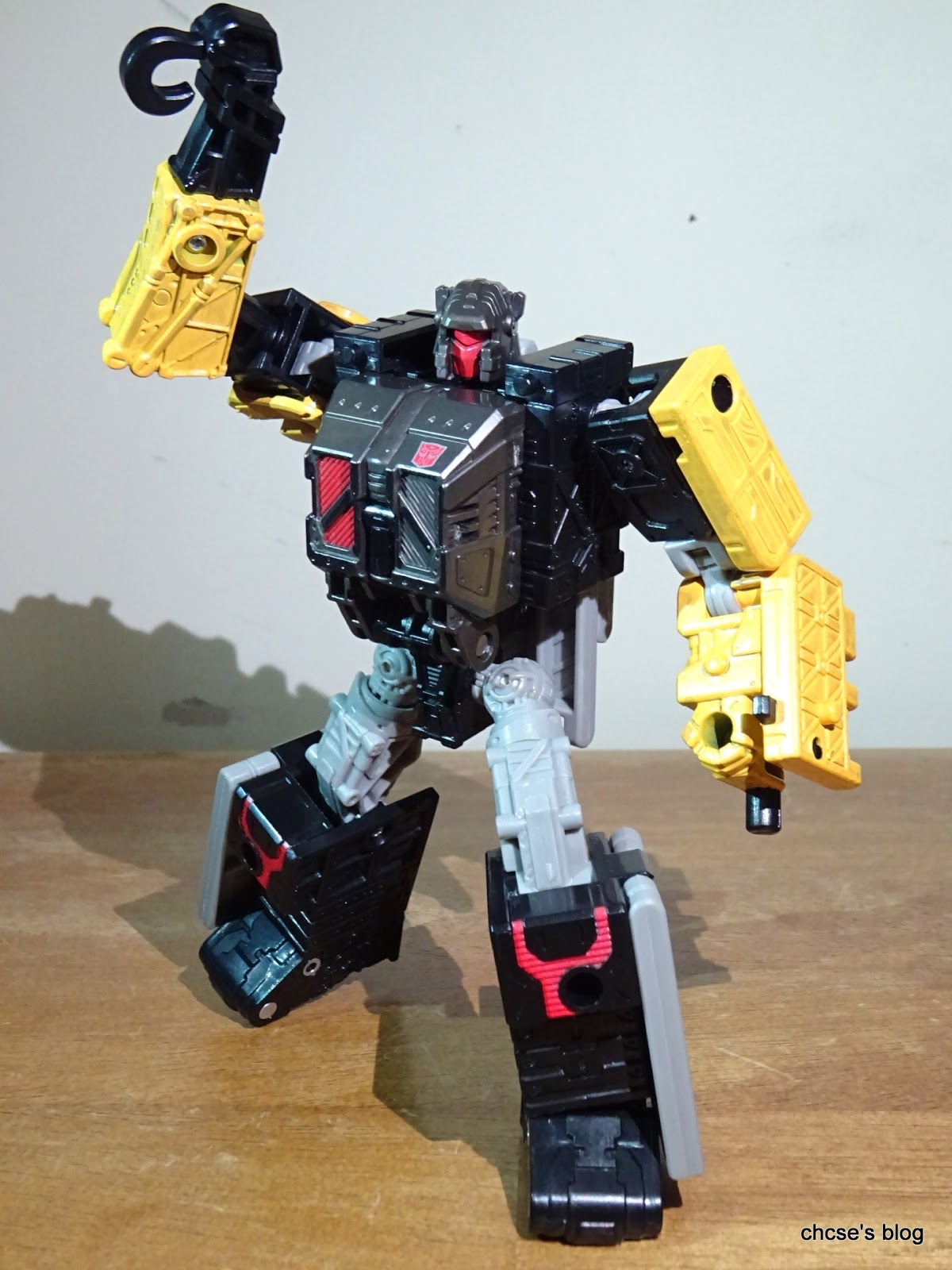
Ironworks robot mode looks great and is arguably the best mode of the figure.


The black and yellow color scheme looks really good.  He doesn't have any kibble that gets in the way, the greatest pieces are the two grey panels that form his back (although they cover the gap in his torso).


The headscupt is decent.  He has a red visor and a red faceplate but the sculpting is deep enough so that they don't look like one undefined red blob.


Ironworks is average height for a Deluxe, he is a little bit taller than Siege Sideswipe.


Ironworks has the crane's hook on his right arm and a fist for his left.


Articulation is decent, although due to transformation, he doesn't have a typical waist swivel.  Rather it is on a hinge joint so he does have some movement, however limited.


He comes with two weapons, both are small guns.


The guns can be held in his hand, and there are a few 5mm ports somewhere to peg it too.


However, the weapon looks better when combined into one.  The crane's hook can rotate as well.


A strong robot mode that works well.

WEAPONIZER MODE:


While not officially named as such, Ironworks can split into parts that you can peg onto other figures to "weaponize them".  Ironworks splits into five pieces in this mode.


The figure used in the instructions is Wheeljack, who gains feet extensions, a shoulder cannon, a claw arm and a shoulder shield.


So while the core figure doesn't have any enhancements, the various weaponry still gives the figure a tougher more heavily armed look.

OVERALL:

Ironworks does a lot of things, having two base modes, a robot mode and a Weaponizer mode (as well as a weird platform configuration).  Considering the amount of work he has to do, Ironworks has done an admirable job of making each mode work, to the point where he isn't compromised for any of the modes.

------------------------------------------------

For other Transformers reviews, have a look at this page.

(As an Amazon Associate I earn from qualifying purchases)

Saturday, July 18, 2020

The Witch and the Hundred Knight: Revival Edition (PS4)


The Witch and the Hundred Knight:  Revival Edition, is an action JRPG originally for the PlayStation 3.  It was ported to the PlayStation 4 with higher resolution (1080p vs 720p), improved frame-rate, a new dungeon and most importantly, the removal of a game-breaking bug that would cause the game to randomly crash without warning.  The most unique aspect of the game has to be the storytelling.  The game isn’t shy of making fun of using course language, or mimicking the typical idealistic stories of JRPGs.  It breaks the fourth wall and carries with it a lot of humor and charm.  Thus it will often have unexpected events that’ll pleasantly surprise you.  Although some of its humor misses the mark and can be somewhat offensive.


The gameplay is a hack and slash from a top down perspective, similar to Diablo.  However, there is only one attack button but you can equip up to five weapons to chain together a five-hit combo.  Different weapons have different ranges and speed, with enemies being resistant or weak to certain ones.  You can using the triggers to pre-organised weapon sets on the fly in order to adapt to enemy weaknesses.


The vast majority of the new, more powerful, equipment are gained through defeating enemies or from chests in the dungeons.  Organizing weapons within a set in a specific order will provide damage bonuses up to 2x the damage output.  The Hundred Knight is also able to dodge.  Dodging at the last moment allows time to slow down and the Knight to whack the enemy to oblivion.  There’s a button for special attacks, shielding to reduce damage, and uniquely, using the touch-pad to use items or summon tohkas to assist you.


While exploring, there is a GigaCals meter.  If the meter runs out, your health will rapidly decrease and once you die, you’ll randomly lose an item that you had found as well as losing experience points.  Thus every dungeon is on a timer and is a balancing act.  When you explore new areas, the meter drops faster, but if you have already explored that part of the map, its decrements are slower.  Spread through each dungeon is checkpoints, known as Pillars, which doubles as fast travel points within the dungeon.  It allows you to also apply bonuses or safely warp out of the dungeon whilst keeping all the items and experience that you have found.


Defeating the enemies roaming the dungeons will net you experience points that are only applied upon exiting the dungeon.  Thus, it might be better to leave and level up before tackling the dungeon boss, especially since you cannot save in a dungeon (which made the PS3 version’s bug all the more brutal).  The Hundred Knight has a stamina bar that is used when attack, dashing, dodging, or recovering health.  You will need to watch out because if the bar depletes, then the Hundred Knight will become unusable for a short period of time.


Tying into defeating enemies are grade points which gives you varying levels of rewards.  There are a total of ten tiers each time you enter a dungeon.  All of these systems linked to dungeon exploring leads to an addictive cycle of dungeon crawling, getting better loot, equip said loot, then return to dungeon crawling.  The story is told in a visual novel style, with English or Japanese voice-overs.  It follows the Swamp Witch, Metallia.  She summons the legendary Hundred Knight, who is supposed to be the most powerful familiar in existence.  Despite its small stature and weak look, it is actually quite strong and during the period that the player controls the Hundred Knight, they will decimate everything before them.


The story has Metallia trying to expand the territory of her swamp.  She cannot survive outside of her swap and so gets Hundred Knight to reveal pillars in the world to extend her territory.  There are other witches in the world too which are more of your typical “good” witch, although no one is as they appear.  A lot of characters are unlikable in the beginning, including Metallia.  However, Metallia undergoes significant amounts of character development over the course of the game.  She goes from an uncaring ungrateful person to someone with hidden depths, especially once her background comes to light.  She keeps her foul mouth though.


The story unfortunately meanders a lot.  The game takes around 50-60 hours to complete and over the course of it, there are too many distractions.  From finding a particular object to heal someone to exploring another piece of the land, the ultimate objective always changes.  There are a lot of scenes that you feel are not essential and serves to confuse thing furthers.  There are three endings and two of them aren’t that great as they end too abruptly.  The true ending is difficult in terms of difficulty spikes but is a solid ending that emphasizes the relationships between the characters.


While the game is fun in the beginning, eventually the maps get too big and boring.  It takes an hour or so to complete 100% of each new map and there just isn’t enough to do to make that worthwhile.  This ends up making the game have vast stretches of little story before you get a meatier cutscene.  The other thing is the pointless difficulty spikes.  The game puts one in during the second chapter.  While it is not a massive one, it forces you to learn the system and try not to smash your way through.  You’ll have to bait enemies and organize your weapon sets to properly target an enemy’s weakness.  The worst difficulty spike comes in if you want to go for the true ending and it serves nothing but drag the game on and on.


Bosses become harder and cheaper by the halfway point of the game, to the point where it ends up being unfun.  When the bosses do not leave an opening, or become cheap with constant attacks or ranged attacks, it drags the whole battle where you can only kite them.  You can grind if you want or you can fall back on cheesing the boss with the super move of the Hundred Knight.  Either way, it’s not great design.  These boss battles also exacerbate the poor camera angles.


The Tower of Illusion is the additional dungeon added to the PS4 version.  The tower boasts 200 floors but each floor is comprised of one to three floors so it can be very tedious to go through in on ego.  It’s not only a place to grind and defeat enemies, it is a side story, using characters fro a parallel world.  You can play it in tandem with the main story and it is actually a great place to grind and level, which helps reduce the monotony of the notorious difficulty spikes in the later chapters.


Overall, if you are interested in the game, then The Witch and the Hundred Knight:  Revival Edition is the version to get.  The removal of the crashing bug alone makes it more desirable.  In terms of the game itself, it is a decent game.  There are plenty of times where you’ll find yourself thinking that the game is dragging things out way too much but it ends up being a rewarding time and on the whole, it was enjoyable and fun.

----------------------------------------

For other game reviews, have a look at this page.

Friday, July 17, 2020

Pocahontas (1995)


Pocahontas is a Disney traditionally animated film, it's a musical again.  The storyline is very familiar to a few of Disney's other films.  Set during a time when Englishman were exploring the "New Worlds" and claiming it for themselves in order to suck out its resources (i.e. gold), it follows Pocahontas.  Pocahontas is a native of the lands and she was the first to encounter one of the new settlers.  What follows is a typical tale of misunderstanding between two groups but this is undermined by a racial undertone.  Even the songs highlight the fact that they don't like the other as they are a different race.  The pacing is slow with a lack of interesting scenes and moments.  The storyline is too predictable by this point to enjoy.  The lack of humor is noticeable, as well as the lack of charming characters that you would like immediately.  However, the music is excellent and are the highlights of the film.  Given these factors, Pocahontas is an average film.

Thursday, July 16, 2020

Toy Review: Transformers BotBots Bankshot (Series 3)


Review:  #571
Name:  Bankshot
Brand:  Transformers
Allegiance:  N/A
Line:  BotBots
Year of Release:  2019
Size Class:  BotBots (Series 3)
Mold Status:  new

ALTERNATE MODE:


Bankshot is a BotBot in the Arcade Renegades subgroup and transforms into a pinball machine in line with the theme.


Since his face is fully visible, while it is recognizable as a pinball machine, it is also obvious that it's just the robot lying down.


Thanks to its longer form, he doesn't look that much smaller than a Legion figure, but he definitely is around half the size.

TRANSFORMATION:

Transforming Bankshot into robot mode is very simple and you can probably work it out from looking at the alternate mode alone.  You pull the bottom to create the legs, pull the arms out from the side, and then flip the head back.

ROBOT MODE:


If you think that Bankshot looks like the pinball machine upright, then you are right.  This is one of the weaker robots in the pack.


He's very rectangular overall.  Thanks to the way he transforms, he's stable since all the weight is evenly distributed.


The headsculpt, or rather, the painted face, has the non-serious look that all BotBots have.  Bankshot's face make him look like he's clumsy and clueless.


A size comparison with a Legion figure shows that Bankshot is very short and small.


Articulation is limited to only swinging the arms forward.  A weaker robot mode, while he looks okay, it doesn't differentiate too much from the alternate mode.

OVERALL:

Bankshot is one of the weaker molds in the pack.  The mold itself is very simple to the point that it can feel a bit lazy, especially considering the ingenuity of some of the other members.  He's not terrible and continues the cute look of the BotBots line, but he isn't worth going out of your way for (so it's good news that he just comes packed in a box set).

---------------------------------------------------

For other Transformers reviews, have a look at this page.
Blogger Widget