Wednesday, August 24, 2022

Warriors Orochi 3: Ultimate (PS4)


Warriors Orochi 3: Ultimate is (primarily) a crossover between Dynasty Warriors and Samurai Warriors. It is the third game in the series and the Ultimate version has additional content compared to the original release. If you have played any of the Warriors series, then you’ll have no trouble playing this as the controls and combat are the same. If you haven’t, then it’s easy to pick up anyway so the lack of a tutorial doesn’t really matter in the end.


The story mode has a lot of content, spanning eight chapters. Even if you haven’t played the first two games, as long as you have read up on the highlights then you’re good (basically, the characters of Dynasty Warriors and Samurai Warriors are brought together to fight off the demon Orochi). The story initially is actually somewhat interesting, as it starts off with three surviving characters fighting against the Hydra. It’s a losing battle for humanity, and at this point, Kaguya, a goddess, arrives.


Kaguya has the ability to travel back in time, within certain limits. The characters then return to the past in order to correct their mistakes and save the other characters who had perished in battles. By doing this, they are able to build up their army and hopefully at the same time, find something that can actually hurt the Hydra. This is a pretty neat concept and although it never explores any deeper than this, it does a pretty good job at pushing the players into all the levels, and then having several characters unlock once those are cleared.


The Warriors games all play very similarly, with only slight additions with each iteration. Warriors Orochi 3 Ultimate’s combat is pretty much the same one from Dynasty Warriors. Light attacks are Square, Strong attacks are Triangle, Musou attacks are unleashed using the Circle button, X to jump, and you can combine the various buttons into a chained combo. Additionally, characters can block, have dash attacks, and you bring with you a team of three that you can switch out at any time. It’s definitely a basic combat that gets extremely grindy, even a few levels in once you’ve realised there is nothing more to it.


The game has RPG elements. Each character can level up, although gaining experience is extremely easy and you’ll hit Level 100 pretty soon. You can then promote them to boost their underlying stats and reset their level back to 1. However, this means the game tends to push the player towards using the same characters to improve them more and more. So even though the levels have “recommended” teams to encourage trying out new characters, it’s almost never worthwhile as those new characters are too weak unless you’re willing to spend limited points to push their levels up.


The key draw of the game is the large scale battles in terms of the sheer number of mooks that you can defeat. The developers seemed to have thought that more is better so there are literally thousands of mooks on the battlefield that dies in one or two hits. You’ll easily get over 1000 Kos each level, if not 2000 or 3000. It’s actually quite distracting with the number of enemies and allies on screen at once, as they end up swarming your character, making it hard to see where they are and where the boss is. Unfortunately, there’s still a ton of pop in, but there’s just something soothing about effortlessly mowing down thousands of enemies that makes it a guilty pleasure.


The other big draw of the game is the sheer number of playable characters. The Dynasty Warriors and Samurai Warriors games alone have impressive large casts, but combining the two here makes it gigantic. Then in addition there are some Warriors Orochi originally characters, and also crossover characters from Koei Tecmo’s other games like Ninja Gaiden and Dead or Alive. The huge number of characters means you’ll probably only play your favorites as there aren’t really enough reason to play all of them, especially with the leveling up mechanics for the story mode.


Levels generally play the same in that your main aim is to not let the leader die, and to defeat most of the bosses on the battlefield. It’s generally an easy game on Normal difficulty, although it can be annoying when the objective changes to preventing the enemy from escaping, but they escape anyway since it tells you too late and you get lost in the environment due to the verticality of some levels. The environments are bland in general but better than Dynasty Warriors because this game has varied settings taken from both present(ish) day to the past.


Each level doesn’t take that long to beat, depending on the difficulty. You can blast through the levels in around 10-15 minutes on easy, although playing on harder difficulties just means the opponents are more damage sponges rather than being difficulty. Although getting stunlocked is still annoying. You can clearly tell where the original’s story ended, as it begins a new arc for the new content. The story has potential, playing with time travel and building up the ultimate army to beat Orochi, but it ends up devolving into fighting against all the characters so that they’ll join you type of scenarios. The new content’s story arc is also quite underwhelming, especially since the antagonist is nowhere near as cool as Orochi and the Hydra.


The takes around 10 to 15 hours if you rush through the compulsory levels, and even more if you decide to play the side levels. Even with just that, there is heaps of content, however, there are other modes apart from the story. Duel Mode harkens back to the original Dynasty Warriors in which it’s a one on one battle. You can either battle against the CPU or online against other players. There is a Survival mode within to see how many opponents you can defeat before you lose all your health. In this mode, there are also “strategy cards” which you would have been collecting throughout the game. These cards have different effects that you can activate during battle.


Then there’s the Gauntlet mode, which is where the meatier content comes into play. In this, you pick a squad of five and then go through the map with infinitely respawning enemies, that also gets stronger as time goes by. The aim is to go around the map and activate portals, one of which will lead to the exit. There’s no story to go around with this mode but it has a ton of stages, and New Game Plus of sorts where you can go back in to unlock more. The Musou Battlefield mode is a level editor, while the Free mode allows you to play a level of your choice. So in summary, there is a lot of content, but it is all very similar and repetitive, so if you’ve had your fill from the story levels, then there’s nothing new in the rest of the game.


Overall, Warriors Orochi 3: Ultimate plays it safe with its formula and doesn’t try anything new. However, this just means that fans of this gameplay can continue to enjoy destroying thousands upon thousands of enemies that has a new story to go along with it. While it can get repetitive and predictable, there are times where it can be soothing just to mow down so many opponents with ease. The game has no shortage of content though so you’ll more than likely become bored of the game before running out of things to do. In that aspect, this game caters to a specific audience, but is a great game to that audience.

------------------------------------------------

For other game reviews, have a look at this page.

(As an Amazon Associate I earn from qualifying purchases)

Sunday, August 21, 2022

Toy Review: Transformers Generations War for Cybertron Kingdom Tracks (Deluxe)


Review: 
#731
Name:  Tracks
Brand:  Transformers
Allegiance:  Autobot
Line:  Generations - War for Cybertron:  Kingdom
Year of Release:  2021
Size Class:  Deluxe (Wave 3)
Mold Status:  new

VEHICLE MODE:


Tracks transforms into a Chevrolet Corvette, and this figure is heavily based upon his G1 version.


This is a good vehicle mode, although there is some sacrifice made for the flight mode, namely the unpainted white plastic that cuts the back, which is is quite distracting.


Unfortunately, Tracks is quite small in hand, he is narrower and shorter than a lot of other Deluxes.


However, due to his small size, this means that he is absolutely packed.  There is no empty space in this mode, giving him a more solid feel.


The robot weapons can peg together to then peg at the back of the vehicle.  It's a bit silly looking but can't expect much more nowadays.


This is a good vehicle mode, it really is a shame that the white at the back breaks up the blue.

TRANSFORMATION (FLIGHT MODE):

Flight mode is kind of an in-between mode between the vehicle and robot mode.  It showed up in the G1 cartoon and every every subsequent toy update features this mode.  The arms fold from underneath, along with the bigger wings.  While the rear has the small fins and it's finished off with the weapons plugged on top.

FLIGHT MODE:


Flight mode was always quite silly looking, and it's no different here.  The arms are the robot arms, but with a big wing.


All the changes are  at the back of the vehicle given the front is virtually unchanged.


Just like with every other single toy that attempted this, this mode causes the vehicle is become slightly more unstable thanks to all the gaps it introduces.


As a bonus, this is fine and gives additional play value, but is forgettable.

TRANSFORMATION (ROBOT):

The transformation to robot mode isn't too difficult.  The front splits and forms the legs, and this are really annoying with how you need to rotate the panels to form the shins.  Go about the wrong way and you'll be left wondering how you are supposed to do it given that the panels keep getting in the way of each other.  It can be a frustrating experience.  The upper torso is much more conventional, but still interesting in how the chest comes together.

ROBOT MODE:


As with a lot of Generations figures, the focus is in the robot mode. Tracks looks really good here.


He wears a big backpack with most of the vehicle on it.  Initial stock photos may have you worried given that he had a gappy torso but it is not as noticeable in hand.


The head sculpt is fine, with his trademark white helmet and red face.


He's an okay size in robot mode, taller than your typical Deluxe nowadays but slimmer.


Articulation is fine, with joints for his head, shoulders, elbows, waist, hips, knees and ankles.


Just like the Masterpiece version, Tracks' feet are horrible.  They're on a balljoint that's severely restricted, and they're attached in such a way that they're like "floating" and not properly a part of the leg.


He comes with a small black gun.


Officially as per the instructions, it can attach to the top of his white guns.


However, of course the way you'd want him to use it is to hold it in his hand.


If you don't want to use the gun, it can be stored by pegging it into his back.


Otherwise, that's it for the gimmicks and play value.  Apart from the feet, there are no major flaws.


This is a good robot mode, looks great and doesn't feel cheap.

OVERALL:

Tracks is an okay toy.  He has a good vehicle and robot mode but is let down by the poor feet design in robot mode.  It's like the designers deliberately copied the Masterpiece version without thinking that it was a disaster then, and it's a disaster now.  It's not a massive dealbreaker but can be annoying like the leg transformation.

------------------------------------------------------

For other Transformers reviews, have a look at this page and this page.

(As an Amazon Associate I earn from qualifying purchases)

Friday, August 19, 2022

Brooklyn Nine-Nine - Season 6 (2019)


The sixth season of Brooklyn Nine-Nine, and the first one to be broadcast on NBC, is eighteen episodes long. It’s business as usual for the team, continuing straight off from the previous season’s finale. We find out whether Captain Holt is able to be promoted to Commissioner or not, and the fallout from that. While Jake continues on his shenanigans with his fellow colleagues at the precinct.


One thing that is definitely missed are the funny and outlandish, yet endearing cold opens. It’s not that this season’s openings are bad, it just doesn’t feel like the writers tried to do anything too much, and rather just made the opening part of the episode, so it can be dull and bland without a bit of fun to spice things up. Despite that, the gang is still as fun as ever, and the chemistry between the characters are tip top.


The blandness does spill over to the scenarios of each episode. They feel… so normal. Well, normal in the sense that it could kind of happen, rather than the clearly slight over-the-top nature of previous seasons. While familiar characters make their return, like Doug Judy, all in all, it feels like the show has lost some of its spark. It doesn’t quite capture the charm as well as it used to. It’s still daring at places, with dialogue that’s toeing the line, but lacks originality.


Another noticeable thing is that the writers have put in a lot more effort for the series to tackle some issues, such as women in the workplace and a person’s sexual references. These themes were present before but is a lot more prevalent here. It isn’t smashing it into your face, but it is not subtle either. On the one hand, it’s realistic to show that just because Rosa came out, doesn’t mean everything is okay afterwards. On the other hand, it's like, isn’t there another more subtle way of showing this instead of making a huge deal out of it.


Despite the weaker opening, one you’re one-third in, the remaining episodes of the season starts to improve. It returns to the quality of previous seasons and is a lot more fun to watch. The characters feel like they’re getting back into their grooves again and you start to enjoy yourself. One big factor is how the episodes focuses on cases again. It was always interesting to see the wacky and over-the-top ways in which Jake, and to a degree, Amy, tries to solve a case and find the culprit, and there are some inventive and clever scenarios here.


With the shortened season length and lack of motivation to move forward, nearly all the characters remain at status quo. There are little major developments or progression to anyone’s situation. We’ve had Jake and Amy’s marriage or Captain Holt’s attempted promotion or Boyle with his adoption in previous seasons, but here, nothing compares. The best that we get is something happening with Gina so that she’s out of the picture but that’s already been done before.


With that said, it isn’t a bad thing that we get the same kind of vibe for most of the season. It’s where the show is at its best and it tries to top itself in the season finale. It does a great job, since it built up this arc in the background over the course of the season. Coupled with Jake’s penchant for crazy schemes that somehow works, and it’s a great close. Surprisingly, it doesn’t leave a cliffhanger.


Overall, the sixth season of Brooklyn Nine-Nine had a rocky start. It felt misguided and was taking a path that might not have been consistent with your expectations based on prior seasons. However, it does manage to turn around in the second half of the season and gives us some stronger episodes that’s on par with some of the better episodes of the show, although not some of the best ever episodes we’ve had.

---------------------------------------------------------

For other TV reviews, have a look at this page.

Wednesday, August 17, 2022

Corpse Party: Blood Drive (Vita)


Corpse Party: Blood Drive is a direct sequel to Corpse Party: Book of Shadows, and is the first game in the series for the PlayStation Vita. It is a visual novel first and foremost, with a survival horror exploration aspect as its primarily gameplay. It’s best to have played Book of Shadows first but if you haven’t, then the story is still easy enough to pick up the important parts and understand in general what’s going on through the dialogue. You won’t recognise the characters so some impact is lost there, but otherwise, it’s still perfectly enjoyable for first time players of the series.


The story mainly follows Ayumi, who had escaped from Heavenly Host, and is back living her life, albeit without her friends who had died, and their existence erased. This constantly haunts her and she is given hope that she’ll be able to bring them back if she returns to Heavenly Host and obtains the Book of Shadows again. The first few chapters start off slow as it builds up the setting but once Ayumi is at Heavenly Host, then that’s when the twists and turns come. Ayumi is joined by several other characters whose stories are interlinked.


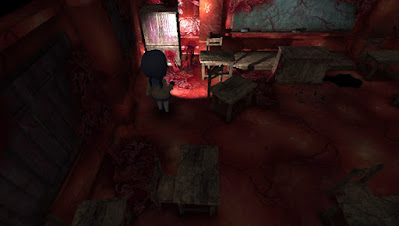
The story is told in visual novel format, and this is actually the bulk of the game. These cutscenes can go on for some time and they like to interrupt the gameplay, which can feel abrupt as if the game is wrestling control away from you (which it is). The cutscenes can come at the worst possible times, and the ones after a big event where you just want to either save or know that something is currently chasing you, but you can’t get back into it as you need to sit through a lot of story can be frustrating. Outside of the story cutscenes, you’ll be left controlling the character as they explore Heavenly Host, which takes on the form of a school that’s falling apart, filled with blood splatters and other traps. The character defaults to walking at a slow pace but can sprint for a short period of time.


Heavenly Host is permanently in darkness, you can still see but it will make the traps harder to spot. As a result, each character has a sort of light, whether this be a proper flashlight or their phone, to help illuminate what’s in front of them. This will allow them to avoid traps such as glass on the floor or tripwires which damages the character, and causes a game over if their HP goes down to zero. The music is slow and eerie, it really helps build up the tension in the atmosphere.


As you go on exploring, there are also other shadows / spirits that pop into being, chasing your character. Whenever this happens, you can either defeat it by having a certain item in your inventory or run away to hide. They can be annoying, especially when you run out of the items and are forced to desperately find a way out. Coupled with the short sprint time (that you have no idea how much is left) and if you exhaust that, you’re stuck in one place, perfect for the spirits to kill you, it can be one of the worst parts of the game.


Exploring is the bulk of the gameplay and it can be confusing at first since it doesn’t have an in-game map, but the school isn’t that big in the end and you’ll be constantly going through the same areas. You’ll start to recognise where you are even without a map. However, since you’re treading through the exact same areas in each chapter, and with no helpful objective markers, you’ll easily get lost or confused in where to go in order to progress the story.


While this may not be the scariest game ever, it can be creepy and get under your skin. It sometimes relies on jump scares but due to the chibi art style, they’re not too bad. It’s more so the survival horror aspect where you can die during story events, resulting in a bad ending. At this point, you’re constantly on edge thinking something will happen and that’s what’s you’ll be stressing about. As you get used to how the game mechanics work, and become more familiar with the school’s layout, some of the creepiness will start to fade.


A negative of the game are the loading screens. Even booting up the game takes a while. Once you’re in the chapter, then every time you enter and exit a room there will be a loading screen. Pulling out the menu will trigger a loading screen, selecting something in the menu is another loading screen. It feels a bit overkill and can become quite an annoyance. It reaches a peak at one of the later chapters where there are instant kill traps, so you’ll be dying and reloading the save, taking ages in the process.


The story takes around ten to fifteen hours to finish, depending on how much you get lost. Obviously, if you follow a walkthrough, you’ll finish it within 10 hours, but this also depends on your reading speed. There are also various bad endings to obtain, and there are extra chapters that you can read afterwards. These are side stories that expand on the background of several characters, although they vary in quality. The extra chapters ranges from a few seconds to twenty minutes in length, so can feel inconsistent but it’s extra content.


Overall, Corpse Party: Blood Drive, for all its flaws, is surprisingly enjoyable. If you are a huge fan of survival horror, then this might not be scary enough for you. This game is also mostly a visual novel, so there is a lot of reading. However, this allows the story to be extremely intriguing, even if you have not played previous games in the series before. It keeps you interested in the lore of the game, and how everything is going to pan out. There are definitely some annoyances such as the cheap deaths and lack of direction so it’s too easy to get lost and not know where to go next. In the end, this is a worthwhile and fun game to play.

---------------------------------------------------

For other game reviews, have a look at this page.
Blogger Widget