Wednesday, November 16, 2022

Atelier Sophie: The Alchemist of the Mysterious Book (PS4)


Atelier Sophie: The Alchemist of the Mysterious Book is the first game in the Mysterious trilogy. As a result, it features a new protagonist in a new part of the world, with new supporting characters. The story is standalone so a newcomer to the series can jump in with ease. It’s not your typical JRPG though as it has a heavy focus on alchemy (known as crafting in other games), but not as restrictive on this point as previous games.


The game’s new protagonist is Sophie. As per usual with a lot of Atelier protagonists, she is not very good as an alchemist but will improve over the course of the game. Sophie had inherited the atelier and discovers an old book left to her by her grandmother. The book then comes to life, being able to float and talk, going by the name Plachta. Upon reviving as a book, Plachta had lost her memories and the main aim of this game is to recover those.


Story progress is tied to recovering Plachta’s memories, which isn’t too difficult. This involves doing the usual things such as exploring, battling, fulfilling requests and alchemizing. Unfortunately, new items to alchemy are locked behind story progression and specific actions you need to take. You don’t just buy a recipe book to learn a bunch of new items anymore. A lot of the content is tied to the side characters, who are quickly introduced in the first few hours. Each side character has their own chain of events, again unlocked through the normal thing you’ll do in a game.


The game loses the time limit mechanic though. Now you can take as long as you want without the game forcing you to progress or causing a game over. This means that there is no more stressing of missing something crucial or planning out your days to maximise the things you can achieve. It’s a natural evolution of the series since the previous game, Atelier Shallie, was extremely lenient with its time limit already. There are some side character events that you can still miss but if you pay attention to the cutscenes, you should be fine.


However, there’s still the calendar system though. The game runs on a five-day week with a thirty-day month, and every action takes time, this means gathering to traveling to alchemizing will cause time to move forward. Day will turn into night and eventually into tomorrow. This is not a huge deal as the day night cycle affects strength of monsters, some different items that you can gather, where side characters will be in town, and specific events on weekdays or weekends.


A big portion of the game is exploration where you go out to the fields in order to gather ingredients required for alchemizing various items. The alchemy system will be familiar to anyone who has played an Atelier game, although it can be overwhelming for newcomers with its various sub-systems to look out for. The biggest change here is how the quality of items work. There is now a minigame of sorts where each ingredient has a different shape and you need to fit them onto a board. Placing them in different orders, or in different places, whether they overlap or not, will change the outcome. This is quite an annoying addition to be honest. The Dusk trilogy’s various different methods balanced intricacy and simplicity perfectly whereas this version is not as efficient.


Enemies roam the environment and getting into contact with one will transition to the battle screen. Battles are turn based but once again, it’s slightly different when compared to previous games. Here, your party and the enemy pick their actions and then the turn begins. This means that speed only dictates the order within that turn, a speedy party member can never have more turns than the enemy now. Each character can attack, use special moves or use items that you have alchemized. You can also change stances from offensive (higher attack power) or defensive (higher defence power).


Annoyingly, enemies respawn as soon as you’ve walked a little bit away. Gathering an item can refresh that area’s gathering points and enemy spawns. This means that you can never really clear out the area as it’ll just keep refreshing or what’ll happen is that you gather, then plan to gather at the point next to it only for the area to refresh and that point despawns. Of note are that character models are absolutely fantastic, while the environments are terrible. The character models are cel-shaded, contrasting the drab 3D graphics of their surroundings.


Like previous Atelier games, once you get into the swing of things, that’s when the gameplay loop becomes addictive. There’ll be plenty of story and side story events to unlock, items to alchemize, monsters to defeat, and equipment to upgrade. At one point, there are too many things to do and you need to pick one to do first. The story is low key as expected as it covers Sophie’s journey as an alchemist. It’s tied to Plachta’s predicament and the memories that she slowly regains, serving to unlock new areas and other stuff during the story, until the very finale.


The story is slow paced and flat overall, with nothing much really happening to be honest. Most of the good stuff are the supporting character events, where you get to understand them more rather than a big story spanning the game. Even the final boss kind of creeps up to you without fanfare. It takes around 25 hours to get to the credits but there are still a ton of stuff left to do. You wouldn’t have finished alchemize everything available yet (although unlocking new recipes are quite annoying by this point) and the game allows you infinite time to finish seeing all the events you may have missed.


The post-game involves several bonus bosses, however, there is free DLC which adds a new area and several more bosses.  If you thought the bonus bosses from before were tough, these ones are crazy.  To help offset it, the ingredients you can gather here have crazy good traits, so that you can alchemize some amazing equipment.  It’s still quite a high difficultly curve from the beginning though, so it stretches out that content for hours as you’ll need to grind and slowly build your strength up.  Still, it adds new story content that helps bridge the gap (but not completely) about Sophie and her decisions that will lead to her appearance in the next game.


Overall, Atelier Sophie: The Alchemist of the Mysterious Book is another solid entry into the Atelier line. That being said, the story and gameplay loop is noticeably weaker than previous entries, just purely because that single motivation for Sophie throughout the game, being Plachta, just isn’t quite enough to carry through twenty hours. Nevertheless, the nice graphics, sweet music (including the traditionally epic final boss theme), and chilled gameplay still makes this a worthwhile Atelier game to play.

---------------------------------------------

For other game reviews, have a look at this page and this page.

Sunday, November 13, 2022

Toy Review: Transformers Generations Studio Series Sideways (Deluxe)


Review: 
#740
Name:  Sideways
Brand:  Transformers
Allegiance:  Decepticon
Line:  Generations - Studio Series
Year of Release:  2022
Size Class:  Deluxe (Wave 17)
Mold Status:  new

VEHICLE MODE:


Sideways transforms into a generic sports car bearing a resemblance to the Audi R8 from the movie, Hasbro couldn't (or didn't) get the licensing for him.


This is a really nice car, thanks to the liberal amount of metallic silver paint.


However, Sideways is a bit small in this mode, above is a comparison with TLK Deluxe Bumblebee.


The robot weapon can loosely peg onto the back, but looks quite awkward there.  Still better than nothing, since the bottom of vehicle mode is packed and there's no space left.


While the car looks quite good from the front, you can see that the back end just kind of ends abruptly, making the car feel a bit too short.  There are also heaps of panel lines breaking up the surface, making the vehicle look messy.


Nevertheless, this is a nice looking vehicle.

TRANSFORMATION:

Not too complicated or simple, the sides, including both front and rear wheels, form the robot arms.  The way the front wheels fold into the forearm, with the bigger claw hands is quite clever.  The front folds to form the chest, while the rear and roof compacts into a backpack.  The legs are just from inside the car, and so is quite skinny as a result.

ROBOT MODE:


The robot mode looks great, and some of the silver carries across, but is mostly dark unpainted plastic that isn't bad at all.


Most of the mass is in the upper body, including the compressed car panels that acts as a backpack.  It sits flush against the body though so isn't in the way at all.


The head sculpt is a bit messy, not helped by it completely being painted silver, blending the details together.


Unfortunately, Sideways is small, very short and small.  Above is a comparison against Siege Deluxe Sideswipe.


As part of the Studio Series line, he comes with a cardboard stand, depicting his one and only scene from ROTF.


Articulation is fine, he has joints for his head, shoulders, elbows, hands, waist, hips, knees and ankles.


He comes with a gun, and it's a fairly big one at that.


The reason is that the gun covers his hand, so it appears integrated.  It's a neat idea, although since his arms are already quite long, this makes it even longer.


Unfortunately, due to the design of Sideways and the inconsistent quality control, you'll mostly like have a figure with weak ankle balljoints, so that he easily keels over.


It's not fun when he loses his balance and that is his greatest flaw, otherwise, this is another strong figure in the Studio Series line.

OVERALL:

Sideways is a nice figure.  It's a shame that his vehicle mode couldn't be licensed but the designer has done a decent job at making a cool looking car that resembles the actual vehicle.  The robot mode is also good, but the poor quality control strikes again meaning it's luck of the draw on whether you can get a figure that easily stands on its own, or one that constantly face plants itself.

---------------------------------------------------------

For other Transformers reviews, have a look at this page and this page.

(As an Amazon Associate I earn from qualifying purchases)

Friday, November 11, 2022

Kevin Can F**k Himself - Season 1 (2021)


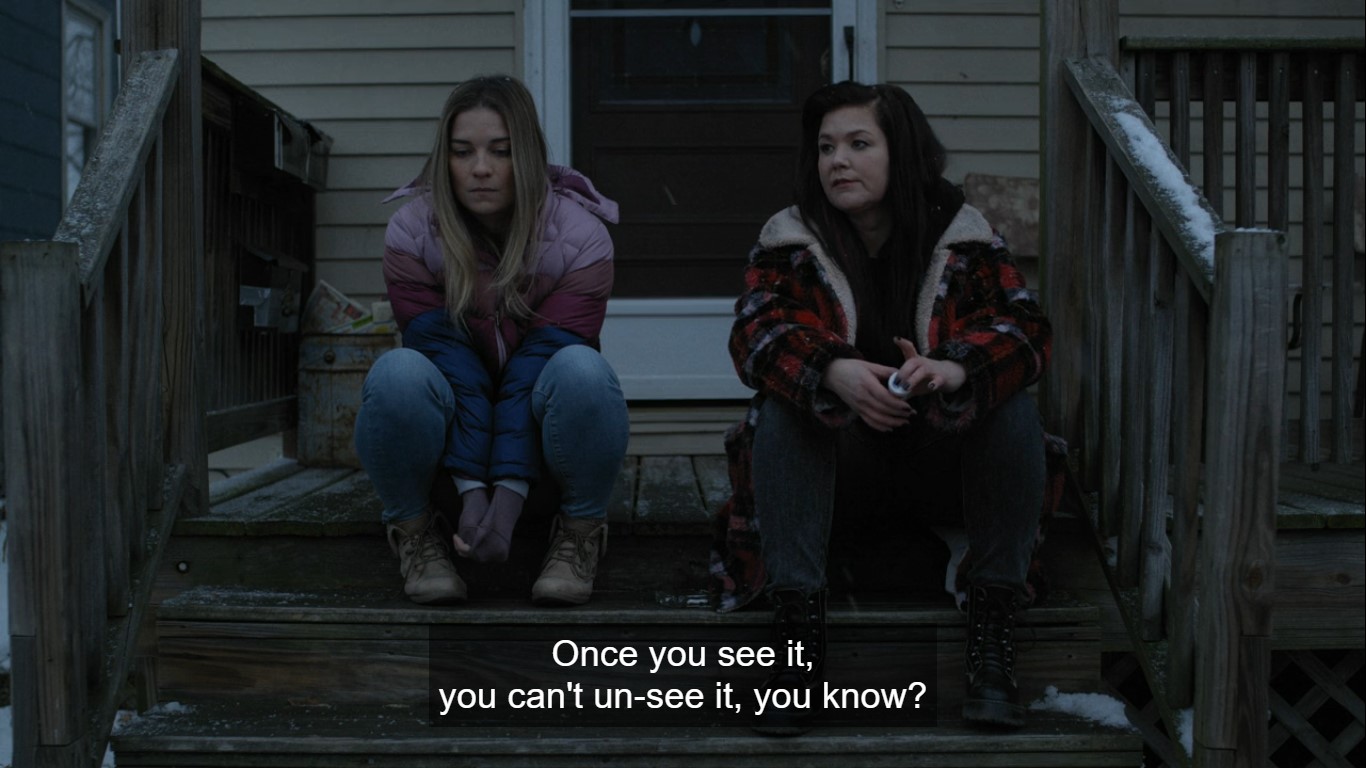
Kevin Can F**k Himself is an eight episode dark comedy. It’s a unique blend of a parody type depiction of classic sitcoms and the darker more serious showing of dramas. It follows what we initially assume to be a typical husband and wife, Kevin and Allison. Both are 35 years old and Kevin is shown to be a man-child who hasn’t grown up, while Allison is showing signs that she’s sick of Kevin’s childish and selfish behavior.


The show initially starts off in a classic sitcom style, with the bright lights, multiple-camera setup and canned laughter. Kevin’s selfishness is played for laughs and Allison, despite her grumblings, will just have to put up with it. Then the style shifts to a single-camera setup and while it’s the same house with the same furniture, it’s a much darker and more realistic shade of color and all that frustration that built up inside Allison is shown. It’s extremely jarring at first but intriguing at the same time. You never really considered those ridiculous scenarios in sitcoms are actually frustrating and infuriating behavior to the normal person.


Kevin, his brother and his dad are pretty much the only characters to only show up in the sitcom style. This means that they’re always bro happy, always reckless, and always stupid. It deliberately paints them as an oblivious couple of idiots. It contrasts with their sister, who is a lot more than meets the eye. So while Kevin may be fun to his siblings and friends, he is a terrible husband. He doesn’t do anything, is selfish, only plays around, and doesn’t treat Allison with any respect. It makes you wonder why Allison stayed with him for so long.


As a result, you’ll soon see Allison’s point of view. Kevin may not appear it at first, but he’s actually extremely controlling of Allison. Whether it is deliberate or not, his actions restrict Allison to only things that he would like her to do. He ignores her whenever she says something that isn’t to his like, and always forces his way. It’s such at odds with the tone of the atmosphere at times. This feels like a type of domestic violence, and yet the happy sitcom theme suggests otherwise.


A common theme is that every time Allison has something positive happen in her life, it quickly gets quashed. This is cruel and you sympathise with her predicament. There are certain things that are totally unfair for her but then some of the characters are correct when they ask her why doesn’t she just leave. Apart from having no show to watch, Allison doesn’t have a proper response for that, so she’s confused herself.


Allison crosses the line midway through the season. The show can get into a dark place very quickly, more so when you realise that Allison wasn’t joking this whole time. The whole season has Allison slowly figuring out a way to get out of the situation she’s in. She’s decided the way is to get rid of Kevin (rather than getting away herself). Unfortunately, the pacing in this season wide arc can be slow, as there is little progress in each episode.


As a result of her decision to get rid of Kevin, she ends up becoming an unlikable character at times. This is a shame as it ends up making every character in the show unlikeable. A lot of problematic situations she finds herself in are caused by herself, so it’s hard to sympathise at times. We get that she’s frustrated but some of her actions can seem extreme and we her very very close to breaking point, if not already. In fact, from the very beginning, Allison’s been depicted to be having a sort of mental breakdown.


The final two episodes of the season had a lot of things going on. It plays into the expectation that there might be a resolution, and you look forward to that. However, since there’s a second season (announced a few weeks after this season finished), you know that won’t be the case. It sucks that the season ends on a massive cliffhanger. Allison find herself in deep trouble and we don’t get to immediately see the serious consequences of that. She’s gone too far in now to back out, and despite everything that she’s done, you still can’t help but lean more towards her side as Kevin is just so insufferable.


Overall, Kevin Can F**k Himself is a really unique take, mixing the light comedy sitcom with dark serious drama. There’s quite a bit of mood whiplash in every episode when it swaps between those two distinct elements, but it manages to make it work. The story is intriguing, even if slow paced for most of the season. There does seem to be a heavy and serious message through its portrayal of Allison’s relationship and how constricted she feels. It’s worth a shot as there isn’t another show like this.

----------------------------------------------------

For other TV reviews, have a look at this page and this page.

Wednesday, November 9, 2022

Final Fantasy IV: The Complete Collection (PSP)


Final Fantasy IV: Complete Collection contains Final Fantasy IV, Final Fantasy IV: Interlude, and Final Fantasy IV: The After Years in one package. This version features updated graphics compared to the original release of the game (although ironically, despite being the more powerful system, it doesn’t get the 3D remake version that the DS release had).

Final Fantasy IV


Final Fantasy IV is the fourth game in the Final Fantasy series, and like the rest, it’s story is standalone. The original was released for the SNES, while the updated graphics allows this game to be presented in widescreen, and it looks really good, even on the Vita when you have bilinear filtering on. The widescreen presentation allows you to see more of your surroundings, although it does make the distance between your characters and opponents during battle quite wide, leaving quite a bit of empty space. Otherwise, this is a standard JRPG for its time with a turn based battle system. It uses the Active Time Battle system where it is still turn based, but there is a bar that fills showing off the speed of your characters and when they can attack next. The unique aspect (for its time) is that even when it’s your turn and going through the menu to determine your action, enemies can still attack you. There is a basic position battle where you can determine the characters in the front and back rows. The front can deal full powered attacks and accuracy with the trade-off being that they get hit harder from enemies.

Unlike Final Fantasy III, there is no job system here. The characters in your party have predetermined jobs, so you’ll get a paladin, or a white mage, a black mage, or a summoner etc. So while you lose the versatility of using your favorite characters, it gives those characters a sense of identity and uniqueness instead. During your turn, you’re able to attack with the weapon the character has, use items or run away. Every character, depending on their job, has additional abilities like magic or special unique abilities that only they have. Your party is constantly changing, which can be annoying when you like a particular character and am forced to swap to a new one to slowly build them up, time and time again. The game is 2D with a faux 3D viewpoint at times. It has random encounters, which can be annoying. The random encounter rate goes up and down, and it is actually had to predict. Sometimes in the dungeon you’ll get an encounter every few steps, but then you can traverse a whole level without encountering one. While you can dash, at least anecdotally, it feels like the random encounter rate is higher negating the faster walking speed. The other annoying aspect is that there is a high chance of having encounters where you’re at a disadvantage, with the enemy being able to attack first.

The story is of course one of the stronger elements of the game, along with the awesome soundtrack. The plot follows Cecil, a dark knight of Baron who follows orders and is at a crossroads with his conscience. On the one hand, he is loyal, but on the other, the atrocities he is forced to commit weighs heavily on his mind. Once he decides to break free, he uncovers a bigger plot. He’ll travel across the world, meet a lot of new people who’ll join his party and save the world. It’s a straightforward story where Cecil will go to each of the crystals, always one step behind the villains until the end. There are several cool locales you get to visit as well optional hidden areas. The unique part about this game is that the story is more complex and deep compared to the previous games, which were basic (but had started to improve). We get characters that are fully fleshed out and while there is still room for improvement, we do get attached to those characters. It also feels slightly darker for the fact that it’s not as idealistic, and characters come and go from the party for reasons more than just wanting to sightsee. As a result, the story does have several genuinely unexpected moments that might cause you to do a double take.

That said, the beginning can tough in terms of the available party members you get. While Cecil is great as a physical fighter and allrounder, he’s primarily the only physical damage dealer you get. A lot of the other early party members focuses on magic, so that they have weak attack and defence stats, that can make battles longer than they need to be. Dungeons can also be confusing, and while some sections will gentle nudge and railroad you to the next area, others can be a confusing mess of paths. The game’s difficulty is not too bad on the whole, but there are certain sections, specifically towards the end, where it spikes up. You’ll encounter enemies who will counter whenever you attack, or groups of enemies who have high speed so you’re being bombarded by several attacks whittling down your party’s HP before you can even make a move. Some characters have low HP due to their class and are easily damaged down to critical levels due to how hard enemies can hit.

The difficulty ends up becoming very uneven towards the end. The final dungeon itself has several difficulty spikes requiring you to grind for a few levels to comfortably beat the game. Thankfully, the game has an Auto mode to blast through some encounters but you’ll need to be careful as it is limited and risky for higher levelled enemies. Yet despite all this, the game is strangely addicting even though the story isn’t too complex. It’s good enough to keep you moving forward. Leveling up, exploring and obtaining treasures from chests is a satisfying formula. You’re given a lot of freedom once you are able to fully explore the world map, but the game’s not great with telling you where you need to go next to progress with the story. If you know exactly where to go, the game takes around 20 to 30 hours to complete. Afterwards, it unlocks a bonus dungeon that’s harder and filled with great items for your characters. Overall, Final Fantasy IV is still an enjoyable game decades later. The graphics have aged well, as did the battle system. Sure it might be simple by current standards but the variety of your party helps keep each part of the game fresh and different. The characters are likeable and the story is engrossing enough to keep you going towards the end.

Final Fantasy IV: Interlude


Final Fantasy IV: Interlude a brand new game for this collection. It takes place one year after the end of Final Fantasy IV, and it set before The After Years. The title is very fitting since this is a short interlude, that kind of sets up the next game, but doesn’t show off a whole lot. We control Cecil again, and see all the party members after the events of the previous game. It reuses the same battle system and annoyingly, everyone is now between level 30 to 40, so you don’t have access to all the abilities you had. That doesn’t matter too much since it takes less than two hours to finish but you end up retreading through various dungeons, fighting a few bosses. Everything is reused with just new story events on top. It’s okay but it isn’t something to jump at buying the game for.

Final Fantasy IV: The After Years


Final Fantasy IV: The After Years is a direct sequel to Final Fantasy IV. It was originally released only in Japan for mobile phones, in episodic format no less. Due to its episodic nature, it’s structure that each main playable character from Final Fantasy IV has their own tale, where you start from a low level with no items and little money. The story itself takes place years after the ending of Final Fantasy IV and the Interlude chapter. It is separated into multiple scenarios called “tales”. Each tale follows a different character, so those that like to have a consistent growing party will be disappointed. There is a slight change to the battle system in this game. It’s still turn-based but the major new feature is the moon where it waxes and wanes. Each phase will affect the power of magic and physical attacks. For example, at full moon, physical attacks does half damage while black magic is doubled. This affects enemies as well as your own party members. The phase changes over time while on the field or manually changes when your party sleeps and recovers. Another addition are combination attacks between the characters, which are quite flashy.

The first thing you’ll realize when you start the game is how it reuses basically everything from the original. You’ll be going through the same dungeons and towns, some of them multiple times. It’s nostalgic if you played Final Fantasy IV on its release years ago, not so much when you’ve just completed it like you likely would have when playing this collection. The random encounter rate is also as high and random as it was in the original. You can traverse a whole floor of a dungeon without an encounter while at other times, you’ll have an encounter after one step. Each tales takes under two hours to complete, depending on how much you grind and how quickly you rush through the dungeons. Unfortunately, playing with a new party in each tale is a flaw as you need to re-level each time as well as stocking up on healing items. Your parties are unbalanced and you’re trapped within a really small area of the world. This is always a problem with games that takes this split viewpoint approach (like Dragon Quest IV). The first tale follows Ceodore, the son of Cecil and Rosa. He is a far cry from his parents who is insecure. This tale sets up the story of the game which focuses on the strange happenings on the moon that coincides with monsters invading Baron.

The second tale follows Rydia and supporting characters from the original become playable characters here. The story starts to become more intriguing, particular since Rydia is a stronger character overall. Although her character is nerfed so it makes battles more annoying. Yang’s tale follows a similar structure and at this point, it starts to become a chore. The enjoyment from new dungeons in addition to trekking through old ones is mitigated through the amount of backtracking required. Once you’ve reached the end of a dungeon and beaten the boss, what does the game need you to do next? Walk all the way back and this is just pure filler. Palom’s tale truly shows how annoying Palom can be. In the original game, he doesn’t get much screentime before he exits your party so his antics aren’t as grating. Here, they’re in full force and it can get to the point where you can’t stand the guy. He becomes better towards the end but it is yet another tale with similar plot points, dealing with the loss of a crystal.

Edge’s tale takes what was already one of the worst elements of this game and makes it even worse. His tale is further splits into five sections, each with a different main playable character. While this split into different viewpoints may be interesting at first, they all result in the same thing and structured in a similar way which eliminates the intrigue. Porom’s tale is as obnoxious as Palom’s… because Palom is in it and this game plays up his angsty attitude way too much. To make matters worse, you’re stuck with an all-mages party for most of the tale so that you’re too heavily reliant on magic, which makes grinding up levels suck. The only saving grace to this tale is how it is a different perspective to the events that happened in other tales so you can see other characters doing their thing.

Edward’s tale isn’t that much better and wow, this one takes the cake for backtracking. In addition to trekking through the same dungeons for the third time in this game alone, the tale includes scenario where you trek through multiple long dungeons, make it through to the end, only to be told to go back, grab an item and then come back again. Throughout all this are seemingly super high encounter rates, and it makes this a really unpleasant experience given that the story in this tale was so shallow and so similar to the others. Kain’s tale is probably the most interesting story-wise compared to the others, but the big reveal on appears at the end. Before that, you’re going to traverse the same dungeons, and swap viewpoints, so more of the same really, and that is such a shame that the pacing is so out of wack in this game. At least this if you’ve been playing the tales in the order that the game presents them in, this is the last one before the final tale where everyone joins up together.

The Lunarian’s tale is long, and if you thought up until this point the game was bloated with filler, you haven’t seen anything yet. The pacing was already bad but it makes it worse here with the constant backtracking of the same extremely long dungeons for only a piece or two of the story. It’s so bad that you can’t wait for the end but despair as there so much of the game that is left. The final tale is split into various sections where you spend the first part collecting the various playable characters together. Then you’re able to finally choose your own party from the many available. Unfortunately, even if you import the save data from the other tales, you will end up with uneven levels within your party. This results in a terrible difficulty coupled with a high encounter rate making the overall experience even worse than it already is. Then there’s the actual difficulty spike in the final dungeon where every enemy hits like they’re a boss, on average twice as fast as your characters, and gives pitiful experience. It is frankly just terrible design that’s disgusting and outdated even when the game was released. It’s as if your time wasn’t wasted enough already with all the filler, recycling and grinding already, you’ll have to do even more if you hope to traverse through the final dungeon.

The final tale is also horrendous in that you’re going through almost every single dungeon in the game yet again, as if the first, second, third, fourth, fifth or sixth time wasn’t enough. Seriously, at this point, you suspect the game’s sole aim is to see how far it can push a player to play through the same area again. The final dungeon itself is too long as well, making it seem that the game never seems to end. All this combines into an artificially padded out game that’s about eight times longer than it should be, where it outstayed its welcome 20 hours ago. Overall, Final Fantasy IV: The After Years is a bad game, it is one of the worst Final Fantasy games available. It’s got a bad story, a bad structure and a bad difficulty. Even being originally for mobile phones isn’t enough to explain some of the baffling design choices. Having you traverse the same dungeon six times? Making the final dungeon over forty floors long with the same design we’ve already seen? Making the difficulty insanely spike up and jacking up the encounter rate? These were all completely unnecessary but no, and for that, it is completely disrespectful to the player for wasting their time. This game sours the memory of the original Final Fantasy IV and should not have existed.

Overall

Overall, Final Fantasy IV: The Complete Collection is great value, having packaged both the original and the sequel. It’s just a shame that The After Years is a terrible sequel and a horrendous game. Buy the game to play Final Fantasy IV, and ignore Interlude and The After Years as both are trash that’s not even worth booting up.

----------------------------------------------

For other game reviews, have a look at this page and this page.

Sunday, November 6, 2022

Toy Review: Transformers Masterpiece MPM-13 Blackout


Review: 
#739
Name:  Blackout
Brand:  Transformers
Allegiance:  Decepticon
Line:  Masterpiece
Year of Release:  2022
Size Class:  Masterpiece
Mold Status:  new

HELICOPTER MODE:


Based upon his appearance in the first movie, Blackout transforms into a MH-53 Pave Low helicopter.


It's a licensed helicopter and looks absolutely fantastic, he is truly befitting of the Masterpiece moniker.


Perhaps the attention to detail is no better expressed than the underside, where the designer even bothered to have panels covering all the robot pieces, so it's smooth and uncluttered.


Blackout is also massive, he's much much bigger than a Leader sized figure.  He's around the size of a Commander but much more complex.  He is impressive to hold in your hands.


There are plenty of great detail here, from the subtle sculpting to the various text on the body, it's faithfully recreated here.


He comes with a pair of guns, which can plug underneath each side.


There are also three flip down landing gear, and they all roll.


A slight divergence, and that is Blackout comes with a mini Scorponok.


The main body of Scorponok unpainted die-cast metal, while everything else is painted with a nice metallic sheen, it's quite impressive.


Even though Scorponok is mini compared to Blackout, he's roughly the size of a Legion figure.


Scorponok can't transform (although he never had a robot mode anyway in the film), but he is well articulated, with some joints for his tail and arms.  It's still quite limited but much better than one would expect.


Scorponok is a fantastic little bonus figure, and something much more intricate and detailed than one would expect from an accessory.


The way that Scorponok interacts with Blackout in helicopter mode is that the back has a flip-down panel that Scorponok can peg to, and store inside.


Perhaps the other impressive feature is that the robot's rotor blade weapon, which is a separate piece, actually forms part of the main rotor.  It's amazingly clever and intuitive, and it's these little touches that befit the Masterpiece moniker.


The helicopter mode is perfect in pretty much everyway.  There are no flaws here, Blackout is truly a Masterpiece.

TRANSFORMATION:

Being such a big and expensive figure, as well as the focus on high accuracy, Blackout is extremely complex to transform, whether that it to robot mode, or from robot mode.  You'll probably need the instructions as there are a bunch of panels that fold away.  Despite its complexity, it's fun and there are no frustrating steps.  On a high level, the sides form the arms, while the bulk of the fuselage forms the legs.  Everything else collapses as a backpack.

ROBOT MODE:


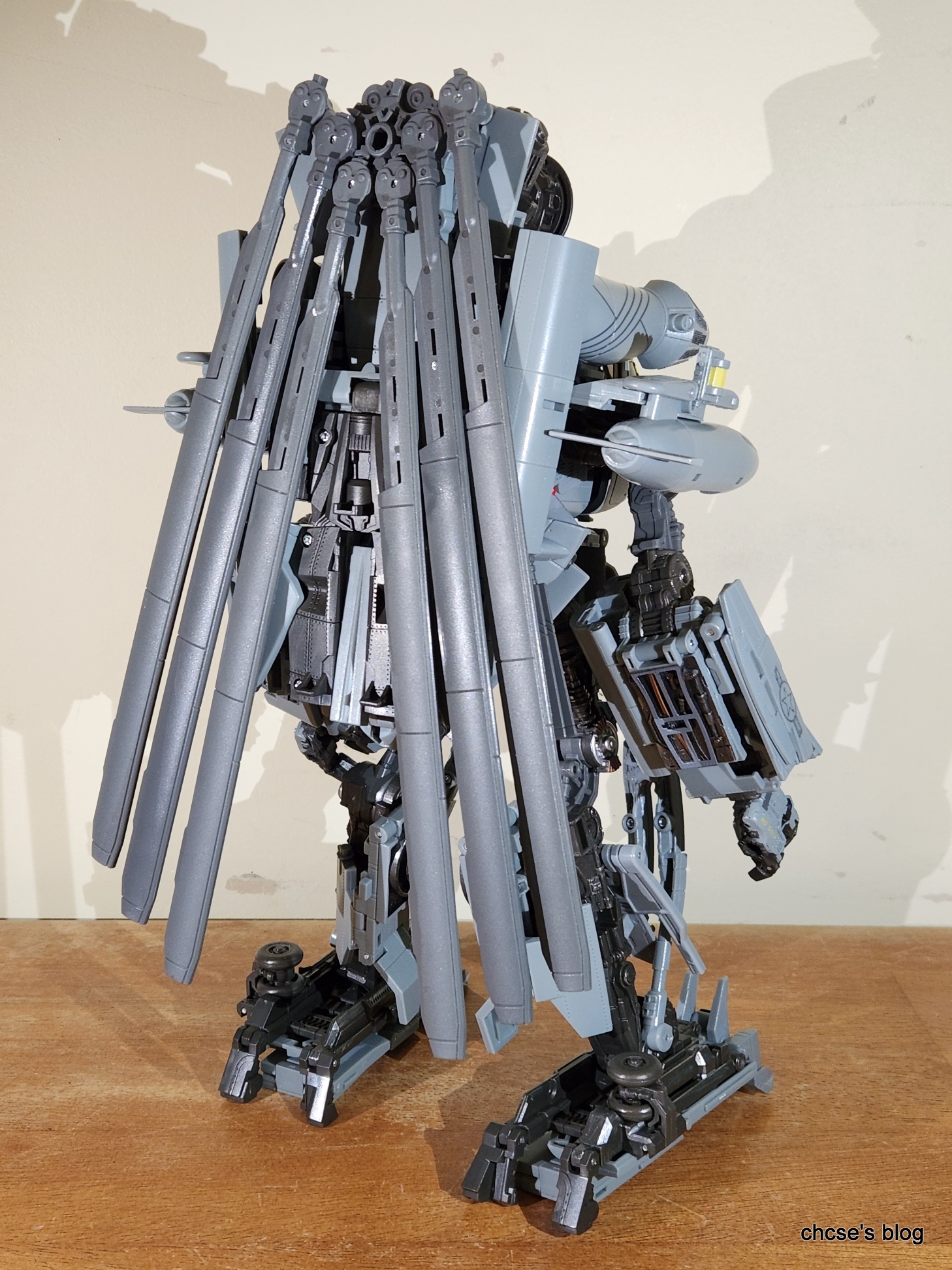
If you thought helicopter mode was impressive, then robot mode will impress you even more.  He is extremely detailed here and looks amazing, even more so than the Leader figure from a few years back.


Of course, his most iconic element is the cape formed from the robot blades, and looks awesome here.  It's a clever and neat use of something that was always destined to be kibble.


The head sculpt is amazing as you'd expect, although he lacks the opening mouth gimmick that most of the MPM line had.


He carries a fair bit as his backpack, but since they are all panels compressed together and most of them locks, it doesn't protrude out.


As one would expect, there is a fantastic amount of detail here.  All the sculpting is intricate, and Blackout is wonderfully painted.


His feet are painted die-cast, to help keep him more stable, given most of the mass is on the upper body.  Each of his fingers are individually articulated.


In terms of size, he is a behemoth here, towering over Leader classed figures.  He stands head to head pretty much with the other big MPM figures Starscream and Megatron.


Scorponok appears tiny next to Blackout, which is in scale with how he was portrayed in the film.  There is also a spot for him to peg in on the back.


Blackout comes with a bunch of weapons, the rotor blade weapon, two guns, and two fire effects.


The first gimmick here is that he has a flip out chest gun, and the fire effect can attach to the end of it, although it makes it a bit too cartoony.


The guns can peg onto either of his forearms.


Again, the fire effects can attach to the end of those guns.


Whereas with the robot blade weapon, it pegs onto the underside of his hand, which isn't entirely accurate to the film, which is somewhat bizarre considering how accurate everything else it.


It's still workable and still looks wickedly awesome.


As one would expect, he has plenty of articulation.  He has joints for his head, shoulders, arms, elbows, wrists, fingers, waist, hips, knees and ankles.


However, given most of the mass is in the upper body, he can be a bit unwieldy to pose, all that kibble doesn't help either, but his sheer presence helps to overcome that.


The robot mode is pretty much near perfection.  There are some slight issues given how big and heavy he is, but that's something that couldn't really be avoided.

OVERALL:


Blackout is one of the best Masterpiece toys in the line.  He is not cheap, but he is worth it.  He's huge, he has a complex transformation, and he is well painted.  Everything is executed very nicely and is one of the best toys in any line, period.

--------------------------------------------------------------

For other Transformers reviews, have a look at this page and this page.

(As an Amazon Associate I earn from qualifying purchases)
Blogger Widget