Showing posts with label ps vita. Show all posts

Wednesday, March 25, 2026

Hideboh Tap Dance Hero (Vita)


Hidenboh Tap Dance Hero is a rhythm game for the Vita and was only released in Japan. There was no English translation, so everything is in Japanese, but given it is a rhythm game, it isn’t too hard to figure out the menus. There is a story mode, and you can use something like Google Lens to get an idea of what it is about, since it’s told in a visual novel format.


It has a shortish story mode where Stan is hoping to become great at tap dancing. A fictional version of Hideboh (given that Hideboh is a real person that the game was based upon) appears, and along with Airi and a robot, they form a trio group, learning tap dancing and facing off against others, ultimately performing in a competition. It is a simple story and one that’s frankly not that interesting, but it introduces the game to the player and gives it some sense of purpose.


The rhythm game aspect is decent, considering all the inputs are regulated to the touch screen. As far as button prompts go, it is quite simple, with only two styles, tapping the screen, and sliding your finger against the screen. Weirdly enough, the prompt for tapping has three different styles, but then again, there’s only so much variety it can give you using touch screen only.


Given that it is exclusively using the touch screen, it is somewhat lenient in its timing and the rating it gives you for successfully completing the prompt. This is good because the lack of tactility doesn’t give you much to go off if you’ve succeeded or not. Furthermore, your fingers are constantly covering up the screen so in faster songs, it will obscure the next prompt.


The story mode only takes about five or six hours to complete. A lot of those hours are visual novel scenes. The rest are short sections, they’re short because due to aligning it with the story, it represents Hideboh teaching sections of the songs to the characters. Thus, you’re learning a song that’s split into three parts, before you then play the whole song together. This makes it easy to lose interest.


The story ends up being very mediocre in the end as there is a lot of fluff to drag it out, However, the difficulty does get harder towards the final few chapters, and this is where the flaw of the game comes in. By being purely touchscreen, it is too easy to obscure notes and can be hard to tell where the new ones start, especially on the faster beat maps. The result is that there are times when you’re not able to see when a drag prompt ends and the next one starts. Compounding this issue is the lack of tactile feedback from taps.


Once you’ve finished the story mode, the only content left is Arcade mode. Story mode only touches upon roughly half of the songs on offer, and Arcade mode is where you get to play the rest. There is a total of 30 songs across three difficulties, which is a decent amount of selection. Only the songs from the story mode will have the characters dancing in the background, whereas the other half have generic backgrounds. While the same issues persist, such as needing to memorize the beat maps as they are nearly impossible to reach fresh without having already played it, at its best, the beat maps do correspond in time with the music and is a lot of fun.


Overall, Hideboh Tap Dance Hero has an interesting concept and is initially fun. However, it’s a bit too generic in its story and its gameplay. Basically, the only actions are tapping and swiping. Even though there are something like five different types of button prompts, four of them are still just tapping at the right moment. You can’t help but feel that this game was developed in the height of the touchscreen craze and the gameplay suffers from it, lending to some higher difficulty if you’re into testing your skills.

-----------------------------------------------

For other game reviews, have a look at this page and this page.

(As an Amazon Associate I earn from qualifying purchases)

Wednesday, November 5, 2025

Taiko no Tatsujin: V Version


Taiko no Tatsujin: V Version is the Vita version of the long-running Taiko no Tatsujin games, a series of rhythm games where you hit the buttons in time with the music based on the prompts. There are two types of notes, the face buttons and direction buttons are used for the red prompts, and the shoulder buttons are used for the blue prompts. There are some different button combinations such as pressing two buttons at the same time or rapidly hitting them, but it is a simple control scheme. It gives you flexibility since you can hit any of the face buttons for the red prompt and any of the shoulder buttons for the blue prompt. There are no other gimmicks such as forced usage of the touch screen or touch pad.

As you’d expect, the game features a Free Play Mode, where you go in, select the song, select the difficulty, and away you go. You can hit the notes and get graded with a Miss, OK, or Great. These will then combine into a score at the end. Of course, it is preferred to not miss any notes and get a full combo. You can also fail songs which will end it prematurely. There are four levels you can pick from, Easy, Normal, Hard and Oni. Easy and Normal are very manageable for most players, while Hard starts to get tough, and Oni requires a lot of practice.  Rhythm games live and die by their song lists, and V Version has over 80 songs from a variety of genres. This is probably one of the game’s strongest assets. The song list is grouped into categories such as J-pop, anime, Vocaloid, game, classic and Namco Originals etc. One thing to note is that the anime music is usually the short versions, rather than the full songs, probably due to licensing restrictions. While the game is only in Japanese (or Chinese subtitles if you have the Asian version), the game is easily picked up even if you don’t know the language given the limited amount of text.

With the free play mode, that’ll be enough content for most rhythm games, but V Version goes one extra step by including a story mode called Donder Quest. The story mode is required to unlock all the available songs for free play. The story itself is simple as you’d expect, having the two characters, Don and Katsu, finding a book that ends up transporting them into an alternate world. From there, they help as adventurers to defeat the monsters. Although they must work from the lowest level up to the top to gain the strength and rank required to fight the villain.  The story mode is structured as you would expect but there are still a few slight differences. Of note is that the minimum difficulty level is Normal. You will select “Quests” from the menu, which his basically playing through a song to defeat enemies. Successfully hitting the prompts will allow characters to attack, while if you’re only getting Good, or missing them entirely, the enemy will attack. There are prompts inserted into the song that you are not supposed to hit, otherwise you will be attacked. There are also effects where it will obscure the prompts, which are explained by the enemies’ special effects. These don’t occur in the free play mode, and so it allows the story mode to feel different and adds another layer of difficulty.

In the story mode, there are some RPG elements, such as ranks, which are used to progress the story, and equipment which will augment your stats. There are ten ranks in the story, and beating quests will unlock more equipment. Although if you play the songs good enough, you can get by. Equipment still plays a role but not a crucial one where you need to min max the stats. The other thing is that in the quests, you don’t necessarily need to play through the whole track either. It will end when you’ve reached the objective, of which there is a variety such as hitting a certain number of notes, beating the enemy, getting the enemy’s health down to 50%, or achieving a certain score.  As you get further into the story, the bosses in each rank do get harder. They’re harder in the sense that their effects are extremely annoying. It basically hides the prompts or moves them in unorthodox manners, so it crosses the line to being overly gimmicky. At least if you keep losing to the boss, then the difficulty is dropped down by lowering their starting health. After the story, which takes a decent number of hours (around 5 hours if you play all the songs), there is a post-game section with harder levels and further unlocks.

The game has a great song selection and variety, and most of the song maps are decent. There are modifiers such as speeding up the notes or inversing the blue and red prompts, that adds more spice. As you complete songs, you will get customization options that can change the appearance of Don.  Overall, Taiko no Tatsujin: V Version is a fantastic addition to the series. It’s a big meaty rhythm game that packs way more effort than you’d expect. Not only is there a huge number of songs to play, but there is even a story mode, with its own unique gameplay mechanics. The graphics give the game a fun light-hearted atmosphere, and the sheer amount of content will give you plenty of hours of entertainment.

-----------------------------------------------

For other game reviews, have a look at this page and this page.

(As an Amazon Associate I earn from qualifying purchases)

Wednesday, August 13, 2025

Sonic & All-Stars Racing Transformed (Vita)


The second in the Sonic racing series and was ported to the Vita with pretty much all content intact. It is a kart racer, but Sonic theme. The controls are easy to pick up, although there are small tutorials when you first start playing. The right shoulder button accelerates, while the left shoulder button drifts. Then the X button uses the current power up that you have. The game plays similarly to Mario Kart and other kart racers. You race along a race with other racers, picking up powerups from containers along the way. Then you use this to wreck havoc on the other racers to get ahead. Drifting around corners is a must, as this is linked to a speed boost that’s dependent on how long you drifted for.


The unique gimmick here is the “Transformed” theme, where both the kart and the tracks will change. The karts transforming from vehicle to boat to plane is interesting, but not too mind-blowing (although the plane suddenly gains another degree of motion). The tracks changing after each lap are much more impressive, especially when some of the changes are substantial, and make it feel completely different.


There is a decent single player mode with initially only three difficulties, but a fourth one will eventually unlock. It forgoes any attempts at a story and instead provides you with events that have a variety of objectives. This is a good decision, and it gives the game a bite-sized play experience that ends up becoming addictive. You will easily get into the mindset of playing just one more stage to progress just that little bit further.


While there are only 20 or so tracks, the single player modes give it variety by having different objectives for each of those tracks. In this mode, the player plays each event to gain stars to unlock new characters and new stages. These differing objectives include racing, drifting events, attacking enemies, ring challenges, boosts and more. This variety keeps it from being too boring. While not all these objectives are stellar as something can be annoying, it doesn’t get to become too repetitive for this mode at least.


The events are spread across six “worlds” and after completing the first five, you will see the credits. The sixth world is a bonus, and it is one where you will need to go back to previous events to play the hardest modes to get enough stars to unlock everything. The gating of events by the number of stars you gain isn’t a big problem for the first five worlds, and it takes around three to five hours to complete it the first time around.


To be fair, the medium difficulty is a good difficulty for people who are not amazing at kart racing. It’s not too hard and not too easy. You must put in some effort to try and secure third place or higher to complete that event. It can get annoying but persist and you will proceed even though it can be luck based. Although that’s nothing new for this genre.


There are five stats to each character, such as top speed, acceleration and handling. Each character trades off one area for strength in another, and you unlock more characters as you play. There is a slight RPG element where every time you complete a race or event with a character; they will gain XP. Level up and it unlocks a slightly different stat distribution profile, like Sonic is focused on speed, but he can unlock a profile that gives up some speed to boost his handling. It’s a neat way to be able to keep using your favorite character but in a way that suits your playstyle, without making all the characters feel the same.


The graphics are good for a Vita game, especially one that was released this early on in its life. Of course, it cannot compare to the console versions but it’s good enough. The design of the tracks is generally good, but some can be annoying with its sharp turns and gaps on the track. While novel at first, the transformed aspect of the vehicles can be annoying as the boat and plane controls are naturally more floaty and harder to control. Also, it can feel like they slow down the race in certain sections.


The World Tour mode with all the events represents the bulk of the single player content. You can then play other modes such as Grand Prix, Time Trials and Single Race as supplements. You will need to play Grand Prix to unlock all the tracks, given that mode provides all the mirror tracks. Mirror tracks can feel so different even though it’s the same tracks you’ve been racing… just mirrored, so it can work contrary to your muscle memory.


Overall, Sonic & Sega All-Stars Racing Transformed is a surprisingly good kart racer. There is a sense of chaos and speed at its best, and it is extremely additive and fun to play. The difficulty is nicely balanced, since no one weapon feels totally unfair, and all of them can be avoided or blocked in some way. Yes, it can still be luck based but it feels less so than some other kart racers. The Vita version may not be the prettiest or the most polished, given that there are still bugs after all the patches, but it is a great portable version.

-----------------------------------------------

For other game reviews, have a look at this page and this page.

(As an Amazon Associate I earn from qualifying purchases)

Wednesday, July 23, 2025

Mary Skelter: Nightmares (Vita)


Mary Skelter: Nightmares is a dungeon crawler JRPG for the PlayStation Vita. In it, you take control of Jack, who is in a world that has been taken over by living dungeons. Jack and his friend Alice managed to escape from jail. During the process, Alice discovers that she is a Blood Maiden, someone with the power to kill the monsters of the dungeon, known as Marchens. Jack isn’t completely useless either, as he has abilities unique only to him that can assist other Blood Maidens.


As Jack and Alice find themselves in the city, they are joined by other Blood Maidens. They eventually explore the dungeons and clear them. In the first few chapters, there is a lot of worldbuilding where we learn about the powers of the Blood Maidens. While they can kill Marchens, their blood will eventually send them crazy, into Blood Skelter mode. This is where Jack comes in, as he can somehow prevent the Blood Maidens from losing themselves this way.


The gameplay is a typical dungeon crawler, taking place in first person as you explore the dungeons. Given it is a Vita game, the graphics are not the greatest, but still decent. There are random encounters, as well as dungeon traps, which can be quite annoying. Given the first-person view where you are limited to four directions, it can be difficult to see more of the surroundings than what is right in front of you. It doesn’t help that the map only maps the current square that you’re on, rather than what you can see.


As you explore, there are things you can find such as treasure chests and levers that will open doors. A gimmick here are that Nightmares will appear. Upon which the map disappears, and you need to run away from them. If the Nightmares catch up, you can still try and run away or battle them, but that will only stall them as you cannot kill them unless certain requirements are met. It’s not as tense and urgent as it sounds, but it is also still somewhat annoying. They end up disrupting the flow of exploration, so it sounds like a good unique concept but ends up grating on your patience.


The battle system is a lot more normal though, given it is a turn-based system. You can have up to four characters, plus Jack, in your team. Jack only plays a support role, such as using items, guarding a character and some other special abilities. The Blood Maidens on the other hand are the offensive ones, able to attack and other special abilities. There is a simple weakness system, and constantly dealing damage will fill a gauge where the characters can go into Massacre mode, temporarily upping all their stats. The battle system at the end of the day isn’t innovative but it is serviceable.


The difficulty at first seems manageable, and the game allows you to save anywhere, at most times. The caveat being that you need to remember to save because if you die, you will have to reload your save. This can be very annoying and frustrating when you play long sessions and are just exploring and exploring, then you accidentally find yourself in a bad spot and lose hours of progress. This is especially true when there are massive difficulty spikes with the bosses. You can easily be defeating the enemies within the dungeon only to be annihilated by the dungeon boss. Once again, this can feel unfair, even for a dungeon crawler.


Due to the first-person view and fog effects, you cannot see that far ahead of you, and stuff to the left and right. Sometimes you cannot even tell if there is an event or another icon until you’re upon it. There are some annoying gimmicks and features of the dungeons, such as when the Nightmares randomly appear, and you cannot open the menu and thus cannot heal outside of battle. You may be forced into a loss situation which can be very frustrating to lose hours of progress. Other times there may be levers or environmental objects that you need to interact with to weaken the boss, but the game does not explain this well.


The story, despite having a decent start and a good concept, ends up being quite boring. The story to gameplay ratio is not great as the game is heavily geared towards exploration. You will be enjoying the exploration but then the story cutscenes ruin your flow. On the flipside, you tend to explore for too long without progressing the story, this is a hard thing to balance, and the game doesn’t do it well. It takes all the way to the end for real progression, and there is supposedly a big revelation but it kind of comes out of nowhere. It’s supposed to be a twist, but it falls flat.


Despite the developer and the design of the characters, this game isn’t as ecchi as you would expect. There’s an optional minigame that plays on this aspect, but it is easily ignored, and everything else doesn’t suggest it much. Despite the predictable gameplay loop of exploring the dungeon, defeating the boss, and progressing to the next chapter, it is still fun to play. The story takes around 30 hours to complete depending on how much of each dungeon you explore. The dungeons can be huge and take hours each. It can be upwards of 40 to 50 hours if you take your time. There are two endings, a good ending and a bad ending, with the postgame content being a humungous dungeon, with a tiny, tiny bit of plot.


Overall, Mary Skelter: Nightmares is a decent dungeon crawler. It can be brutally difficult in the beginning but once you get more characters to put into your party, get access to more skills, and have a general idea of how the battle system works, you can easily wreck the normal enemies. Bosses are still tough and the unique aspect of bosses randomly appearing while you’re exploring with no way out can be annoying and pointless towards the end of the game. It’s still a fun enough game to play.

-----------------------------------------------

For other game reviews, have a look at this page and this page.

(As an Amazon Associate I earn from qualifying purchases)

Wednesday, August 7, 2024

Disgaea 3: Absence of Detention (Vita)


Disgaea 3: Absence of Detention is a SRPG with a focus on leveling and grinding. There is a story mode, which takes place in the Netherworld and follows Mao, the son of the Demon Overlord. For a petty reason, he wants to defeat his father and as such, he must take on the class of a Hero. It’s a contradiction given that demonic traits are the complete opposites of heroic traits, but the story is mostly made for laughs anyway. It has a lot of self-aware references, puns, and humor. While it can get too much at times, it generally works and is enjoyable.


Mao is technically a student at the Evil Academy but like a true demon honor student, he doesn’t attend class. He has a rival, Raspberyl, as well as the hero who accidentally stumbled upon this place, Almaz. Together, they are dragged by Mao along his quest to defeat his father. The story isn’t spectacular as it easily gets distracted, which is to be expected. The whole story is voice acted, which is impressive.


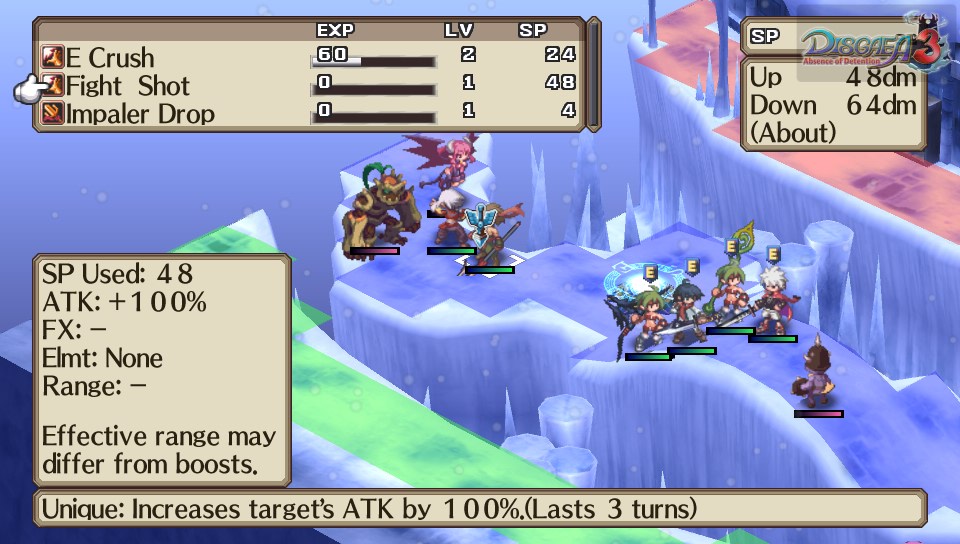
The main gameplay is the battles, where it takes place over grid-based maps set in an isometric view. The isometric view means it can be annoying to see properly at times. The overly sensitive back touchpad option to change the camera zoom makes it annoying as you will accidentally trigger it time and time again. The game has a ton of playable characters, although apart from a few story characters, the rest of your party are generic characters. You can even create and train monsters, so the game and its mechanics are overwhelming for new players.


The battle system throws in a few additional things that sets itself apart from other SRPGs. Characters came move, attack, and use spells, that is normal and to be expected. However, they can also lift blocks in the environment, or other characters, and then throw them. This can be clunky as it is all menu-based but can be extremely useful in travelling a little bit further than what a character normally would be able to move. The other thing is that when you select a character to attack, it puts them in a queue. The action in the queue only gets activated when you decide to. This is important as it allows you to position characters to gain the advantage of a team-based attack before you can then revert and move them somewhere else after the attack is done.


Levels and equipment play an important role in the game. With so many characters that you can use in the game, it can be hard to level up properly and evenly amongst all of them. Therefore, you are forced to replay previous levels to quickly grind up their levels. This isn’t as bad as it sounds and can even be a satisfying process. A lot of power gain will come from better equipment and this is where the game doesn’t do a great job at its tutorial since it doesn’t explain how all those systems interact with each other.


Each character has a bunch of skills that they can learn. Characters hitting enemies will give them mana points which is used to learn new skills. These can be passive and active skills. With so many game mechanics, it’s only natural that some of them are easily forgotten and feel tacked on, and this is one of them. However, the many mechanics do give the player flexibility in how they want to approach the game. The story levels are somewhat easy enough to progress, with a little bit of grinding of course.


The unfortunate thing with your party consisting of so many generic characters that you have created is that you don’t have story attachment to them. Yet because story characters join relatively far into the game, you’ve probably already got your preferred team and it will be a chore to keep every character up to date in terms of levels and equipment. The game has some ridiculous difficulty spikes even during the story. Enemies often like to one or two shot your characters, which combined with overwhelming numbers, can make some levels unfair. This artificial difficulty to force you to grind holds the game back at such an early stage. At least once you hit a certain point towards the end of the story, you can quickly grind up levels for your characters and easily crush all enemies from then on.


The game’s graphics are so so. Since it is in an isometric view, the characters are represented by sprites. The story is told via visual novel styled cutscenes. The attacks during battles can be flashy but you might want to turn them off so that you don’t waste too much time during battles as these are long animations. Even if you turn animations off, you will see the attack animation the first time you’ve ever used it, so you won’t be missing anything. The game does the annoying thing of forcing you to manually save as you cannot quit a level without reloading. It’s an archaic practice and does nothing to add difficulty. If you lose during a level, at least you don’t completely lose your progress.


The story is surprisingly not too bad. It isn’t amazing or stellar, but it is enough to keep you invested in it. The characters slowly creep up on you in terms of how likeable they are, as you understand them more and more from their actions. The dialogue has a good balance of stupidness and funniness so that it works and doesn’t detract from the plot either. It plays into tropes and subverts them at times. For example, you know a character is suspicious and will betray you at one point, but then the game also knows this and will give you a surprise on top.


The story takes around 25 to 30 hours to complete, although this really depends on how much you grind to get through it. As mentioned, once you hit a certain point, it is trivial to grind up a ton of levels that makes the rest of the story levels a piece of cake. However, the postgame assumes that you have grinded like this, plus more. There is a lot to do in the postgame, from the DLC stories to the expectation that you are to grind to level 9999 and defeat the super boss. That is literally hundreds of additional hours, if you like this type of content.


For the DLC, you don’t have to grind *too* much. However, its levels can be painful to play. It was already present in the story where there will be special layouts in stages with certain tiles having special effects. It basically slows you down and you’re forced to advance in a certain way. You will get levels where it is impossible for your characters to hit back or advance, leading to a frustrating, annoying, and horrendous experience. The DLC is comprised of five additional stories, and they all take place after the main game. It takes around another six to eight hours to complete if you have sufficiently leveled characters. They are a little bit of extra fun with the characters before the postgame grind has barely any story.


Overall, Disgaea 3: Absence of Detention is a fun SRPG, even with the grinding aspect. It can be annoying if you wanted to play this as a typical SRPG for the story as there are difficulty spikes in every chapter. However, if you can spend a little bit of time grinding, then it is very satisfying when you level up and get better gear, to the point of easily passing through the level. The postgame content is crazy for the fact that it assumes you have grinded and will continue to grind. However, there is a lot of content here and even if you don’t play the postgame, the normal story is fun and worthwhile enough.

-----------------------------------------------

For other game reviews, have a look at this page and this page.

(As an Amazon Associate I earn from qualifying purchases)

Wednesday, April 10, 2024

Ys VIII: Lacrimosa of Dana (Vita)


Ys VIII: Lacrimosa of Dana was originally for the Vita, but was later ported to the PS4, PS5 and Switch. First off, Falcom always had decent graphics for their games on the Vita, such as Trails of Cold Steel and Ys: Memories of Celceta, and the trend continues here. The game looks great, although it is similar in style to the previously mentioned games, so can feel a bit samey at times.


The game follows Adol, who is travelling on a boat. It gets attacked by a giant sea monster and the boat capsizes. Adol is washed ashore on a mysterious island, named the Isle of Seiren. It’s an infamous place, as it is somewhere that is extremely dangerous from which no one has ever returned from. While on the island, he meets up with the captain of the boat and they work together on surviving. The captain oversees the building of a base where the stranded passengers can stay safe, while Adol explores the island and saves any other passengers that were washed ashore.


Adol starts off alone with weak equipment but that will eventually change. He soon meets up with two more characters, Laxia, who is seemingly your generic tsundere character, and Sahad, a gruff and down to earth kind of guy. Combat was always the key highlight of the Ys series and Lacrimosa of Dana plays in a similar fashion. One button is used for combat and then you can map special moves via hotkeys. The character can dodge and block, and doing these in the right moment will give you bonuses and advantages over the enemy. Finally, the characters can dash and run.


You have three characters in your party at any one time and each one will aid in attacking the monsters. They tend to go off on their own at times to seek out the nearest monsters, which can be good or bad. You can swap the playable character at any time with a button press and each one plays in a different way. Defeated enemies will drop items which you usually use to upgrade equipment, cook, and synthesize. It’s one of those simple but addictive gameplay loops. The key aim is to explore the island, which is separated into small sections that have a loading screen between each one.


The goal of the game is to explore the whole island. Despite what it may look like at first glance, the game is quite linear. It blocks off sections of the island until you have saved enough people to open those paths up. Enemies roam the environment, and they are usually quite easy. From time to time, you might encounter slightly higher leveled enemies that are harder to beat. You’ll have to take advantage of their weaknesses to specific types of weapons in such a case. There are frequent bosses which generally trend towards being big and uniquely designed to impress the player.


Scattered around the world are landmarks, which act as the collectibles of the game. There are fetch quests, as well as combat quests where you need to fight waves of enemies to protect the settlement from being overwhelmed. The game has good quality of life features such as the ability to fast travel from the get-go. However, if you die in combat, you will have to reload from your last save which feels archaic. You could potentially lose quite a bit of progress in such a case. Thankfully, you can save anywhere and anytime but there is a distinct lack of autosaving.


Despite all the positives, the game has a very slow start. It unlocks things at a glacial pace and the story goes nowhere for a long time as it continues its attempt to set things up. The boringness remains for at least 15 hours. The first section revolves around exploring the island and finding castaways, so it can feel repetitive. It gets better as it then unravels the mystery of the island of Seiren but doesn’t quite recover from the slow beginning. However, the exploration and fast paced gameplay never gets old. The characters have depth to them, including all the NPCs who are all given personalities and backgrounds that you spend time on getting to know about. Their dialogue frequently gets updated after every major event.


Collecting item drops from enemies is a huge part of the game. Every enemy you defeat will drop at least one item. They are used to get all your items, including equipment, potions, and food. You will struggle to upgrade everything right after something unlocks but that is what keeps you wanting to get out and explore. There’s also a bit of inventory management happening early on. You must go into the menu to constantly swap items that you need to equip to climb up vines or to see in the dark. Thankfully, you will eventually unlock more slots, but it is still much more annoying than it has any right to be.


There are some annoyances with the game such as the overly slow panning of the camera during scenes and equally slow animations. If there was a way to speed them up, that would be great. combine this with the large amount of filler in the story and the game can feel bloated. The story does become better towards the end as it explains the way the world works with a huge revelation. The ending can feel weak and rushed, but it highlights the relationships built between the characters and when the credits roll, it feels a bit sad to say goodbye to the characters.


When you eventually unlock all the characters and build up a good repertoire of skills, the gameplay still doesn’t get boring. At its core, it is simple but it’s just so easy and addictive. The difficulty can trend towards being a grind at times, with some enemies having too much HP, doing too much damage, or moving too fast for you to hit consistently. Most of the side quests are hunt or fetch quests but they are dressed up with some dialogue to try and mask the repetitive nature of them. The game had a terrible translation upon release and got a patch, but there are still formatting errors here and there.


The game takes around 30 to 40 hours to complete, depending on how much you explore and the difficulty that you are playing on. As per usual for Falcom games, there are a lot of missables and you can load your cleared save into a New Game Plus while carrying over a lot of things to make the second playthrough easier and faster. Even if you don’t, you can continue to explore the island and find all the collectibles and items. This is a big game and very impressive for the Vita.


Overall, Ys VIII: Lacrimosa of Dana is a good game and the best Ys yet. The gameplay is fast paced and polished and there is a high emphasis on exploring. It is a lot of fun finding new areas, although enemies are a little bit on the bloated side in terms of health, so it can start to grate later. Similarly, the story is too bloated with a slow first half, and even when the plot picks up, it wastes a lot of time with slow animations and scene transitions. The story itself is much more in depth than you would expect, and while it doesn’t completely justify the first half, it is a good story by the end.

-----------------------------------------------

For other game reviews, have a look at this page and this page.
Blogger Widget