Showing posts with label psvr. Show all posts

Wednesday, December 14, 2022

Pirate Flight (PS4 / PSVR)


Pirate Flight is a simple VR game where you are flying a plane. The title refers to the default pilot being a pirate. The controls are simple. You use the analogue stick to direct the plane (thankfully with the ability to inverse the Y-axis if required), and the right trigger to boost your speed. In one of the modes, the left trigger will also fire pallets. You move your head to look around, although you only really need to look at the front without moving and you’ll be fine, so it doesn’t utilize VR as much as it could have.


As you’re in a moving vehicle that’s constantly moving around in all three axes, it’s very easy to get nauseous and trigger motion sickness if you’re prone to those. There are VR comfort settings that’s only by default, such as the blackening of edges (which can be turned off if you’ve got your VR legs). The game also runs at a solid high framerate.


The game has three distinct worlds with an island theme, a forest theme, and a snow theme. Each world has thirty levels, making for a total of 90. There are three different types of levels and each world has ten of each. Ring mode where you fly through rings as quickly as possible. Race mode where you fly through pillars and aim for the first place against other opponents. And Balloon mode where you find the balloons around the level to shoot them down.


The Ring and Race modes are very similar to each other, particularly since the opponents are so weak. The Balloon mode is the harder one as there is no crosshair to aim your bullets. It’s still very easy though. To add a tiny bit of variety and challenge, there are times where the balloons will be dragged around by other planes.


In front of you is the plane’s dashboard which shows the time elapsed, fuel gauge, and a compass showing the general direction of your next objective. Your fuel gauge is constantly dropping and you need to refill it by flying or shooting down tokens. This isn’t much of a problem given that they’re numerous and are spread along the path that you’re going to take anyway. The rings and pillars are easy to find, with the balloons being slightly harder. Although in a few levels, the next one is not obvious and you’ll be forced quickly look around.


Each level has three objectives that awards you a star each: finishing the level, not crashing, and a time limit (or first place in the case of the Race mode). The default difficulty is extremely easy and you’ll easily get all the stars on your first go. There is a harder difficulty that has the planes flying faster with tighter time limits but isn’t too challenging overall.


The purpose of the obtaining the stars is to unlock additional pilots. You can also “crash” the plane but it’s not so much crashing head on as just clipping an object and the screen goes black. You’ll respawn immediately and since the game’s controls are easy and smooth, this rarely happens. There’s not much replayability here as the game only takes around 90 minutes to clear and unlock everything.
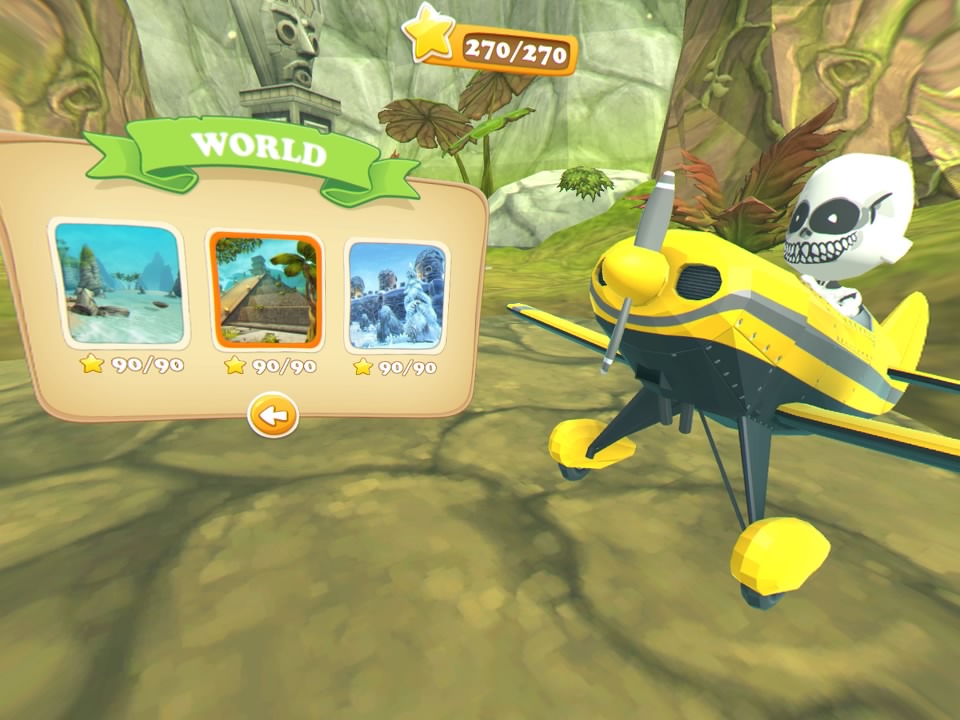

Overall, Pirate Flight is an easy cruisy game. The bright and colorful graphics are decent, although with only one music track, it adds to the repetitive feel of the game. It’s something to play if you want to relax and not stress. The content is repetitive as you’re flying through each area thirty times, and a free roam mode would be nice. It’s tough to recommend at full price, but you can’t go wrong for free.

---------------------------------------------------

For other game reviews, have a look at this page and this page.

Wednesday, June 1, 2022

Paper Beast (PS4 / PSVR)


Paper Beast is a VR adventure game. If you don’t know what to expect then the game will feel like an oddity when you first start it. The opening scene is futuristic, and you feel like you need to double check that you are in the right game. After that, you’re placed in this world where beasts, that look like they are made of paper, roam around. This is supposed to be a peaceful and chill game, so you can’t really die, and the gameplay revolves around walking to the next destination and solving some puzzles.


There isn’t really a story as such but will encounter some weird things or messages are you progress. You’re not going to be really sure what the context is and this, coupled with the lack of handholding, can be confusing in the earlier parts of the game as you try and figure out what you need to do. The game lets you loose with nothing to say on how to progress the game. It doesn’t help that the opening sequence locks you into place, so you can only look around and fiddle with things.


You’ll soon learn the controls though. The game is played in first person and you can use either two Move controllers or the standard DualShock 4 controller. If you’re using the Move controllers, the left stick regulates your turning and teleportation, while the right is what you use to aim and grab things to pull it closer or push it farther. The game uses the teleportation mode of movement to minimize motion sickness and it works well here.


The simplistic graphics of the environments helps emphasis the beasts themselves. Their designs are intriguing and has a sense of elegance to them since they are similar to the complexities of origami. The puzzles can be abstract and you solve them by observing the current situation and the behaviors of the beasts. Then, you can use those beheaviors to your advantage to free up the way forward. There are some puzzles which you will have no idea what to do though.


The game is really designed for you to take it slow and take in your surroundings, enjoying the experience. The puzzles in the second half of the game were more obtuse at first glance, but once you realise what you needed to do, it felt so simple. Unfortunately, the control scheme does let it down somewhat as even if you know what to do, actually wrestling with the controls to do it is another matter, and makes it slightly more frustrating than it should be.


One of the more enjoyable part of the game in the beginning was finding out how you can actually grab those beasts and swing them around. Yes, it’s cruel in the context of the game, but it’s still fun as you test out your capabilities and how far you can go. It’s also fun interacting with the beasts to see how they react, and of course, eventually use that to your advantage to progress forward.


One of the strongest aspects of the game is its atmosphere. Even though the graphics are simple, it utilizes the sound to its advantage, creating an immersive experience. It can be serene or creepy or tense, getting you into that exact moment. There will be several times where you’ll be impressed at what the game is showing you. There will be plenty more times where you have absolutely no idea why what is happening is happening. It can feel like that someone was on drugs when they designed this as it makes no sense whatsoever, and you end up progressing without having a clue why or how.


The game focuses on the “art”, therefore the game suffers. More than a few times you will have to wait for the game to progress itself. Yes, while you shouldn’t rush a game, this is really pretentious. It feels like it deliberately wastes your time because the developers knows better than you do on how you should spend your time. The last part of the game gets worse in terms of its slow pace and annoying “puzzles”. As a part of the puzzle, you will actually fight against the controls and it’s frustrating. They’re not fun, it’s boring, and even if you are supposed to drink in the sights and the atmosphere, it’s not for everyone.


The bulk of the game, which is its single player mode, can be finished in two to five hours. The former if you already know the solutions and speedrun through the game, the latter if you play it for the first time and explore. Nonetheless, it continues the trend of short-ish VR games which isn’t a bad thing. By the end of it, you probably still don’t really know what the story or concept is since the plot elements are so vague. You’re encouraged to explore and think about it in your mind instead.


The only other piece of content is the sandbox mode. As its name suggests, this gives you a sandbox to play around in. The collectibles you find in the single player will unlock more items in this mode. You can then place the plants and paper beasts you’ve seen in the game in this mode, and they’ll interact with each other. It’s pretty cool. Furthermore, you can influence the setting by adding in weather effects, modify the terrain, change the time of the day and objects with special effects like weakening gravity or emitting light. It’s fun for a short amount of time although it depends on your interests if it entertains you for longer.


Overall, Paper Beast is an “artsy” game. It is actually perfect as a VR experience given the atmosphere and slow pacing. As a game however, it is not that great. The pacing is sluggish and the puzzles can be obtuse. Even if you know the answer to a puzzle, you can end up fighting the controls to get past it. That’s not to say a game can’t focus on both the art and the gameplay, since we’ve gotten amazing games like Journey and Shadow of the Colossus, but Paper Beast will speak out to some, while others will not enjoy it.

--------------------------------------------------

For other game reviews, have a look at this page.

Wednesday, May 25, 2022

Moss (PS4 / PSVR)


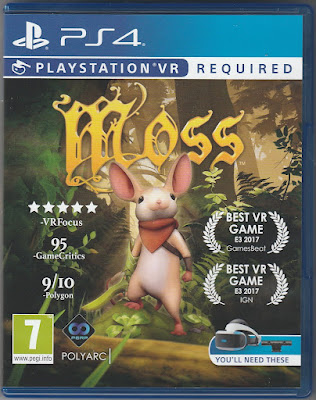
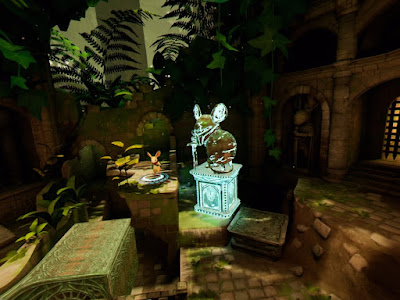
Moss is a puzzle platformer VR game. Like a lot of VR games, it’s strength it in its charm, novelty and sense of presence where you are actually in the game. The story is about Quill, a mouse who journeys on to save her uncle. This is told in a storybook fashion. This feeling is further enforced when you are brought into the world for the first time and realise that the scale is perfectly suited for a storybook adventure. Thanks to that scale, everything, including Quill, is very cute.


You play as Quill and as far as her abilities goes, they’re very simple. She is able to jump, which also extends to climbing blocks and shimmying on ledges. She wields a sword used to strike enemies and that’s basically it. While the game has a lot of platforming, her jump will take a bit of getting used to. It feels inaccurate and you can easily miss ledges, requiring you to try again.


The graphics, also with the presentation of the rest of the game, makes it feel like a storybook fairy tale. The game looks great and Quill is unbelievably cute. It’s one of the best looking games for the PSVR. The unique thing here is that while you play the game using Quill like any other third-person game, you are also an entity in the game, played through first-person. You, as the player, exists in the game and Quill is aware of you and will actually interact with you. You also have the ability to interact with certain objects in the world, which is where the majority of the puzzle elements come into play.


The puzzles are simple, the ones in the early levels only require you to move blocks in order to allow Quill to pass the gaps and obstacles. Interestingly, the game opts for a passive VR experience, and it is one of the most comfortable games to play in VR thanks to that if you are easily subject to motion sickness and nausea. The camera is fixed at all times, and the screen blacks out in order to show the next area. The flipside of this is that it can feel restrictive and slower paced when compared to say, Astro Bot (although that game was released later), which has a similar set up of first- and third-person.


The combat is very simple. Quill can swing her sword into a short combo. She can dodge, which is executed through pressing two buttons at the same time. Considering the number of unused buttons, it would have been better if that was mapped to another one instead. She can take three hits before you have to repeat the section, but you can actually spend a few seconds to heal her back to full health if you find the chance. Thus, the combat ends up being quite simple and is mainly focused on recognising the enemies’ attack patterns.


So while the puzzles start off easy, they soon get more involved, with the player having to interact with the environment, moving platforms, controlling enemies and placing objects. The tracking of the controller isn’t too great. As soon as it doesn’t detect all of the light of the controller, the tracking is iffy and starts drifting. Considering other games don’t have this problem, it’s kind of annoying. This becomes more of an issue (but not a fatal one) in later levels where you need to control enemies in order to solve puzzles, and make combat easier, but you need to stretch and move around you, making it easier to get out of range of the camera and hide the light of the controller.


The final set of levels, which act as the final boss of the game, was intense thanks to its use of music and typical platformer chase sequences. It slowly builds up the tension and anticipation, and you don’t know what is going to come next, feeling both dread and excitement at the same time. However, the actual final strike against the boss was somewhat disappointing as a result, as it didn’t live up to the build up.


There is free DLC which is downloaded as a patch to the game, titled The Twilight Garden. It is not a standalone piece of DLC, rather, it is built into the story in the form of three portals that you need to find through the game. Once found, it transports you to the titular location and you have to solve various puzzles to obtain better gear. It’s a surprisingly substantial DLC, especially considering it is free, as it adds new and more inventive types of puzzles that doesn’t just recycle assets. It adds in a new combat ability that may seem overpowered and gimmicky at first glance but will come in handy throughout the main game as well.


So as if to make up for the somewhat anticlimactic final strike of the story boss, the boss of the DLC is much more typical for a platformer. It’s a full battle and while the boss reuses an enemy design, it was fun and frantic. It’s tougher than what the rest of the game was but that isn’t saying too much since the game is pretty easy on the whole. This is where the generous checkpoints come in as well, so you never feel cheated out of time if you make a mistake and die as you aren’t forced to lose a lot of progress to restart from the very beginning.


The game is definitely on the shorter side, at three to four hours long on your first playthrough. That includes the time taken to think about each puzzle, and to play through the DLC. If you do a second run, you’ll realise how quickly you can blast through each section. However, it’s not about the quantity but rather the quality and Moss delivers on that front. It’s a good valued package all in all. There are plenty of collectibles scattered through the levels though, and a chapter select to help you get to those places a bit faster.


Overall, Moss is a great VR puzzle platformer. It doesn’t use the VR gimmick to its full potential since with some minor retool, it would work find as a non-VR game. However, its strengths lies in its charming protagonist and whimsical fairy tale feel. The difficulty is just right since it is not too hard but still presents enough of a challenge. Thanks to its relatively shorter length, it never outstays its welcome while still making you feel that you’ve gotten plenty of value out of it.

-------------------------------------------------

For other game reviews, have a look at this page.

Wednesday, May 18, 2022

Eagle Flight (PS4 / PSVR)


Eagle Flight is a VR game developed and published by Ubisoft. You play as an eagle, flying through the skies of Paris in France. The game takes place in the future where humans do not inhabit Paris anymore, allowing nature to reclaim the city. Therefore, there are wild animals like elephants, bears and wolves roaming around, as well as buildings being overrun by plants that has grown there.


The premise and the story are simple. You are an eagle, who was hatched into this world and am flying through Paris to learn about it, such as the best places to hunt, and the best places to nest. This is presented via a story mode where you fly to the next challenge, have a bit of a voiceover by the narrator (so that it can feel like a documentary at times), and then proceed to complete the challenge to unlock the next story mission. It’s simple and a little bit boring to be honest. It’s understandable given that this is not a story driven game, it’s only there to provide a bit of context at what is happening.


Gameplay is easy to pick up. The eagle is constantly flying forward, to turn left or right you tilt your head in the respective direction. Then the left trigger button slows you down while the right trigger increases your speed. The game was designed to minimize motion sickness and nausea as much as possible, so it includes things like seeing the beak of the eagle at all times and the blackening of edges whenever you turn, as well as whenever you get close to a building. This is to minimize peripheral movement, and the blackening of the edges is very aggressive. It won’t work with all people, and it can be nauseating at times especially when you forget to turn by tilting and instead looking left and right, while moving forward at the same time.


There is combat of sorts. You’ll face off against other flying creatures such as vultures and crows. They attack eagles who have encroached into their territory. To fight them off, you eventually gain a screech attack that basically fires off a projectile with the press of the square button. You aim with your head and since there’s always a permanent crosshair, once you get used to it, it’s pretty easy. Later on, you’ll also gain a shield that you can deploy for a limited time.


The combat is probably the weakest area of the game because while it’s easy to pick up on what to do, it is really easy to miss the first many times you do it. You need to factor in the time it takes for your sonic screech to reach the enemy, who is constantly moving. This means you’ll need to anticipate their movements and where they’re going to be at half a second after you fire. Once you get the hang of it, it’ll be fun and be second nature.


Level variety is low, they comprise of flying through wings, flying through tunnels, collectibles, and combat. These all have plain and predictable objectives with only the novelty of VR that keeps it interesting enough. It seems like the whole game collated together some of the most hated mission types, like escorts and time limits, in its level. Since you can fail any level by crashing against something or running out of time, it can be painful and annoying when you are forced to restart. That’s not mentioning that it can be stressful when you know you are on a strict time limit and can’t take your time.


You get rated on each level too based on the time it took you to clear it. Getting all three stars is tough. You need to be flying as fast as you can, all the way, and being perfect in your run to have a good chance in the later levels. The instant death that comes when hitting or being hit by enemies is extremely frustrating during these attempts since you have to repeat the whole level again.


While it is not a big deal in the earlier levels, the later harder levels where you fly through rings are a pain because when you’re flying at high speed, you are not able to see the next ring when it is blocked due to poor level design. Then there are the levels that takes place as night so you literally cannot see anything sometimes. If Ubisoft wanted to give a challenge, then at least make it a fair one and not the cheap stuff where you lose due to not providing enough time to react. The levels ends up requiring you to attempt multiple times and die in order to memorize the layout, and it also revels in forcing you to fly through small tight spaces where the control scheme is not perfectly suited for it.


Combat can also be annoying when enemies are out of your field of vision, so it’s harder to track where they are. There is a marker that points towards them but that disappears as soon as they’re in your field of vision but it doesn’t mean that they are easy to make out. What makes this worse is that you’re constantly moving, the enemies are constantly moving and turning your head will cause you to turn. It can be a real mess at times.


This is a typical Ubisoft open world game though. It has a decently sized map which is scattered with hover a hundred collectibles (which in typical Ubisoft fashion, are feathers). The whole game takes place in Paris and while there are five “areas”, they’re not that much different to each other. There is little of anything else that makes it actually worth exploring though. The graphics are okay. Due to the low resolution of the headset and the low power of the PS4, the buildings are fuzzy and in low detail, particularly when you’re close to it. This is partially masked by the aesthetics though and in motion, you don’t notice it.


The game’s story mode does not take long to finish given that it is comprised of only 24 levels in total. If you have no issues in a level, then it’ll only take you one to three minutes to complete it. Therefore, the story mode takes around two to four hours depending on how proficient you are. While this may feel short, the story is really only a tutorial for the tougher challenges that unlocks as you progress through the game and earn the more stars for completing levels under the shortest time limit. There is also a multiplayer mode (with one game mode) to spend more of your time in if you wish and can find players.


Overall, Eagle Flight is an average game, even more so if it wasn’t for the novelty of VR. The controls are done well enough but there is not enough meat to the game to justify its price. It feels more like a tech demo at times with its simplistic gameplay. There are definitely moments where the rush of flying is great but with some cheap level design that may frustrate you, this isn’t even close to a killer app for VR.

----------------------------------------------------

For other game reviews, have a look at this page.

(As an Amazon Associate I earn from qualifying purchases)

Wednesday, May 11, 2022

Astro Bot Rescue Mission (PS4 / PSVR)


Astro Bot Rescue Mission is a platformer exclusively for the PS4 / PSVR. It is based off the Robots Rescue level of The Playroom VR. That was one of the best and cleverest use of VR in that game, so it’s great that it was popular enough to be selected to be expanded upon into a full game. This is a colorful platformer that reminds you of older 3D platformers, where the focus is on the platforming gameplay, and it’s great.


The game is immediately charming right from the very beginning as you’re introduced to Astro. The premise is that Astro, along with his crew, onboard his ship when they are attacked by an alien. The alien destroys the ship, scatters the rest of the crew and then disappears. Then it’s up to Astro Bot and you, the player, who is a larger robot trailing behind Astro, to go through the levels and save the crew that are scattered within.


As the player, you can look around by moving your head. The right stick does nothing to move the camera, instead, it will automatically move forward as Astro moves forward. You cannot move the camera back so sometimes you’ll stretch yourself looking backwards to see if you could grab that thing you’ve only noticed now. It’s a bit disorientating at first but you’ll quick get used to it, and it’s one of the easier to stomach VR games if you’re prone to motion sickness, although there are still moments where the camera will move quickly.


The game uses VR in creative ways, even right from the beginning. It takes advantage of the player’s perspective and freedom to move what they’re looking at to hide the crew in inventive places. Most often, it likes to have you look up really high or down to platforms far below where you are. Most of the crew are easy to find, but there are some hidden in unexpected places, and you’ll keep an ear out for the tell-tale cry of help whenever you’re near one.


Unfortunately, no matter how fun the levels are, they are fairly short. It’s probably because you are having so much fun that you’d wish that they were longer. The game naturally adapts the many gimmicks of VR such as the motion control of the DualShock 4, and does it in such a natural way that it’s fun and novel. You’ll use the controller to shoot grappling hooks, throw ninja stars and shoot water. Then you’ll have other gimmicks like using your head to knock projectiles back or the microphone picks up that you’re blowing the dandelion seeds away.


The attention to the small details is what makes the game really enjoyable. Even the simple act of replicating the controller onscreen in a cooler design, and with the bots you save staying inside it, will leave a smile on your face. The bots you save would sometimes be crying for help, or they’re just chilling away without a care in the world, while others would stick up their butt for Astro to kick them back into the controller. The idle animations of Astro are funny to watch, everything just oozes charm and ingenuity. Another strength is that each world doesn’t have a set theme, this allows it to be varied and not confined to arbitrary restrictions in any way.


Naturally, like in most platformers, there are boss fights. The game is familiarly structured if you have ever played a platformer. Each world has five levels, with the fifth level being the boss level. While Astro is normally a one-hit wonder (i.e. he dies in one hit and respawns at the nearest checkpoint, which are plentiful), during boss fights he can take three hits before succumbing. This is because the boss fights are longer and have several stages. They can be quite intense when they’re throwing enemies at you while at the same time attack and then you have to contend with the gimmicks involving the VR headset or controller.


On the whole, the game is fairly easy. The early levels are naturally the quickest to breeze through but the last few levels were more challenging without being frustrating. The game continues to utilize new and imaginative obstacles, and this is really hard to achieve, but none of the levels or gimmicks were ever annoying. The last two bosses were a little bit more difficult than the ones before but nothing that you cannot handle. The final boss was extremely awesome in its execution as it was frantic fun and brought with it a cool gimmick. The most impressive element is how the game doesn’t handhold yet, but still manages to make it very intuitive on what you need to do and where to go next.


The game only takes around six to ten hours on your first playthrough (25 levels before you finish the game). While this may seem short (it doesn’t help that most VR games are short), this is actually a pretty decent length for a platformer. There’s no padding or excessive difficulty to drag out the time, it’s sharp and to the point. The music is another memorable aspect of the game, and it’s no wonder, it’s composed by the same person who did Tearaway and LittleBigPlanet.


There are over 200 of the bots to rescue, which acts are collectibles (and unlike other games, these do not feel like a chore at all), and then there are 26 challenge levels afterwards, which is where the difficult portions of the game are. These challenge levels range from minigames (utilizing the same controller gadgets in the story mode), repeat of boss fights with no damage and time trials. Some of these levels are new, and some are reused portions of the main game. It’s a good thing that the game loads extremely quickly.


Overall, Astro Bot Rescue Mission is a fantastic game. It is one of the best games on the PSVR, and even if you broaden it, this is one of the best platformers we’ve had in years. In an age where AAA games are chasing realistic graphics and heavy stories, it is refreshing to get a fun colorful platformer that focuses on gameplay first and foremost. If you have a PSVR, this is a definite must play, and if you don’t, then this game is actually good enough to maybe make you consider getting one.

-------------------------------------------------

For other game reviews, have a look at this page.

(As an Amazon Associate I earn from qualifying purchases)
Blogger Widget