Search This Blog
Friday, October 26, 2018
Journey to the Center of the Earth (2008)
Journey to the Center of the Earth follows Professor Trevor, whose nephew, Sean, comes to visit. Together, they discover that Trevor's brother and Sean's father had left some notes right before his mysterious disappearance 10 years ago, and they travel to Iceland to investigate. Naturally, through various events they accidentally end up travelling to the center of the Earth where they discover a hidden underground world full of extinct animals and wonders. It is a classic story and doesn't do anything to change it up, thus becoming very predictable. This isn't necessary a bad thing but unfortunately, the film relies heavily on special effects. The problem is that the special effects are terrible and whenever they're used, they are obviously fake which breaks any sort of immersion. This leads to some awkward acting in certain scenes. You must suspend your beliefs because there are plenty of moments where the characters would have died or suffered fatal injuries but they come out completely unscathed. In the end, if you can overlook those flaws, this is a fun adventure.
Thursday, October 25, 2018
Book Review: The Dark Prophecy
Review: #787
Title: The Dark Prophecy
Series: The Trials of Apollo - 2nd book
Author: Rick Riordan
Comments: While The Dark Prophecy bears all the hallmarks of a Rick Riordan book being a deadline, a prophecy, pop culture references and a very predictable structure, this is still a fun adventure. Lester, the human mortal form of the god Apollo, arrives at Indiana to search for the second ancient Oracle. Of course, he is targeted by the second Emperor who wants to kill him. There are plenty of clichés here, such as withholding names until later in the book (but constantly teases you about it), puns and other jokes that misses their mark and feels like the author is trying too hard, and the tendency to force characters upon the viewer even if they were not strong or likeable. Having so many books in the series, there are only so many well known gods you can pull out, thus there are so many minor gods and lesser known characters that viewers don’t get the same enjoyment of “seeing” a familiar face. It really feels like the author is starting to clutch at straws. It doesn’t help that the ending is so predictable, setting up for the sequel. In terms of the actual story, it’s interesting to realize that it all takes place in the one city but at the same time highlights the fact that there’s a lot of padding. In the end, while still feeling familiar, it is a solid story.
Rating: 7/10
Wednesday, October 24, 2018
Saekano: How to Raise a Boring Girlfriend (2015)
Saekano: How to Raise a Boring Girlfriend is based upon the light novel series. The first season has 12 episodes and an "Episode 0". The series follows Aki Tomoya, who while riding on his bike during spring break, comes across a girl whose white hat blows away. He picks it up and is stunned by the girl's beauty. This inspires him to make a game to capture this magical and fateful moment. Tomoya is an avid otaku, loving anime and dating sims while purchasing all their merchandise. From little, he wanted to be a game producer.
So it turns out that the girl Tomoya met is Kato Megumi, who is his classmate for a few years... This is explainable given that Megumi has no presence and is forgettable, despite being pretty. She is the title character for the game. Tomoya sets about recruiting other members to take on specific roles for the game. First up is Sawamura Spencer Eriri, who is half-Japanese and half-British. She is Tomoya's childhood friend and is introduced as an ace artist. Despite her looks and her refined attitude, she is secretly an otaku as well as being a doujin artist (of the more erotic kind). As she wants to keep her secrets, she initially doesn't interact with Tomoya that much at school. Eriri is the illustrator for the game.
Kasumigaoka Utaha is yet another promising candidate who despite being in high school, is already the author of a bestselling novel. She is shown to be intelligent but quiet, sleeping during class. Despite that, she is the number one student in terms of results at the school. While pretty, she has a sharp tongue and will not hesitate to voice her critiques. She is responsible for writing the scenario of the game. The last member of Tomoya's circle is Hyodo Michiru. However, Michuru appears really late into the season, which kind of feels like a spoiler since she was so prominent in Episode 0 and also in the opening theme. She is the one that will create the music for the game. She is in her own band and is talented all around except for the fact that she loses interest quickly.
Episode 0 has the group going on a trip to get ideas for their game and it ends up as a typical hot springs episode. Watching this first may be confusing since it jumps right into things and a really quick introduction of the characters. It has all the cliches you'd expect from a visit to the hot springs, such as ping pong and Tomoya listening to the girls' conversation from the other side of the wall. Once you get into the main episodes, you see that Tomoya has to work hard in the beginning in order to win the girls over to join his circle to create the game. We see him from hanging out with Megumi, who is shown to be "boring" to working through the Golden Week holidays in order to push out a proper proposal.
Megumi ends up having a lot more depth than you expected and quickly rises from her unremarkable personality to the most interesting heroine of the anime. She also quickly becomes the cutest girl too. The anime cycles through each of the girls' backstories and how Tomoya works to resolve their differences and strengthen their relationships. We find that Utaha's side profession as an author isn't as smooth sailing as she would lead you to believe. Surprisingly, Tomoya actually had a fairly big impact to her style. It's good to see them working together to improve upon the first draft of the game's plot, as Tomoya discovers what he really wants to portray in the story.
Characters surprisingly have a lot of depth and the anime goes into detail on how it affects their relationship as a circle. However, at the same time, some characters unlikable, even when they try to justify themselves. It's easy to see that all of them harbor feelings for Tomoya right from the start, although they display their affections differently. Eriri is a tsundere, while Utaha keeps it more to herself unless she's jealous. The later episodes are really good in terms of the dynamic of the group. While the characters still display their reluctance from time to time, you can see them working hard together. The fact that they are achieving tangible results like starting to put the background, character portrait and text together makes it seem like they are progressing and is not just another plot device that is shelved in favor of day to day harem events.
There is a noticeable improvement to the quality of humor as the series goes on too. In particular, the one where Utaha kept jabbing at Eriri about how she is just a cheap knockoff childhood friend in hilarious yet so true. Throughout it all, the characters each work hard in their own way to help making the game come true. Eriri struggles with trying to get multiple expressions off Megumi since she is so expressionless. On the other hand, once Utaha gets her first draft in and the circle reads it, it's way out of wack with abrupt changes and plot twists.
The ending was good in how it solved the problem of recruiting Michuru into the circle. Thanks to the rousing speeches and how it all works together in Tomoya's favor, it was a happy moment at seeing the circle now complete. Overall, Saekano: How to Raise a Boring Girlfriend is an interesting slice-of-life anime wrapped around the concept of creating a game. The depiction of Tomoya working hard to make his dream come true, and seeing how the game slowly comes together from the efforts of everyone is satisfying.
----------------------------------------------
For other anime reviews, have a look at this page.
Monday, October 22, 2018
Grand Theft Auto: Episodes from Liberty City (PS3)
Grand Theft Auto: Episodes from Liberty City are the two pieces of story DLC from Grand Theft Auto IV combined and released as a standalone package. It reuses all the assets from the main game such as the city and combat mechanics. Both of them follow a different protagonist but occurs during the same time as Grand Theft Auto IV and even with a few intersecting missions. As well as new story content, there are various other additions such as new radio stations, new weapons, new vehicles and new activities to do. The first DLC is called The Lost and Damned and follows Johnny Klebitz, who is a member of the biker gang The Lost. It begins when the President of the gang, Billy, is released from rehabilitation and regains leadership over the gang.
Billy is a lot more hot headed, rash and stubborn. Johnny tries to convince him that some of his actions are not good ideas but is forced to go along with them anyway. Naturally, this means that eventually, something will happen to Billy as a type of karma. The Lost and Damned tells a more focused story surrounding Johnny and the loyalty of the gang being tested. There are a few shared missions with Niko's story, with a lot of supporting characters making an appearance. As Johnny is a part of the biker gang, a lot of the missions and his preferred method of transport involves a bike. Unfortunately, the handling of bikes in the game is the worse out of all the vehicles, with wide turns when you are at high speed and just makes it somewhat annoying.
With the main transport being bikes, it does seem that traffic density is lower and it is not as easy to be thrown off your bike as Niko was. Interestingly, the game feels like it had an orange filter applied to it during daytime. There are 22 missions in the story and will take around 5-8 hours to complete. That being said, the things you do in the missions are the same as the things you did in Niko's story. It doesn't add anything new but still quite a lot of fun to play. Gang Wars in which Johnny targets and kills opposing gangs, as well as Bike Races are introduced to lengthen the play time.
The second DLC is The Ballad of Gay Tony and follows Luis Fernando Lopez, an assistant/partner to nightclub owner Tony Prince. Like all the other characters in Grand Theft Auto IV, Tony is a lost cause, being involved in drugs, money laundering and the like. Tony gets himself into all sorts of trouble including taking out loans with people he shouldn't have. Thus Luis will have to sort out his mess and this quickly escalates to Luis helping out this person and then that person etc. After the focused story of The Lost and Damned, it's a lot more undefined here and the narrative suffers. However, this DLC covers off the final viewpoint in a key mission from the core game and it is insightful.
The Ballad of Gay Tony has 26 story missions, taking around 5-10 hours to complete. A new feature is the score you get at the end of each mission, with certain criteria to tick off in order to get 100%. These include time it took to finish the mission, damage taken, headshots etc. If you used a cheat code, or perhaps more annoyingly, used a taxi, during the mission, it invalidates your score. The missions are a bit more action oriented but unlike the missions from the core game or The Lost and Damned, they have a tendency to force you to waste time driving to the destination and not allowing you to take a taxi to fast travel.
Even worse is that a number of missions force you to use the helicopter. The helicopter controls remain horrendous, with one mission forcing you to chase enemies on boats and shooting them down. It is annoyingly frustrating purely because of the crappy controls. When will the developers realize that the handling of all the vehicles in the game is NOT FUN when you are forced to race or tail someone because they are not tight enough. Other additions include even more minigames (golf, cage fighting, dancing etc), parachuting and Drug Wars, which are yet again basically short missions where you defeat all enemies, stealing vehicles or obtaining items.
The core concept and controls in the DLC remain the same as Grand Theft Auto IV. There are no new combat mechanics. Therefore, the characters can shoot, punch, jump and take cover. The game uses an auto-targeting system and you can still wreck havoc in Liberty City. You will attract the attention of the police if you're seen performing crime, with varying Wanted Levels. Each successive level will cause the police to use more resources to capture you.
All the flaws from the core game is still here from the heavy vehicles that can't make turns at high speed (and tendency to flip over), repetitive mission design and sidequests, and a choppy story at times. Overall, Grand Theft Auto: Episodes from Liberty City is a great supplement to the core game, fleshing out some of the background of key events. As DLC, they are pretty good value wiht at least 10 hours of story content plus all the additional side content. As a standalone game though, you won't get as much enjoyment since you won't recognize all the cameos.
--------------------------------------------------
For other game reviews, have a look at this page.
Sunday, October 21, 2018
Toy Review: Transformers Generations Studio Series Thundercracker (Voyager)
Review: #468
Name: Thundercracker
Brand: Transformers
Allegiance: Decepticon
Line: Generations - Studio Series
Year of Release: 2018
Size Class: Voyager
Mold Status: retool of The Last Knight Nitro
JET MODE:
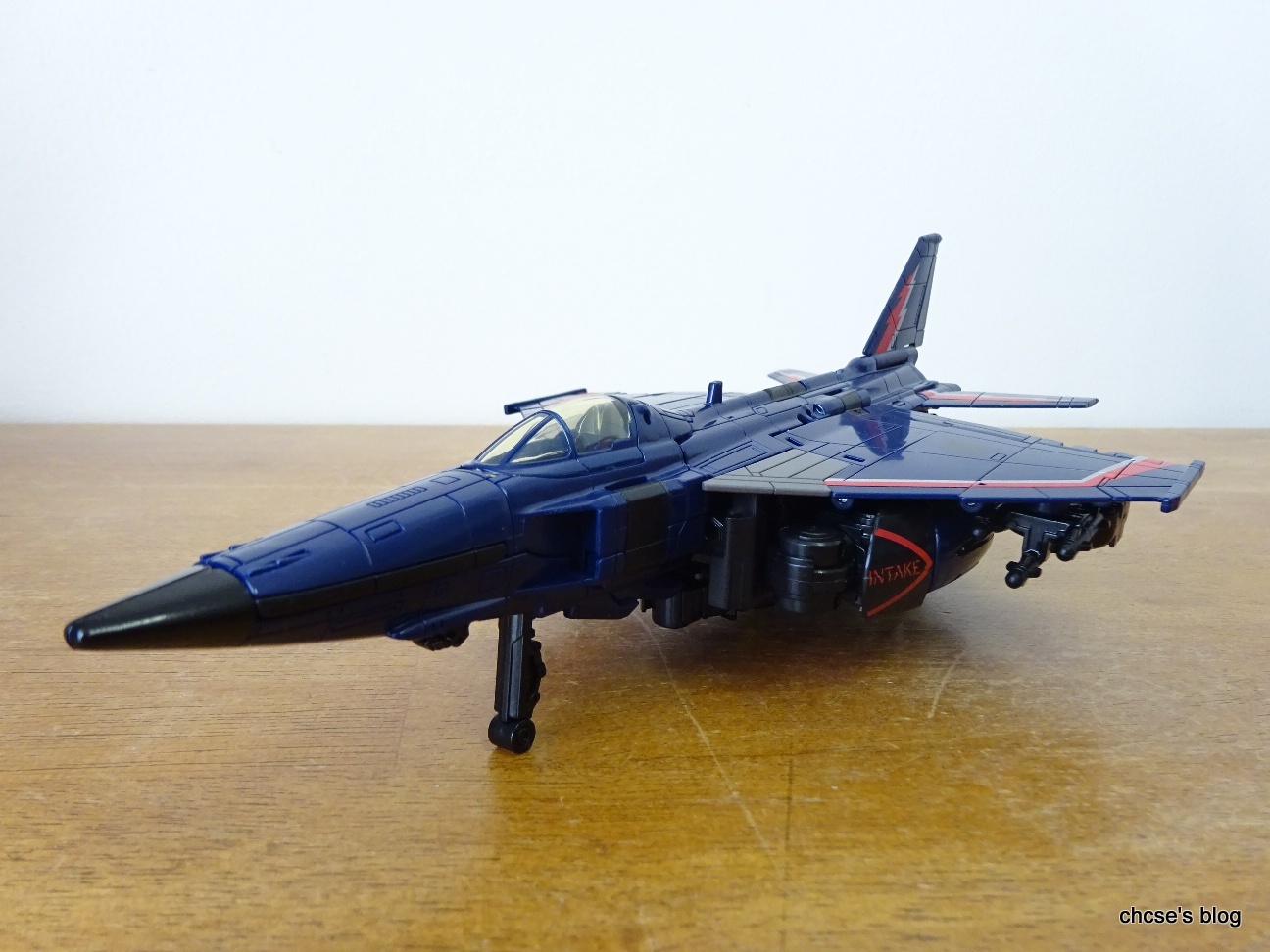
Thundercracker transforms into a blue and black jet with red and silver highlights on the wings.
This is a great looking jet although it has a bulky undercarriage. When looking from above, you can see the robot legs between the wings and tailfins which is a bit distracting.
In terms of size, this is one of the larger Voyagers we have had in a while. Thundercracker feels great and hefty in your hands. Above is a comparison against Studio Series Starscream.
Thundercracker is a retool of The Last Knight Nitro, but there are no differences in jet mode. However, the rich deep blue looks amazing in person.
The cockpit opens up and is able to fit a Titan Master in there if you have one handy.
This is a really awesome jet mode with a wicked color scheme.
TRANSFORMATION:
Getting Thundercracker into robot mode isn't too hard, although it is a bit counter-intuitive at times. This is because the arms are formed from the front and back of the jet, and there are various joints which are used in order to position them around the legs and into their proper places. When transforming into jet mode, there is an annoying trick to getting the legs to clip into the wings where you have to insert it at an angle.
ROBOT MODE:
Thundercracker's robot mode is big and bulky, looking very imposing.
There's a fair bit of kibble but the iconic element of the design is how the wings fold up onto his back to act as thrusters/shoulder cannons.
The aforementioned retool is the head. It is reminiscent of Starscream's head but much more alien with multiple eyes. It actually looks really cool in person.
Again, a size comparison against Starscream and Thundercracker has some bulk to him.
Compared to Nitro, the deep blue makes the figure look much less bland and cheap. It actually looks premium now as the plastic used is quite glossy.
As part of the Studio Series line, it comes with a cardboard stand, apparently with a scene from Dark of the Moon.
However, this version looks nothing like the Dark of the Moon Thundercracker, which used the same design as Starscream.
The cockpit of the plane splits open to make a sort of bladed weapon. It is permanently attached to the arm.
On his left hand is a cannon that extended from his forearm.
Furthermore, if that wasn't enough, then the backpack can tilt forward to form shoulder cannons.
There are no complaints with articulation, particularly since he has ankle hinges as well to keep him stable.
A fantastic robot mode that looks great and has a ton of play value in the form of his varied weapons.
OVERALL:
Sadly, Thundercracker was the last exclusive before Toys r Us closed down. However, this is a fantastic figure, even if you already have Nitro. Not only is the mold a great toy, but the color scheme is a clear winner. The deep blue of the plastic really helps make the figure pop and gives it a premium feel.
----------------------------------------------
For other Transformers reviews, have a look at this page.
Saturday, October 20, 2018
Book Review: Magnus Chase and the Ship of the Dead
Review: #786
Title: Magnus Chase and the Ship of the Dead
Series: Magnus Chase and the Gods of Asgard - 3rd and final book
Author: Rick Riordan
Comments: The Ship of the Dead is the third and final book in the series, which crosses over with the Percy Jackson series (he even appears early on along with Annabeth). Magnus teams up with his friends and goes on a quest to defeat Loki, all this as the deadline looms. Yes, this is a typical Rick Riordan novel and this is the biggest flaw, it does not do anything new. The plot structure has been done 10+ times already, with extremely similar themes and no plot twists anymore. The humor is better but still heavily reliant on contemporary pop culture and feels forced a lot of the times in a misguided effort to be “relevant”. There is too much fluff, padding out the novel, it could have benefited from tighter and more ruthless editing as the author spends literally pages describing things that does not add anything to the story. Nevertheless, this is a solid finale with interesting encounters with different Norse gods. The climax was underwhelming and Loki seemed to have been defeated much too easily, a far cry from previous series. While some of the characters never seem to grow on you, the journey was enjoyable.
Rating: 6.5/10
Friday, October 19, 2018
Love Actually (2003)
Love Actually is a Christmas themed ensemble romantic comedy, and ended up becoming a classic for Christmas viewing. Following so many characters, each has their own mini story about their search for love, trials of love and other love-related matters. It presents a nice variety although this also means that none of them get too many details, just enough for you to understand the characters' situations and root for them. Despite getting a bit out of hand with the developments toward the end, you can't help but smile at the happy endings (and some bittersweet endings) and how things are resolved for each of the pairings. Throughout the film, you also see snippets on how each of the characters are connected, they don't directly influence each other's stories but it's a common thread that ties them all into one cohesive film. It is surprising as how much the film captures you with its characters and scenarios.
Subscribe to:
Posts (Atom)