Wednesday, June 22, 2022

Adventures of Mana (Vita)


Adventures of Mana is a remake of the first game in the Mana series, titles Final Fantasy Adventure (which was on the Game Boy). Interestingly, it was remade in 3D for iOS, Android and PlayStation Vita, making the Vita version the only version of this game available on a non-smartphone device. It’s an extremely faithful remake of the original game, right down to the separate scenes that has a short sliding transition animation as you go to the next one. The graphics are solid, relying more on the aesthetics rather than as a graphical powerhouse, it’s actually really reminiscent of the Final Fantasy III remake, and works well enough here.


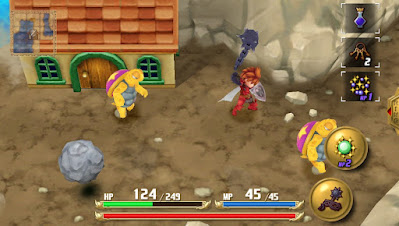
The best part about the Vita version compared to the smartphone versions are the physical buttons. You can still play using the touchscreen but thankfully, Square Enix has mapped all the controls to the physical buttons and they work great. You use the analogue stick to move, X to attack, square to pull up the Ring Menu, triangle for the system menu and Circle to use the equipped item or spell. Furthermore, there are three additional shortcuts that you hold down either shoulder button and a face button, so you don’t have to constantly equip and unequip your most used items. There is a bar at the bottom of the screen that slowly recharges. Once it gets full, you can unleash a special attack that’s unique to each weapon type. You can also block using a shield, but it’s automatically by not moving and facing the attack so it can be clumsy to use.


Unfortunately, it’s such a faithful remake that the game lacks a tutorial and throws you straight into the game to explore and figure out yourself like many games of that era. At least it’s a simple enough game to figure out the basic combat system which just relies on one button to attack, and you quickly learn that you are hurt by either you running into a monster, or a monster running into you (except for bosses, enemies have no attack animation). Perhaps more annoying is the tendency that if you run through screens, the enemies load just a tad bit after you enter, so you’ll end up running into an enemy and taking damage, which can feel unfair.


Back in the day, the game touted the Ring Menu, which is basically a menu in the shape of a ring. Intuitive and ingenious during the era that had relied more on menus using lists, but nothing spectacular in this day and age, and actually a bit confusing to use at first. It can be clunky browsing and selecting the items you have, especially when equipping or selling them. There’s a limit to the number of items you can hold, and several key items required for progression have limited uses, so you’ll either need to find or buy it again if you are unlucky enough to have exhausted that item and require it to keep going.


As mentioned earlier, the game lacks a tutorial, and it lacks any sort of objective marker. You’re left to figure out where to go, which can be a bit frustrating when all you have a vague “go to the east” or something like that. It gets harder and harder to know where you’re supposed to go as you progress the game. There is a simple map that uncovers as you enter each area, and has a grid layout since the game has a grid layout reminiscent of the NES and SNES Zelda games. Playing this top down action game with such basic controls really feels like a 2D Zelda game but has enough of its own quirks and features to not feel like a cheap imitator.


The story is simple, as you’d expect of a game on the Game Boy from so long ago. While you can name the protagonist anything you like, his default name is Sumo. He was a gladiator and managed to escape. A chance encounter with Fuji later, they travel together until she is suddenly snatched away. The setting of mana is revealed, and then basically, Sumo travels around chasing and trying to rescue Fuji. If you know where to go, it is fairly fast paced, but the trouble is, you’re more likely to not know and the game’s pacing dramatically stalls as a result.


While Sumo usually travels on his own, there are guest party members that join. They’re controlled by AI and are basically useless since they rarely attack and more often than not, misses when they do. The game is easy in the beginning since enemies aren’t too aggressive and don’t swarm you. Most enemies usually deal damage by running into Sumo, while some have projectile weapons. Even the early bosses feel too passive. By the halfway point, the challenge increases but is not unmanageable since by this point, you should have become familiar with the battle system.


One of the most annoying traits of the game is that while you can put items in the shortcut, you cannot put weapons there. Therefore, you’ll constantly go into the menu to swap weapons, so that you will have one that can remove trees or grapple to another area. It’s clunky and breaks up the flow. This gets worse when the game spawns monsters that each are immune to a different weapon, and to top it off, have an environmental obstacle that requires yet a different weapon to clear. Constantly going to the menu to swap weapons starts to get on your nerves at that point.


As per usual, Sumo will gain experience points by defeating monsters. Upon gaining enough and levelling up, you get to pick a specialisation. Each of the four will put stats into different parameters, so you can end up building a character that suits your own playstyle. Coupled with how fast you can level up, and this is quite addictive. There are some minor flaws in the game’s presentation though. The game likes to freeze for a split second when going between environments or transitioning into cutscenes. Since the rest of the game runs so well, this sticks out.


Despite the simplistic story, there is enough of it that it keeps the game chugging along quite well. You also end up growing attached to the characters to the point where you will be affected by the ending, and the fates of the characters. It helps that the music is great, and as you reminiscent about your journey to this point, you’ll realize how much fun the game actually is (when it doesn’t annoy and frustrate you with its other mechanics). Interestingly, the final boss is too easy to beat since you get a strong weapon just before it. There were several other previous bosses that were much harder.

If you know where to go, whether from a walkthrough you’re following or if you’ve played the game before, then it only takes around seven to eight hours to beat. Play through it completely blind and you’re looking at over ten hours since it is way too easy to get lost.  Unfortunately, once you beat the game, there’s nothing else to do since there is no new game plus, and there’s no way to get back to where you were to continue exploring unless you have a save point.  The worst part is the game doesn’t even tell you where the point of no return is, so you might not realize you cannot exit and explore the rest of the world map (not that there is much left to explore) before you’re locked into the final dungeon.


Overall, Adventures of Mana is a great remake. Don’t like the phone roots fool you, this is a well thought out remake that keeps all the gameplay mechanics untouched, while improving the graphics. Granted, there are several relics of the past that makes the game frustrating at points, such as the lack of any objective marker, too easy to get lost, and the constant and tiring trudging through the menus to change weapons in order to defeat enemies or pass through certain obstacles. However, the good outweighs the bad and this game reminds you of the simple soul and charm that games of that generation had.

----------------------------------------------------------------

For other game reviews, have a look at this page.

Monday, June 20, 2022

My Love Story!! (2015)


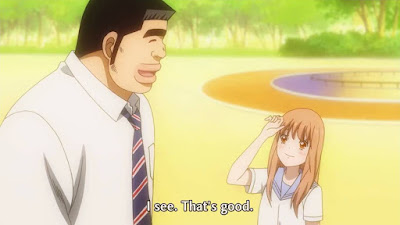
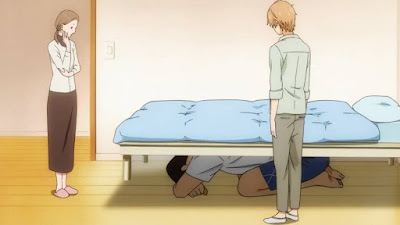
My Love Story!! is a 24 episode anime that’s based on the manga. The anime, is as you’d expect, a romantic comedy. It follows Gouda Takeo, who had just graduated from junior high. However, you won’t be able to tell since he’s huge, muscular and looks like a delinquent. However, he’s a good guy at heart, but he just does not have any luck with romance. He’s best friends with Sunakawa Makoto, who is pretty much his opposite. Makoto is handsome and attractive, and he’s the reason why Takeo is so unlucky. Any girl that Takeo has feelings for, the girl falls for Makoto instead.


You can’t fathom at first why Takeo and Makoto are best friends, since they are so different. Takeo ends up being a bit more open in his personality, while Makoto is more reserved and indifferent. We find out that they are friends since childhood since they live close to each other and their mothers are good friends. Anyway, one day on the train, Takeo saves a girl, Yamato Rinko. Rinko is small and shy, and she appreciates Takeo’s help. As thanks, Rinko bakes for Takeo.


This is where the comedy sets in. Takeo is adamant that like every single previous time, Rinko doesn’t actually like him and had set her sights on Makoto instead. Takeo, being the selfless guy that he is, devotes himself to setting up Makoto and Rinko together. He acts as the middleman, giving the two opportunities. Every time that Rinko asks Takeo something, Takeo will justify that as Rinko using him to get closer to Makoto. While at first you may not be sure whether Rinko likes Takeo or not, we soon get more solid evidence that is the case.


Spoiler alert from here on out, but given that this is a 24 episode season, it cannot fill up all that time with just Takeo and Rinko’s misunderstandings. In fact, it actually takes no time at all before things are clarified and they’re officially a couple. This is where the anime really starts, and it is just so cute watching them together. Both Takeo and Rinko are pure-hearted and filled with innocence, while Takeo is more on the naïve and denser side, it adds so much to his charm.


While the comedy and gags aren’t too frequent, they can still hit you pretty hard. The events like to pluck on the viewer’s heartstrings. Takeo is such a good person, always willing to help out (although it helps that he’s so big, intimidating and absurdly strong). The lengths that he is willing to go just to help a stranger means that you never view him in a negative or jealous light, he deserves all the happiness that he is currently experiencing. That, and the facial expressions of his reactions are hilarious.


The anime is pretty much a slice-of-life story at the end of the day, as it goes over Takeo and Rinko’s relationship. Their progress is slow, because both are inexperienced, and Takeo is quite modest. Despite that, it has an innocent charm to it, and you can’t help but cheer them on when things go well, smile when they show how much they care about each other, and stand by their solidarity as they face obstacles.


Interspersed with all the romance are Takeo’s other positive traits. We learn about how Takeo upholds justice, and never hesitating to help out others, even when he doesn’t get the thanks he deserves. It’s awesome to see how his good nature has earned him the respect and loyalty of many of his friends. It’s heartwarming to watch how much Makoto understands Takeo and despite his cool appearance, he helps Takeo time and time again, even without him asking. Seeing Takeo’s interactions with his family is also a highlight. All in all, the anime is so wholesome that you really can’t hold anything against it.


Takeo’s also initially introduced as being misunderstood, and thanks to his appearance and straightforward personality, is unlucky with the girls. This turns around as the season goes on, to the point where there are several other characters that fall for him. Usually, when this happens to the protagonist and bordering on a harem route, you tend to be put off. However, Takeo is so likable due to his no nonsense and genuine personality, that you don’t mind it and even feel sad that Takeo has to hurt both himself and others when he cannot please everyone.


Surprisingly, there are enough developments to keep the pacing up during the whole season. It all feels natural, and towards the end, it changes the focus slightly to Sunakawa. This is a pretty good decision since it felt like Sunakawa was a major supporting character all this time, but not enough involved him. He’s always there helping Takeo navigate around his relationship, and we see just how much he was contribution that you can’t help but feel he deserves some happiness of his own.


The season finishes up with a drama that’s typical of the romance genre. Takeo has to face off against a rival of his own, but it can feel contrived. Sure, we understand that Takeo may have issues with his own self esteem (even though he’s a great and genuine guy all around) but to actually feel threatened about Rinko’s feelings for him is a bit too much. Surely, he should have understood by now how strong his and Rinko’s relationship is, especially when they have been through so much together. Thankfully, this doesn’t take up too much time before it is resolved.


Overall, My Love Story!! is a surprise hit with the genuine protagonist, Takeo, and his wholesome romance with Rinko. The pair complements each other really well, and what makes this anime so wonderful is how they’re selflessly supported by their friends. Sunakawa is surprisingly deep and caring. The obstacles that the characters had to encounter and overcome felt natural, even if there were some stupid boneheaded moments. This all adds to the charm of the anime, and the ending really reinforced the idealistic (in a good way) nature of an unlikely yet sweet romance.

-------------------------------------------------------

For other anime reviews, have a look at this page.

Sunday, June 19, 2022

Toy Review: Transformers Generations Studio Series Ratchet (Bumblebee Deluxe)


Review:
  #722
Name:  Ratchet
Brand:  Transformers
Allegiance:  Autobot
Line:  Generations - Studio Series
Year of Release:  2022
Size Class:  Deluxe (Wave 15)
Mold Status:  new

VEHICLE MODE:


Based upon his appearance in the opening scene of Bumblebee, Ratchet transforms into a Cybertronian truck.


This is a fetching vehicle mode, made the better with a rear that doesn't has any exposed robot parts, which is quite impressive in this day and age.


Unfortunately, it's quite a small figure, above is a comparison against TLK Bumblebee.  While Ratchet is compact, he still feels too light.


The robot weapon can peg onto the top.


A good looking vehicle mode, albeit one that's too small.

TRANSFORMATION:

Just like his wave-mate Wheeljack, Ratchet suffers from a complex transformation done at too small a size that makes him fiddly.  While Ratchet isn't quite a bad, there are still some annoying sections.  The front is the torso but the legs unfold from the bottom.  The rear are the arms, and pretty much the whole vehicle collapses to form the torso, but in a clever way to peg together on his back.

ROBOT MODE:


Ratchet's robot mode is really good looking, striking the perfect balance of bulkiness and slimness.


He's clean from the back too as everything folds into his torso into a neat box.


The head sculpt is okay, it's a tad too busy for his face as it's trying to replicate the many moving parts of the design but is hard to pull off at this small scale.


In terms of size, Ratchet is small here too, but at least he's the same height as Siege Sideswipe.


One interesting thing is that the outer wheels on his legs are faux, something you might not notice when you first get Ratchet out of the packaging.


Articulation is good, with joints for his head, shoulders, elbows, waist, knees and ankles.


As part of the Studio Series line, he comes with a cardboard stand depicting war torn Cybertron.


He comes with a gun as his weapon.


He can hold the weapon in either hand.  As we've come to expect, Ratchet has a ton of hollow parts, but they are not too obvious.


The gun can peg on his back when not in use.


The quality control on the other hand feels worse than ever, with a lot of my recent Studio Series figures (and the mainline Generations figures) coming with loose floppy joints, and Ratchet is no exception.


Otherwise, this is a great looking robot mode that's fully poseable.

OVERALL:

Ratchet is a good figure but just like with Wheeljack, if the designer could simplify the figure and make it bigger, so that it feels better valued and isn't as fiddly when transforming him, then Ratchet would be perfect.  It's like they struck a good balance in the earlier Studio Series lines and earlier Generations lines such as Siege and Earthrise, before the budget was cut yet again, leaving us with these clearly inferior figures compared to what we could have gotten.  Ratchet is still worthwhile, but borderline.

----------------------------------------------------

For other Transformers reviews, have a look at this page and this page.

(As an Amazon Associate I earn from qualifying purchases)

Friday, June 17, 2022

Food Wars! Shokugeki no Soma - The Fifth Plate (2020)


Food Wars! Shokugeki no Soma - The Fifth Plate is the fifth and final season that’s based on the manga series. It is 13 episodes long and finishes off the story of Soma of his time at Totsuki Academy, and his journey to become the top chef of the academy and beyond. After the end of the fourth season with Soma almost achieving his goal, you might wonder what’s next, what else is going to happen that’s going to take another thirteen episodes? Well, the answer is of course, another competition, where Soma will be competing against many others, not just those from Totsuki, and try to win it.


The opening episodes are quite lighthearted. It follows the day to day events of the students and their various assessments. This is combined with the fun of youth, as the friends work together, argue against each other and just generally have fun. Since the story has built up a substantial cast that we’re familiar, it can feel somewhat nostalgic. However, we can’t forget the antagonist of this season, who is a newly introduced character that seems to have something against Soma.


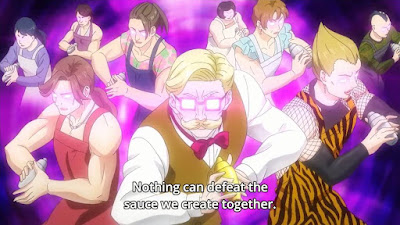
The new characters introduced are wackier and more out there than normal. Whereas the series used to try to limited the eccentricities of its characters, it had gradually loosened it up whereby now, we have “chefs” who were outrageous costumes, with roles that parallel the crime lords in other genres. It doesn’t even try to make it plausible anymore, with chainsaws, claws, syringes and other unconventional items used in the kitchen. Cooking is serious business and the events that happen in this season shows it.


The bulk of the season takes place in another tournament style setting, and the pacing is really fast in order to cover the events within the thirteen episodes. Matches rarely take more than one episode, and plenty of matches are skipped straight to the results. This is even more abbreviated than the third and fourth seasons. It feels like it favors the wackiness more than the cooking techniques used to win, which feels in contrast to before where it would go into painstaking detail.


As the final episode, it settles the feud between Soma and Erina. While the previous season made great strides in healing the rift between the two, this season effectively unravels everything. It’s disappointing that Erina goes back to her cold self, becoming arrogant and self-absorbed, effectively mellowing in her own misery. Yes, this sets up the scene for Soma to come in and save the day but it makes Erina unlikable and reverses all the character development that she had. Then comes the revelation that whole series focuses around Erina, and she’s not really strong enough for that kind of role. This also has the detrimental effect of sidelining a lot of the other characters, including Takumi and Megumi, whom both had a focus in the beginning but quickly disappears back into the cast of supporting characters whose only role is to cheer Soma on.


Soma is portrayed as model chef. After facing off chefs one after another who had lost their way, Soma shows them what cooking means to him. It’s a warm and fuzzy feeling, and he manages to carry it with a straight face. You can’t help but feel positive seeing Soma walk through his own difficult path, and finding a way forward, enjoying what he does. Unfortunately though, if you felt unsatisfied about some of the character threads in previous seasons, then they attempted to expand on it here, but failing by cutting it short.


Being the ending for the series as a whole, the finale tries to wrap everything up. As mentioned earlier, it retcons the motives behind several characters into one that involves Erina, and can feel like a bit of a copout. We also never got to see Soma truly reach the top like he had declared. It can feel unsatisfying in how idealistic it is, with all the characters being redeemed and living a happily ever after. Then there’s Soma’s and Erina’s relationship which depends on whether you think they end up being a good pair or not. All in all, it can feel divisive.


Overall, Food Wars! Shokugeki no Soma - The Fifth Plate wraps up the series as a whole, and it’s been a long journey, and yet looking back, they dragged out the earlier parts and then rushed through the later parts, so it can feel uneven as a whole. This fifth and final season rushes things too fast so it doesn’t allow the viewer to actually invest into the situation before it is resolved already. That being said, it’s still sad when you reach the end and realise that there are no more episodes coming. Personally, the end of the fourth season felt more like a proper ending than this fifth season.

----------------------------------------------

For other anime reviews, have a look at this page.
Blogger Widget