Wednesday, March 23, 2022

Unravel Two (PS4)


Unravel Two is a puzzle platformer that is a sequel to the first Unravel. It retains the charming nature with its protagonist, affectionately named Yarny, a character made of red yarn, and adds a partner, one made of blue yarn. The sequel puts an emphasis on two-player gameplay, although it is only available as local co-op. It is also playable as a single player experience and the developer has a well thought out control scheme to compensate for the lack of another player so you are not disadvantaged at all.


Carrying the same setting and aesthetic, the game takes place where normal everyday objects are enlarged, thanks to the protagonists’ small sizes. As a result, getting from one end of the room to the other is a challenge, requiring the two Yarny’s to jump, climb and swing their way around. The game adds several new abilities to Yarny, who can now jump, use its yarn as a lasso, swing, wall jump, swim and climb on certain surfaces. The single player control scheme has you controlling both Yarny’s, where you can swap who you are controlling at the press of a button. So that you aren’t running one Yarny to the other end, and then swap to the other so that it too can go to the objective, they can merge together into one.


The game is a sidescroller and a lot of the puzzles require the cooperation of both Yarny’s. For instance, the platform to move to the next section may be too high jump, so you can split up the Yarny’s, where one will anchor itself into place for the other to swing to it. Or one can hold an object into place while the other uses it as a ledge to reach a higher place. This allows the puzzles to require more thought and adds some variety when compared to the first game. It also doesn’t feel too cumbersome.


There are several quality-of-life improvements to the game. If you get stuck on a puzzle, you can bring up hints. There are three hints for each puzzle, each revealing more than the last, with the third one pretty much giving you the steps to get past the section. Not every section will have a hint section, so you may just have to keep experimenting to see how to get through a platforming section rather than a puzzle section. Then there is the slow motion mode, where you can slow the game down to make the platforming easier.


One major annoyance though are the enemies, black shadowy blobs that kill you instantly upon touch, requiring finesse for some of the platforming. They’re annoying, especially when the beginning of the game is fairly relaxed and chilled. Then they start appearing more than the occasional instance. Their aim is to add some “urgency” and “risk” into the game, which is not required. It forces you to rush the puzzles, effectively giving you a time limit on doing certain steps, instead of giving you the luxury of slowly thinking it through, so it’s a big blight of the game if you don’t like that style of gameplay. At least whenever Yarny dies to one, it only puts you at the start of that puzzle section, so you can immediately try again.


The platforming is physics based, you need to gain momentum when swinging, and objects will fall back down due to gravity. While most of the puzzles are not too hard, there are some where it can be confusing when playing solo. This is because you’ll need to switch your control between the two Yarny’s, which ican be very easy to mess up requiring you to restart the puzzle as Yarny either died or missed a critical jump. That said, no matter how many times you do it, yarn-slinging is heaps of fun and you’ll never get bored of it.


The story has a bigger scope. It begins with red Yarny out at the sea during a storm when he encounters are blue Yarny. After they are washed ashore, they decide to journey together and connect the ends of their yarn. A spark emerges, and while it is important in the story, it also lights up the objective during gameplay. Throughout their journey, memories are dredged up showing two young children who run away from home, and what happens to them.


The storytelling is in the background behind the two Yarny’s is fairly unique. Although it ends up being a somewhat abstract story as the ending doesn’t really show off or resolve that many things. There is also not enough time to bond with the two young children beyond seeing them run away and hiding from people, so you end up not really caring about their fates ultimately at the end.


Just like the original, this game is a bit short. There are seven levels in total and each level takes around half an hour to complete on your first go. Given that once you know what to do and can speed run them in 10 minutes with a lot of practice, this ultimately means it’s a four hour first playthrough. However, this is definitely one of those games that’s short and sweet, as well as that it doesn’t outstay its welcome. Most of the game is fun to play, although the chase scenes and those smoky enemies are the more annoying and unnecessary additions to the game. It also helps that the game is brilliant to look at, the graphics are pretty and due to the scale, there are several breath-taking scenes.


To extend the game a bit longer, each level has several optional things to do. The most obvious one are the collectibles scattered throughout. You can also attempt to beat the time trials and attempt no-death runs. Both of these are difficult and you will most likely end up in frustration as you attempt it multiple times to perfect your runs.


There are also 20 bonus levels, which are each comprised of one tough puzzle each. These levels are no joke, they are much harder than the ones found in the story levels. These will test not only your puzzle solving skills, but also your reflexes and skills at controlling Yarny. Naturally, attempting and succeeding at these can be a frustrating experience.


Overall, Unravel Two is a good sequel and a strong platformer. It’s impressive at how well the developer managed to create a co-op game that’s also fun and very achievable in single player. The story tries to be more complex and deeper than the first game but ultimately does not achieve much. The bright and colorful visuals are awesome, and the new additions to the platforming makes this a fun experience.

-----------------------------------------------------

For other game reviews, have a look at this page.

Monday, March 21, 2022

White Album - Season 2 (2009)


The second season of White Album is again at thirteen episodes long and concludes the story. It starts off straight after the first season, and if you were hoping for improved storytelling, then your expectations was too high. It is still as disjointed and confusing as well, jumping between the different characters. It mostly follows Toya, and his interactions with several female friends / romantic interests / goddesses. It’s not always about him though and that’s where you will be confused at scenes that seem irrelevant.


Toya and Yuki is still supposedly a couple, although their relationship is muddy. Yuki’s job as an idol prevents her from being with Toya too much since she doesn’t have much time herself. At least in this season, the pair are seeing each other again and actually communicating, instead of just thinking about the other and avoiding each other’s phone calls. Toya’s dad also suddenly became a lot more important with quite a bit of focus on him in the earlier part of the season. Again, it’s hard to tell since the anime does such a poor job at everything. All we know is that Toya and his dad has a bad relationship, and somehow one of Toya’s female friends is wrapped into all of this.


The season also places a heavy focus on Rina and Yuki. While they seem to be genuine friends, they are also rivals at the same agency. While Rina’s brother is the one calling the shots, he seems to favor Yuki a lot more. He thinks Yuki holds promise and does a lot of things to prioritize her, which can be confusing in the scheme of things on why he is neglecting Rina despite her still being extremely popular. This is made even more confusing when Rina holds no bitterness, and continues to support Yuki by truly looking out for her.


Just like at the end of the first season, Toya is not presented in a good light. His has relationships, or at least hints of one, with many of the characters, and yet never really gets serious with any of them. He doesn’t think or reflect what he is doing, and takes a more passive approach which is why the character is so unlikable. If he consciously two or three or four timed the characters, then it’s a clearer picture but at this stage, you’re not sure what story the anime is trying to tell because everything is so confusing and poorly explained.


Toya is just too selfish and it’s hard to see why he is so sought after by all the other characters (apart from being a visual novel / anime protagonist). He hurts pretty much everyone, whether intentionally or not, but we don’t really get to see what makes him so attractive in the first place.


Whether it is poor writing, or context is skipped during the adaptation from the visual novel, or this is just how it is, the lack of intent or explanation is present on all characters. We see one character being effectively blackmailed by another, who is clearly a terrible person, but they end up being so submissive and as the viewer, you have no clue why the situation had gotten this bad. The only good thing about the anime is the music that plays at certain points.


There are many scenes where it feels very coincidental and at times unclear, on how and why all of the characters seem to know each other or are linked to each other, in unexpected ways. They end up just turning up in one episode as if it was assumed all along. As expected, the ending is not great either. It does reveal what all the “goddess” business that Toya was going on about but due to the lack of build up and lack of caring of the characters, it was never going to be satisfactory.


Overall, if you liked the first season of White Album, then you’ll like the second season. Conversely, if you didn’t like the first season then the second season will in no way change your mind. The storytelling is subpar, the scenes are disjointed and the characters aren’t great. It had potential, focusing on a complex relationship between a normal person and an idol, but it feels too distracted, and the characters having too many coincidences linking them together.

------------------------------------------------

For other game reviews, have a look at this page.

Sunday, March 20, 2022

Toy Review: Transformers Cyberverse Cheetor (Deluxe)


Review:
  #708
Name:  Cheetor
Brand:  Transformers
Allegiance:  Autobot
Line:  Cyberverse
Year of Release:  2021
Size Class:  Deluxe (Wave 6)
Mold Status:  new

BEAST MODE:


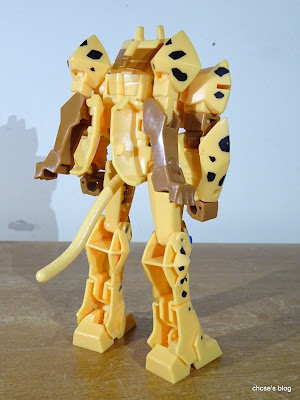
Cheetor, like his namesake, transforms into a yellow robotic cheetor.


The beast mode is barely passable as it is very obviously a robot crouching on all fours, particularly the rear legs which has the minimum effort required to be put in.


The beast is pretty much dominated by the long rear legs, and the hollowness when viewed from behind can be a bit disappointing.


The beast mode is quite limited in articulation here, although the mouth opens.


In both size and mass, Cheetor is smaller and lighter than contemporary Deluxes, even his recent Kingdom version.


However, the one thing that this version has going for it are the armor parts, which are a pair of claws, a pair of swords and a helmet.


The helmet pegs onto the beast head, the claws on top of his normal claws, and the sowrds on his shoulders.


The armor parts is awesome, and makes the beast mode much better, as it gives a more futuristic robotic element tot he figure.


The clip on armor for his face also makes him look much more powerful and wicked.


So while the beast mode may seem disappointing at first, it's surprising at how five pieces of plastic that clips on can make such a big positive impact.

TRANSFORMATION:

As expected for the Cyberverse line, the transformation is really simple.  The rear legs just straight t oform the robot legs.  the front legs fold up into the back, while his arms come from underneath the beast mode.  Fold the beast head down, flip out the head and you're done.

ROBOT MODE:


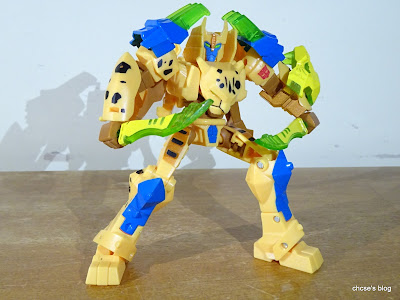
The robot mode is fine, a bit on the lankier side thanks to the long legs but otherwise, it is passable.


For some reason, even though they're the same price, the Cyberverse Deluxes seem to have heavier cost-cutting in the form of hollow parts in more obvious places in comparison to the Generations Deluxes, which is a shame as it cheapens the figure a lot.


The head sculpt is fine, it's still very much Cheetor, even if you're unfamiliar with this character from the cartoon.


In terms of size, he's roughly the height of a normal (short) Deluxe nowadays, but as mentioned, he has so many hollow parts that he feels lighter than what his looks might indicate.


Articulation is fine, with joints for his head, shoulders, elbows, wrists, waist, hips, knees and ankles.


He has plenty of weaponry options, as the robot mode can utilise all five of the armor pieces in various ways.


Naturally, his can hold both swords in his hands, and thanks to the clear plastic used for these parts, they look fantastic.


One thing to note though is that the beast head doesn't properly clip into the torso, which feels like a minor design flaw.


If you don't want to use the swords, they can be stored on his shoulders, whether facing up or down, depending on your preferences.


The beast head pegs onto either forearm to form a shield and it works surprisingly well like this.


Lastly, the claws peg onto his shoulders to form shoulder armor, just like beast mode, it's surprising at how much it can elevate the robot mode with just five pieces of plastic.


His large feet coupled with the ankle joints means that he is extremely easy to pose, as his feet will more likely than not be able to stand flat on the surface.


The core robot mode is passable but when you add in the armor pieces, then this is just brimming with play value that also looks great.

OVERALL:

At its core,  Cheetor is a mediocre figure.  Add in the five armor pieces and suddenly, he opens up a lot of options and becomes very fun in the process.  As a result, this is one of those rare Cyberverse figures that's actually worth purchasing if it interests you.

------------------------------------------------

For other Transformers reviews, have a look at this page.

(As an Amazon Associate I earn from qualifying purchases)

Friday, March 18, 2022

White Album - Season 1 (2009)


White Album is an anime that is based on a visual novel. The first season is thirteen episodes long. It has a confusing first episode where it feels disjointed and doesn’t properly introduce the setting. Instead, it feels as if we are thrown into the midst of things and left to piece it together ourselves. Perhaps what makes this noticeable is that scene transitions are abrupt and they don’t seem to tell a coherent story. Or maybe it’s due to the frequent periods of silence with no background music, causing a solemn atmosphere and a feeling of unknown. Nevertheless, this feel persists for the whole season.


The story follows Fuji Toya, a university student who is dating Yuki. Yuki has just become an idol and is currently working hard to gain popularity. We see that she has to suffer some unpleasant things in the industry and that it is not all easy and fun. She has to put in a lot of hard work and good for her that it’s starting to show results. As far as you can tell, Toya is sad that he doesn’t get to spend more time with Yuku due to her work and wishes that it wasn’t so.


There are many characters introduced that relate to the two protagonists in some way. However, it is tough to determine how exactly they relate to the story being told. Eventually we come to realize that all these female characters are Toya’s “goddesses”. They’re probably the romance options in the visual novel but it doesn’t translate to this anime well. We have Rina, who seemingly develops an interesting Toya. She takes the initiative to contact him but what’s confusing is that she keeps creating opportunities for Toya and Yuko to meet so that they can catch up, which is a nice thing to do.


Another character of note is Haruka. It feels like there is more to the background yet we only see a tiny bit. It doesn’t explain why for some reason she keens showing up wherever Toya is and waits for him until she is noticed. All these alternate character viewpoints feel so out of place and their interactions are too awkward.


What’s tough is that while it feels like Toya and Yuki are the main pair and that the story revolves around them, it jumps around too much and becomes out of focus. It’s always looming there in the background but we may get a scene with them after several unrelated interactions of Toya and another character, making the whole plot feel out of focus. You can see that there are serious issues in Toya and Yuki’s relationship, affecting them both. Yuki’s job as an idol severely restricts her freedom and she has an image to uphold. It’s a big sacrifice and one that can be too much of an ask for Toya. This makes it all the more shame when you see how they got together in the first place.


It just doesn’t feel like that there would be a good ending for anyone at the rate things are going. Toya has a “bad end” with some characters where they don’t end up together. And just when a character doesn’t seem relevant anymore, they pop up interacting with another character and you’re wondering if that will lead to anywhere. The problem is with the way the story is structured and written, you don’t have a strong connection to any of the pairings. They are all too distant and disjointed and thus you have no investment into any of the characters. It gets to the point where Toya’s unfaithfulness and indecisiveness does not paint him in a good light.


Another thing is that you can tell that the original visual novel is set in an older time and the anime keeps it in that time period. This is because the characters still rely on payphones and home phones. There are more than a few situations which would have been easily resolved nowadays with the convenience of mobile phones. Due to all this drama unfolding from miscommunication, it’s harder to stomach when you realize how easily these misunderstandings and problems could have been solved.


Overall, the first season of White Album is extremely mediocre. It’s disjointed while at the same time, it is trying to cause drama but not succeeding at this as there are a lot of contrived moments and misunderstandings. This can be forgiven if at least the story is told well but it’s just not. The characters are not likable or memorable. You will actually feel glad when the season finale is up, only to feel disappointed when you remember that this is only the first season. At least the one good thing in the anime are the various pieces of music.

----------------------------------------------

For other anime reviews, have a look at this page.
Blogger Widget